Published : 31 Oct 2022, 11:20 PM
Updated : 31 Oct 2022, 11:20 PM


Edward Kennedy Jr, son of late US Senator Edward M Kennedy who supported Bangladesh during the Liberation War, thinks Bangladesh and the United States have a good relationship despite differences in views.
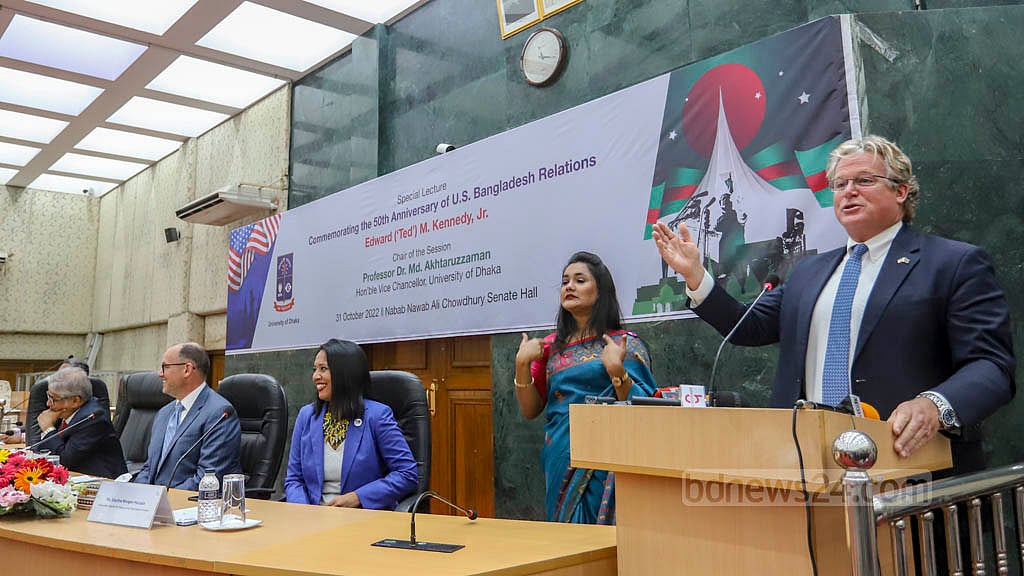
Speaking at a programme at Dhaka University on Monday, he said: “Although there have been some areas of disagreement and concern over the years between the government of Bangladesh and the government of the United States, the important thing is our two nations continue to build the relationship and camaraderie in the areas of mutual interest.”
The programme was titled Commemorating 50 Years of US-Bangladesh Relations at Nawab Ali Chowdhury Senate Bhaban.
His father was a staunch advocate for Bangladesh’s fight for independence against Pakistan in 1971. Upon being obstructed from travelling to the then East Pakistan during the Liberation War, the US lawmaker visited the refugee camp in Kolkata and Agartala.
On his return to the US, he submitted a report titled Crisis in South Asia to the Senate Judiciary Committee on Refugees.
In February 1972, Kennedy visited the newly-independent country and was warmly greeted by the people of Bangladesh. He planted a banyan tree, known as Edward Kennedy Tree, in front of the university’s Faculty of Arts watched on by a huge crowd.
On Monday, Kennedy Jr and his family spent some time under the tree and took a tour of the campus on rickshaws.
In his speech, Kennedy Jr highlighted his father’s contributions in favour of Bangladesh in the Liberation War, and how he battled for democracy and human rights throughout his life. He also spoke about the stance of the then American government, led by President Richard Nixon, on the struggle of Bengalis.
“As we reflect on the fifty years of independence that happened since that time it’s clear that our partnership between our two countries has been a remarkable success. Bangladesh and US are key partners in the world.”
“The Bangladeshi economy, as you know, has expanded dramatically and the US really views a lot of these initiatives in agriculture and climate change, food security, global health and we applaud your commitment to global peace as the largest contributors to the UN peacekeeping operations.”
A nephew of former US President John F Kennedy, he said: “Kennedy family has always felt a very special kinship with the people of Bangladesh. And we always admire the unique spirit and pride exhibited by your citizens. You have faced tremendous injustice, adversity and bloodshed through the years in your quest for independence and beyond.”
“Observing first-hand the refugee crisis and other atrocities that were committed by the Pakistani Army, my father was one of the very few political leaders to stand up and call the conduct of the Pakistani Army a genocide and exalting international community to taking note of what was happening here in your country in the hope that he could enlist other Americans, other members of congress and other people around the world to better understand what was happening and why the world should support the struggle for independence,” he added.
Kennedy Jr mentioned that he had grown up listening to stories of Bangladesh’s war for freedom. “... which is one of the reasons why we have always heard in the Kennedy family about the great nation of Bangladesh and why it’s such an honour for us to finally be here to meet so many incredible people".
He also spoke about how the last American Consul in East Pakistan, General Archer K Blood, was removed from his position for supporting the Liberation War going against the government.
The consul had sent a protest telegram, known as Blood Telegram, portraying the struggle of Bengalis.
“The Blood Telegram is now an important reminder of the importance of dissenting views…” Kennedy Jr said.
He also stressed how his father viewed foreign policy differently than Nixon and the then Secretary of State Henry Kissinger.
Kennedy Jr brought up a conversation between them. He quoted Kissinger as saying to his father: “‘What does humanitarian mean, I don’t understand that?’ That’s a quote. He didn’t understand.”
“He understood geopolitical power, he understood the economy and how the US should align itself militarily or economically with different countries from around the world. But he didn’t understand a foreign policy that was based on freedom and humanitarianism.”
Kennedy Jr pointed out that his father stood by those fighting for freedom in different countries with humanitarianism at the centre of foreign policy.
He also said that a huge portion of the people of the US supported Bangladesh during the war and mentioned that his father fought for the freedom of mass media as crucial for transparent and impartial elections, and for democracy.
“My father understood that the partition that was created after the second world war, essentially two countries that were clipped in half by India. That was only a matter of time before Bangladesh would become an independent nation. It does make no sense historically, socially, geographically and politically.”
At the end of his speech, Kennedy Jr presented the original copy of the Crisis in South Asia report to the vice chancellor of Dhaka University to preserve it at the central library of the campus.