
Published : 05 Oct 2026, 10:10 AM
Updated : 05 Oct 2026, 10:10 AM


India is working to emerge from China’s shadow while improving diplomatic relations, but the more the world’s most populous country pushes, the more apparent its dependence on its wealthier neighbour becomes.
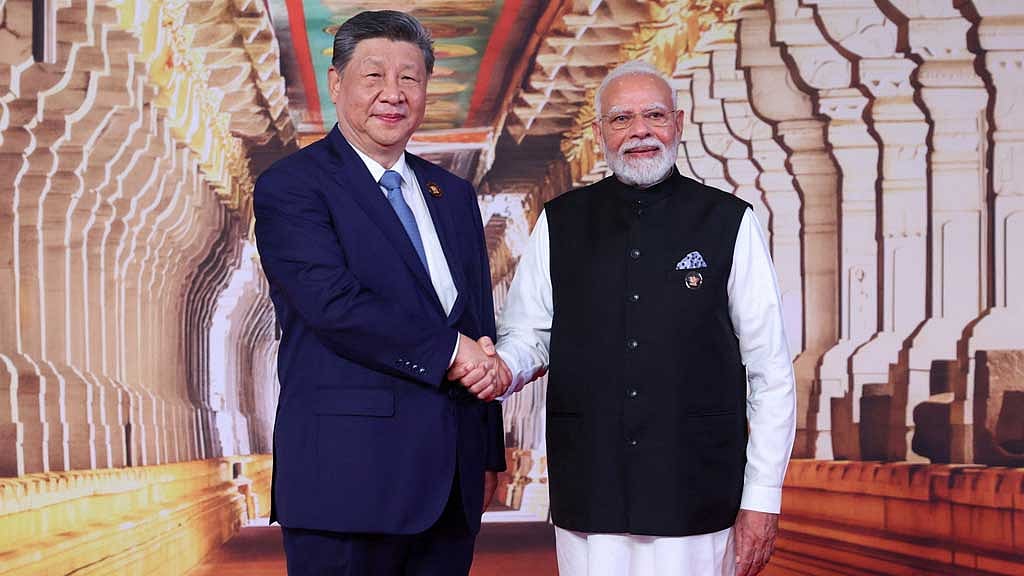
Indian Prime Minister Narendra Modi and Chinese President Xi Jinping met in New Delhi last month, Xi's first visit to the subcontinent in seven years. The two leaders pledged to rebuild ties badly damaged by deadly hand-to-hand troop clashes in 2020 on their shared but ill-defined Himalayan border.
There are other signs of warming relations since the two Asian giants last year agreed to end the military standoff. Direct flights between Indian and Chinese cities have resumed after being suspended since the COVID-19 pandemic in 2020, and visa services in China have expanded.
But such measures only go so far. Long-standing trade dependence and strategic mistrust will not be addressed with handshakes and plane flights.
The two Asian giants’ economic relationship remains deeply asymmetric. China's share of global value-added manufacturing stood at 28 percent in 2025, dwarfing India's 3 percent, according to the World Bank.
The export picture is just as lopsided for India. China’s 16.3% share of global merchandise exports in 2025 massively surpasses India’s 1.7 perceent. Moreover, India imported goods worth $116 billion more from China than it exported in 2025. By August this year, the deficit had already hit $91 billion and was on track to surpass last year's record.
Captive Supply Chains
The problem is not only that India imports more from China. It is also that many of those imports are indispensable to Indian industry. Electrical and electronic equipment, machinery, and chemicals – the three largest import categories – are largely intermediate goods used by domestic manufacturers. The more India exports, the more it needs to import from China.
Smartphones and generic medicines illustrate the dilemma. India has made progress in assembling electronics and expanding pharmaceutical production, but many of the components and inputs needed for both sectors still come from China.
This intense reliance has many broad strategic implications. For example, Beijing's imposition of export licensing requirements on seven heavy rare earths in April 2025 exposed vulnerabilities in India’s automotive and defence manufacturing sectors.
Of course, some of India’s manufacturing weakness is primarily homegrown. The country’s research and development spending stood at just 0.64% of gross domestic product in 2024, according to the most recent Economic Survey, sharply lower than that of Asian peers, partly because of private-sector underinvestment.
Skilled-labour shortages compound the problem. Foxconn's 2317.TWwithdrawal of Chinese staff from its Indian iPhone factories in 2025 illustrated how dependent advanced manufacturing can be on foreign technical expertise.
India’s Fixes
New Delhi is seeking to address the imbalance.
India recently relaxed restrictions on foreign direct investment (FDI) from Chinese companies, allowing them to take up to a 10 percent stake in Indian firms.
The government simultaneously announced fast-track clearance of investment proposals in five high-technology areas within 60 days, with the stipulation that they must be structured as joint ventures with majority Indian ownership.
On top of this, Indian exports to China rose by 40 percent between April and August. Industrial machinery, automotive components, printed circuit boards, smartphones and other electronics have driven much of that increase.
But the export surge should not be mistaken for a fundamental shift in the relationship. Much of India's electronics growth still depends on imported Chinese components. Smartphone manufacturing — India’s biggest export success story — remains only 18-20 percent locally sourced.
Northast Asia’s AI boom appears to be generating positive spillovers for the subcontinent, with Indian firms picking up sub-component work from Chinese tech giants facing surging hardware demand. But, again, this dynamic reinforces the centrality of Chinese supply chains.
Trust Deficit Persists
For India-bound Chinese FDI and technology transfer to materialise, one question needs to be answered: what does India bring to the table?
The obvious answers are access to a large market and a young, low-cost labour pool as well as New Delhi's various incentives to spur industrial growth — including tax breaks, production-linked payouts, and capital subsidies — but China doesn't appear to be taking the bait.
China’s pressure on its leading companies to withhold critical technologies illustrates how protective Beijing is about its most sophisticated capabilities — electric vehicles (EVs), batteries, solar energy and electronic equipment.
Meanwhile, the 3,800-km (2,400-mile) disputed border in the Himalayas continues to cast a shadow over the relationship. A gradual, multi-year stabilisation strategy is in place — diplomats met in Beijing in August pledging a "fair, reasonable and mutually acceptable settlement" — but a final resolution doesn't appear imminent.
For now, both governments appear willing to give economic cooperation more room. But India's challenge is not simply to import less from China. It is to use renewed engagement with its neighbour to build its own domestic capabilities. Until then, the relationship between Asia’s two largest economies will remain decidedly one-sided.
[Manishi Raychaudhuri is the founder and CEO of Emmer Capital Partners Ltd and the former head of Asia-Pacific Equity Research at BNP Paribas Securities]