Published : 26 Jul 2023, 01:56 AM
Updated : 26 Jul 2023, 02:01 AM


Shihab Sarar Ovi was recruited by the Bangladesh Public Service Commission for the administrative cadre after he cleared the hurdles of the 40th civil service examination.
Generally, applicants from non-technical backgrounds commonly opt for the administrative cadre as there are separate civil service recruitment tests for applicants with technical and specialised backgrounds.
Shihab has a technical and specialised background. He is an MBBS graduate from Rajshahi Medical College and had already acquired his practising licence from Bangladesh Medical and Dental Council, or BMDC.
Moreover, a few years ago, he even passed the hurdles of the 37th special civil service examination to be recruited as a doctor, the profession he entered after at least six years of rigorous training.

Instead, he tried his luck again to become a cog of the massive Bangladesh administration and is currently working as assistant commissioner with a district administration.
Shihab, who no longer uses Dr as a title, showed no remorse for his choice.
Rather, he seemed happy with his decision.
"I never wanted to become a doctor in the first place. I went through my studies because my family wanted me to. Then, I got a chance to reshape my life, so I took it," he said while speaking to bdnews24.com.
Shihab is not alone.
A trend of MBBS graduates, after years of sincere effort, hard work, and dedication, opting for general cadre civil service jobs in Bangladesh has been growing lately, so much so that it even caught the prime minister's attention.
Earlier this year, Prime Minister Sheikh Hasina expressed her disappointment at those who joined other government jobs after studying medicine.

When asked why they are switching careers, these MBBS graduates raise the issue of facilities and benefits afforded to seniors and the inequality in the cadre.
Like Shihab, some even left positions in the health cadre after several years or stopped working as doctors at private hospitals and institutions to get another BCS cadre-based job. These MBBS degree holders then opted to join the administration, police, foreign affairs, income tax, or customs cadres in the last few years.
Those who have left the medical cadre and leaders of medical organisations cite the privileges and benefits of positions in equivalent cadres and greater opportunities for advancement as the main motivating factors.
Health Minister Zahid Maleque has expressed concern that, if the trend continues, it could deprive people of health services in Bangladesh.
The years of education and the money spent by their guardians and the state are well-spent if people get health services from them, said Health and Family Planning Minister Zahid Maleque.
"You must remember that your education was paid for by the tax money paid by the people of this country," he told medical students during a recent programme.
"We spent millions on the medical students who get their education at state-run medical colleges. You must not forget that.
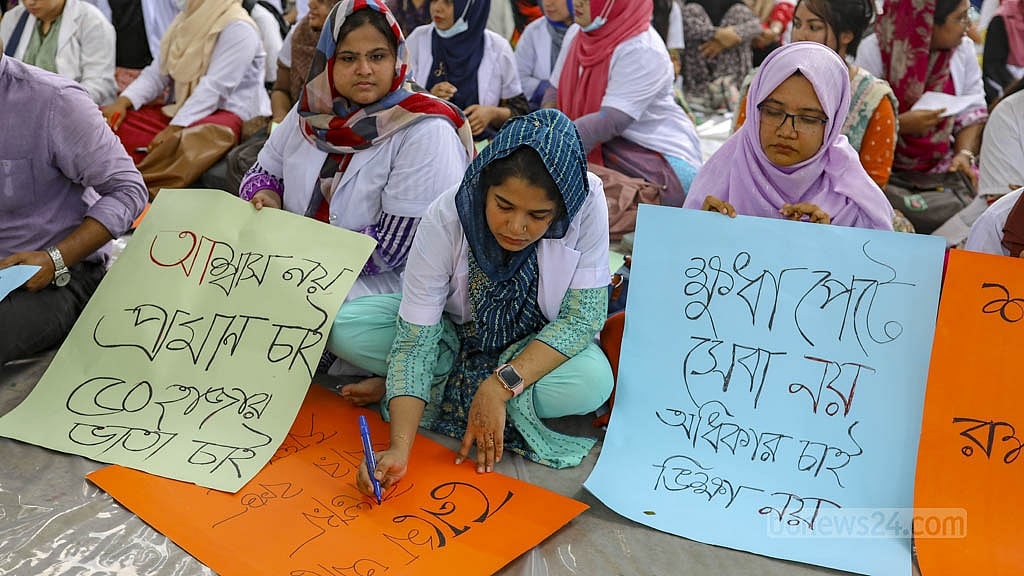
“Accordingly, the people have a demand of their own – to get proper treatment from good doctors. And so I say to those of you who are here today, use your education to serve the people of our country."
Academic Rasheda K Chowdhury told bdnews24.com that the state and family have invested heavily in medical students.
"From that perspective, it can be called a waste. Moreover, the student occupied a seat in the medical field. If they had not, another person could have pursued their studies instead."
After receiving specialised education, they instead became like other ordinary graduates, she said, "As a result, their professional qualifications were not used, and the country was deprived of their services."
WHICH CADRES DID THEY TRANSFER TO?
There are 26 cadres [categories of professional fields] in the Bangladesh Civil Service. Of these, 14 are general cadres, and 12 are technical or professional cadres. Doctors are recruited in the BCS Health Cadre.
According to the BCS data, after the release of results, 23 people switched from medical and dental colleges in the last 40th BCS and went to other cadres. Among them, nine took up positions in administration, five in police, four in the income tax section, two in customs and audits, and one each in the foreign affairs and Ansar cadres. A total of 1,929 people were recruited in that BCS.
In the previous 39th special BCS, 4,792 people were appointed to the health cadre. In the 38th general BCS, 22 doctors out of 2,204 have joined other cadres, including five from the dental field. Of these, six have joined the administrative cadre, five in foreign affairs, four each in police and income tax, two in information, and one in audits.
In the 37th BCS, out of 1,314, 12 doctors joined other cadres, of which five were from the dental faculty. Of them, ten have joined the administrative cadre, one foreign affairs, and one police.
BMDC data from 2002 says that 108,000 MBBS graduates and 11,350 BDS degree holders are in the country.
THEIR FRUSTRATIONS AND UNADDRESSED CONCERNS
A high-ranking Dhaka Metropolitan Police official, an MBBS graduate from Mymensingh Medical College, cited the uncertainty over being recruited as a doctor under the public service health cadre as the reason that drove him to ditch his Hippocratic oath and opt for a career as a police officer.
"Every year, you will see at least 10,000 MBBS graduates passing out of all the medical colleges in Bangladesh. The specialised BCS takes place every two-three years, which means a doctor has to compete with at least 50,000 people for hardly 5,000 posts. I reckoned that the odds were not in my favour; hence I opted to apply under the police cadre," he said.
Besides, the DMP official, who chose to remain unnamed, said that in Bangladesh, only the specialised doctors in different disciplines could end up with a successful career, and it takes ages as the process involves years of post-graduate training, fellowships, residencies etc.
"Even after doing all these, the odds are still not in the doctors' favour, as only a handful can reach the top. In my batch at the medical college, only three classmates can call themselves specialised successful doctors now. The number is pretty chilling."
Even as a doctor within the civil service, the advancement options are almost next to none.
An official of the Directorate General of Health Services, or DGHS, which supervises the doctors within the civil service, said he could show 23 senior officials at the agency who are qualified enough and have reached the threshold to be promoted as a grade-1 officer, the highest salary rank for a civil service officer.
"These officials, however, will never get the promotions since Bangladesh civil service policy dictates only the directors general of DGHS and DGME [Directorate General of Medical Education] are eligible for grade-1 salary. In my opinion, it's a form of discrimination," he said.
The official, who also refused to identify himself, shared an anecdote explaining why more and more MBBS graduates are moving to general cadres like administration, police, customs and tax.
"A friend also in the health cadre moved to the general cadre after a few years of service. He has already been promoted as a joint secretary and will likely be promoted again soon. Meanwhile, our upward mobility options are non-existent."
Prof Dr M Iqbal Arslan, former president of Swadhinata Chikitshak Parishad or SWACHIP, an organisation of pro-Awami League doctors, agreed with the DGHS official.
"When medical graduates realise the competition to at least reach a certain stage in their career is too stiff and even when they make it there, the perks and benefits and promotions are lower compared to other civil service cadres, they get demotivated and opt for other general cadres," he said.
Prof Dr Prof Dr Rashid-E-Mahbub, chairman of the National Committee on Health Rights Movement, sees the trend of doctors opting for a different cadre from a different perspective.
"Yes, it's true that a doctor takes an oath to provide healthcare. However, not everyone thinks like that. Along with care, some doctors seek professional security as well. Many doctors in the country became politicians and even became ministers. They felt they had different kinds of talent, which they used. Simple," he said.
Rasheda K Chowdhury's view, however, was not as sympathetic.
"The state invests a lot in these doctors, which is why if someone opts for a different profession, I see it as a matter of concern. I suggest those already studying or soon starting the study of medicine should receive state-sanctioned career guidance and counselling," she said.
[Writing in English by Adil Mahmood and Shoumik Hassin]