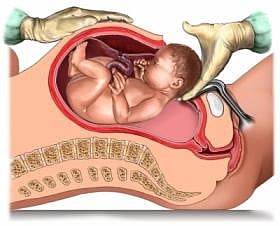
SPECIALLure of lucre pushes C-deliveries
Twin factors taking Caesarean section births to all-time high are irresistible jingle of quick bucks for medical professionals and charm of painless delivery for expectant mothers.
bdnews24.com News Service
bdnews24.com
Published :
17 Apr 2011, 01:03 PM
Updated :
10 Aug 2022, 04:40 PM
Nurul Islam Hasib
bdnews24.com Senior Correspondent
Dhaka, Apr 17 (bdnews24.com) – Caesarean section deliveries are at an all-time high in Bangladesh and expected to rise further in the absence of proper guidelines and monitoring, experts say.
Bangladesh Maternal Mortality Survey 2010 showed almost five-fold increase in surgical deliveries in the last decade – from 2.6 percent in 2001 to 12.2 percent.
More worrying is the fact that private facilities contribute two-thirds of such deliveries. "Making money can be the factor for such high numbers," say experts.
Director General (DG) for health services Khondaker Md Shefyetullah told bdnews24.com that unnecessary caesarean sections did take place in Bangladesh. "It's beyond doubt."
But he cannot ensure steps to stop such practices, "It's difficult to monitor all such cases unless doctors practice ethics."
A professional body of the obstetricians and gynaecologists, however, defended the rise of caesarean sections staunchly saying, "it's not unusual…it will even rise in future."
"In Bangladesh context where women suffer malnutrition, but bear children too early, it could be even 100 percent in rural areas," Prof Nasima Begum, secretary general of Obstetrics and Gynaecological Society of Bangladesh (OGSB), told bdnews24.com.
But the concern is that while some women who need a caesarean section may not get it, some women who do not need it are getting it unnecessarily, according to Dr Shams El Arifeen, a scientist of ICDDR,B, one of the partners in the survey that interviewed over 176,000 households across Bangladesh.
He said they found around 19 percent C-sections among women who reported no complications, presumably for the convenience of the women or the provider.
Experts say, some women choose to give birth by caesarean section, but for others it's a decision taken when a normal delivery stops progressing as it should, or when life-threatening problems are anticipated for both mother and foetus.
The issue of biggest concern is the high rate in first-time mothers. Once a woman delivers surgically, she never tries for a normal delivery again.
Would-be mothers are requesting caesareans in the absence of medical reasons as they fear labour pain, while clinic managers as well as some doctors motivate them to undergo such procedure for making money.
Rebeka Begum, one of the mothers delivering first baby surgically, was rushed to a clinic at Narayangonj near the capital at midnight last month when her labour pain started.
The clinic manger convinced Rebeka's family that the foetus was in trouble and that C-section should be done immediately to save the foetus. And the family agreed.
bdnews24.com is not giving the name of the clinic, as this practice is widespread in Bangladesh. The manager told the internet newspaper that they paid Tk 2,000 to the doctor who did the surgery while the anaesthetist got Tk 1,000.
"The patient stayed for four days in my clinic," the manager said, confessing that there was no one at that time to try for a normal delivery. "We have a list of doctors who will attend C-sections on call." Rebeka ended up paying Tk 12,000 for the entire procedure.
Samia Afrin, senior project officer of Naripokkho that works on women health rights, said sometimes they (doctors and clinics) do not consider whether the patient could pay.
Citing their experience, Afrin said some poor patients had been trapped in the cycle of money-lenders as they borrowed money for C-section.
"Clinical impatience has also played a role. Obstetricians do not want to wait for cervical dilatation that takes even four to six hours or more," Afrin said, adding that even in government hospitals, they (doctors) perform C-section as they have no time to attend to normal deliveries.
The ICDDR,B scientist said C-sections generate income for many providers, so care must be taken not to allow commercialisation of this life-saving procedure.
The DG said it was a money-making procedure and that is why it was on increase.
"We are concerned, but only laws cannot check it," he said, urging practitioners to be transparent in mind and practice ethically.
The OGSB secretary general, however, said one or two percent could be malpractice. "Then gossips snowball."
She said they saw many would-be mothers in a complicated state when C-section would be the only option. "The complications arise while trying to deliver at home in the hands of untrained birth attendants," she said, adding that in Bangladesh, 75 percent deliveries occurred at home.
"It's not a problem even in Bangladesh context, if the C-section rate goes up by 15 to 20 percent or even more," she said.
But the repercussions must be taken into account. "The caesarean is a surgery, so the mother cannot give her newborn the attention it needs. It takes even months for a mother to recover fully," said Dr Md Janibul Haque, a young obstetrician, who practices in a rural district.
He said families from middle class and poor usually did not want to undergo surgical delivery.
But, Haque said, C-sections had been so common even in training institutes that fresh graduates were unable to learn normal deliveries.
"If current trend (C-section) continues, normal delivery will soon become history," the young physician said and urged the government to act now.
bdnews24.com/nih/nir/1820h