Published : 16 Jul 2023, 01:18 AM
Updated : 16 Jul 2023, 01:18 AM


Basements of high-rise buildings have become a hotspot for breeding Aedes mosquitoes, the species responsible for spreading dengue.
The stagnant water found in the basements of high-rise residential, commercial buildings, and under-construction buildings have become fertile breeding grounds for such mosquitos.
The disease has run rampant in the monsoon season, but building owners are still not properly caring for their basements.
Most basements collect water from car washing, water pumps, and water seeping through the walls, according to the discoveries of city corporation workers. As the water is never removed, Aedes larvae breed there.
Experts say the basement is the most suitable spot for breeding Aedes larvae, and owners must clean them properly. Hence, some water stored in the basement becomes a larvae hotspot.
Another 1,239 dengue patients were hospitalised in the last 24-hour report, pushing the number of total dengue patients in hospitals nationwide to over 17,000. Over the previous three days, more than a thousand patients were admitted to these hospitals daily.
The dengue death toll for this year stands at 93, with at least 46 dying in the first 13 days of July.
SURVEY OUTCOME MATCHES REALITY
The Disease Control Department of the Directorate General of Health Services (DGHS) conducted a survey in 98 wards of Dhaka city from Jun 18 to Jun 27 to find the pre-monsoon prevalence of Aedes mosquitoes in the city. The survey results were published on Jul 4.

The survey result showed that the authorities inspected 3,190 wet pots or places and found Aedes larvae in 722 of them.
Larvae were most commonly found in the water collecting on basement floors, accounting for 14.54 percent of the total. The lowest number of larvae was found in used and discarded tyres, at 7.76 percent.
The Dhaka North City Corporation and Dhaka South City Corporation now say the DGHS survey outcome matches the reality. The authorities’ drive to kill larvae is finding them mostly in basements.
On Jul 8, DNCC Mayor Md Atiqul Islam visited the basements of six buildings at Japan Garden City, Pisciculture Housing, and Ring Road. He found Aedes larvae in five of them.
Later on Monday, he visited eight government and private buildings in Karwanbazar and found Aedes larvae in the basements of five of them.
Basements are becoming larvae hotspots as most of them are used for car washing, said DNCC Deputy Chief Health Officer Golam Mostafa Sarwar, who runs a regular mosquito killing programme.
“Usually, second or third basements do not have a proper drainage system. It’s tough to remove the water from them. First, we need to bring the water to the street level, and then it can go to the drains. Mosquitoes are taking this opportunity and breeding in the water stored in the basements,” he said.
The officer said they found larvae in most of the buildings’ basements they visited, adding that Aedes larvae were found in four of the seven building basements they checked on Tuesday at ward No. 13 in Zone-4. “The situation is the same for most of the areas.”
Dr Fazle Shamsul Kabir, acting chief health officer of DSCC, provided information similar to that of Mostafa Sarwar.
“Basements are the riskiest place. We’re finding larvae at every basement we search,” he said.
The low light, less air and colder temperature of basements make them better for mosquitoes to breed, explained Dr Kabirul Bashar, professor at the Zoology Department of Jahangirnagar University.
“The people are not aware that mosquitoes can breed in basements. Hence, they never pay attention to it.”
THE ONSITE SITUATION
While Aedes larvae have been found in some Dhaka buildings, most owners claimed they regularly kept the water clean. Also, they said they were unaware that larvae can breed in small amounts of water.
DNCC staff found larvae in the basement of the Association for Prevention of Septic Abortion-BAPSA building at Borobag in Mirpur-2.
“Everyone went on leave during the Eid holidays. That’s why the larvae breeding took place,” said BAPSA Administrative Officer Mamun Hossain.
“Our staff couldn’t look after it properly when we went on holiday. Usually, we keep the basement clean.”
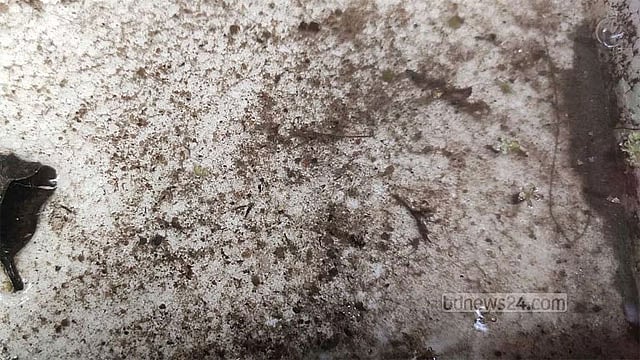
Aedes larvae were found in the basement of another high-rise building under construction in Borobag.
The owner of that building, Shahi Nur Gazi, said they never allow water to collect in the basement, but the water seeped through the walls.
Upon visiting the RZ Chamber building in Mohakhali on Thursday, the drains were full of water. Numerous Aedes larvae were seen when a light was flashed into it.
Some drivers and the electrician of the building were present in the basement. Sometimes, the basement is used for washing cars, they said. They said some water from the water pump also ends up in the drain. But they did not know that mosquito larvae can breed in such places.
Electrician Rakibul Hasan showed a small reservoir and said they clear the water regularly. “We only threw out the old water today. Drains are cleaned regularly, too,” he said.
“I look after the building regularly. Even yesterday, I instructed them to remove water,” said Jahid Hassan, secretary of the building.
The Real Estate and Housing Association of Bangladesh- REHAB is responsible for looking after under-construction buildings, said its president, Alamgir Shamsul Alamin. But he said they were not responsible for the buildings already handed over to owners after construction.
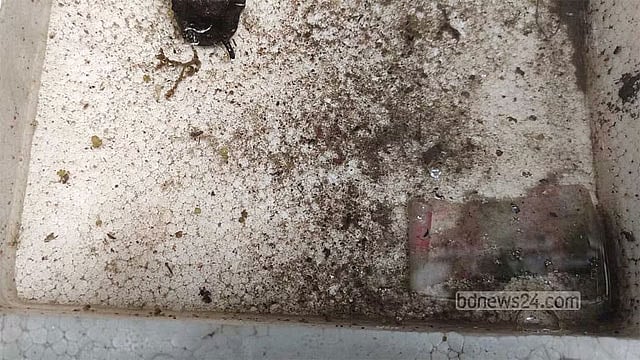
“REHAB provides regular messages to construction companies to keep the construction sites clean. I send two weekly text messages to our members and try to make them aware. What else could we do?”
“Larvae can be found in some buildings as the staff do not perform their duties well. But we’re running a regular campaign, and it had a good result. Not many under-construction buildings are found with larvae now,” the REHAB president said.
Shamsul Alamin believed that disputes between apartment owners sometimes hindered the proper management of a building.
“Some buildings are handled professionally, and no problem arises there. But some lack coordination between owners and staff. Multiple committees exist in such buildings, and owners and tenants have disputes. Those types of buildings face irregularities in management.”
[Writing in English by Sabrina Karim Murshed; editing by Shoumik Hassin]