Published : 25 Aug 2026, 03:58 PM
Updated : 08 Sep 2026, 09:35 AM


Jinna Talukder is nearly 50 years of age. For the past six months, he has been suffering from oesophageal cancer.
He has undergone chemotherapy twice before. He came to the National Institute of Cancer Research and Hospital on Saturday to undergo his third round of treatment.
But there was no room in the hospital. As a result, he was forced to sleep in a field next to the hospital on Saturday night.
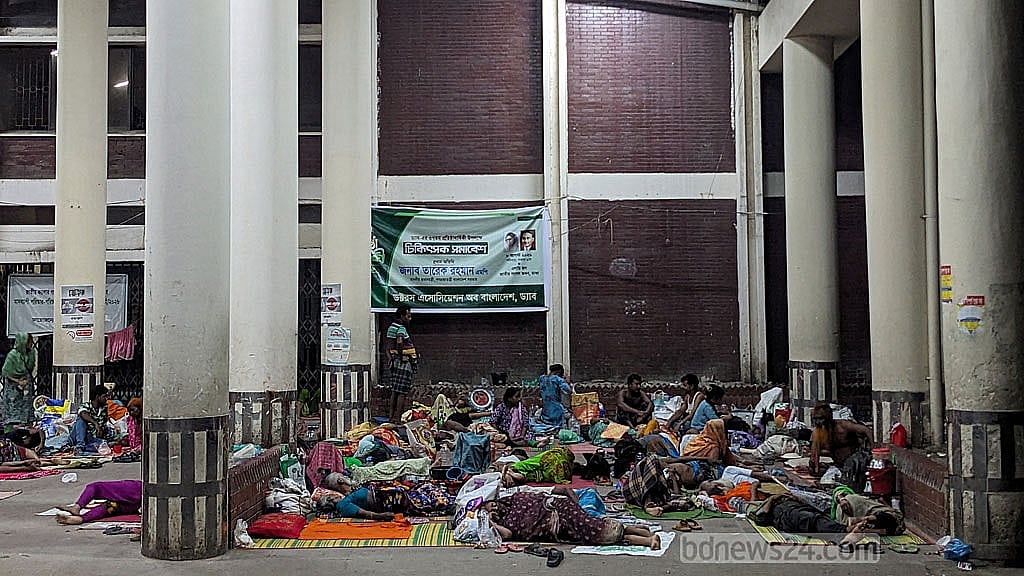
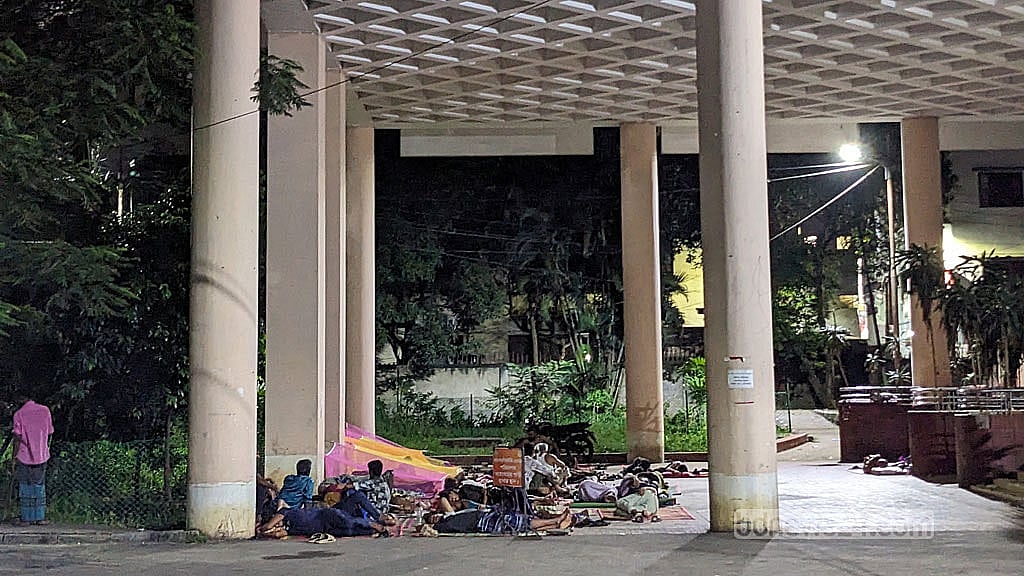
Jinna is one of more than a hundred patients and their relatives who could be seen spending the night in the open area between the hospital's “B” and “C” blocks and across the grounds of the National Institute of Disease of the Chest & Hospital.
Jinna, who came from Faridpur, said: "I have undergone my third round of chemotherapy, but it was already evening by the time I received it, so I did not consider going home. I cannot get a vehicle to take me from the town to the village at night. I will take the bus home tomorrow morning."
From 12am to 1am on Sunday, patients and their relatives could be seen lying on makeshift bedding on the grounds of the cancer institute.
The patients say that proper cancer treatment is not available at their local district hospitals, forcing them to come to Dhaka. But the hospital and its surrounding areas have limited places for people to sit.
They say it would be best if there were a low-cost accommodation facility next to the hospital.
Jinna's wife Nazma Begum said: "We came on Friday afternoon. We have been sitting here since then. We cannot sit here all day and night; we are afraid that it will start raining at any time."
"We have to get up very early in the morning, get a ticket, and deposit the chemotherapy money. We have to take the receipt and then go for chemotherapy. The cost of therapy here is very low, so we are forced to wait in the field. We cannot afford to get this therapy elsewhere or from any other hospital."
Nights Spent in Fear
The National Institute of Cancer Research and Hospital has 500 beds. According to the hospital’s director, more than 2,000 people come to the facility every day for medical services.
Many of these patients and their relatives have to wait a long time.
Since it is a specialised hospital, patients come from all over the country for services. They sometimes have to spend more than one night in the area to get healthcare. Due to their financial constraints and distance from home, some have to spend the night outside.
Main Uddin, who comes from Khulna’s Koyra, said: "My wife has lung cancer. After undergoing treatment for the past year, we don't have much money left.
"After running around to different places, we have been getting chemotherapy here since July. I have to stand in line early in the morning to buy a ticket and arrange the therapy. But what is more difficult is staying here overnight. We come from far away, and we carry some money for medical expenses. It’s hard to sleep with my bag next to me. I worry – how will we get treatment if I lose the money?"
Liton, a cancer patient, came to the hospital from the Narail district. He said, "I used to drive a Charger car. After being diagnosed with cancer, I sold it and started receiving treatment. I bring a little money with me, but it’s hard to sleep while carrying it. So my wife, who accompanies me, sleeps for a while as I stay awake. And when I sleep, my wife stays awake.”
He said, “We spend the night together. But I'm more afraid of the rain. When it starts to rain, everyone in the field rushes under the stairs. Then we have no place to sleep because there are so many people.”
A Two-Month Wait for Radiotherapy
There are six radiotherapy machines at the National Institute of Cancer Research and Hospital. But currently, only two are operational. Due to this, it takes two to three months to get radiotherapy treatment.
A man named Azizul Haque said, "My elder brother has cancer. Doctors have recommended radiotherapy. But it has taken since May to get in the queue for treatment."
He said, "I come with my brother on Saturday afternoon so we can get in the queue early. My brother and I endure the night outside. In the morning, I can get a ticket and arrange his therapy."
Regarding the suffering of patients and their families, National Institute of Cancer Research and Hospital Director Mostafa Aziz Sumon said, "Honestly, due to the shortage of machines, we are not able to provide the services required by patients.
“Currently, we are providing emergency services to patients with two functioning machines. More than 7,000 patients are waiting at the moment. It is becoming very difficult to arrange queues for them. As a result, patients are usually getting their spots after four to six weeks.”
Asked about the patients and their relatives spending nights in the open field, he said: “In our country’s health system, there is no accommodation for the relatives of patients. Here, several people typically accompany a patient; it is not possible to arrange accommodation for all of them.”
Still, the hospital director gave some assurances.
“We have planned to move the morning ticket counters to the side of the main road. A new shed will be built there, and a ticket counter will be opened. Then, maybe some patients and relatives will be able to stay there at night.”