Published : 14 Nov 2026, 11:06 PM
Updated : 14 Nov 2026, 11:06 PM


A committee’s draft audit report has found “inconsistencies” and structural weaknesses in Bangladesh’s GDP growth and national income figures.
It says the high growth shown in official figures over several fiscal years of the ousted Awami League government’s past 15 years does not match indicators of real economic activity.
The seven-member panel analysed national accounts and industrial output data of the Bangladesh Bureau of Statistics (BBS), questioning manufacturing growth and the industrial production index in particular.
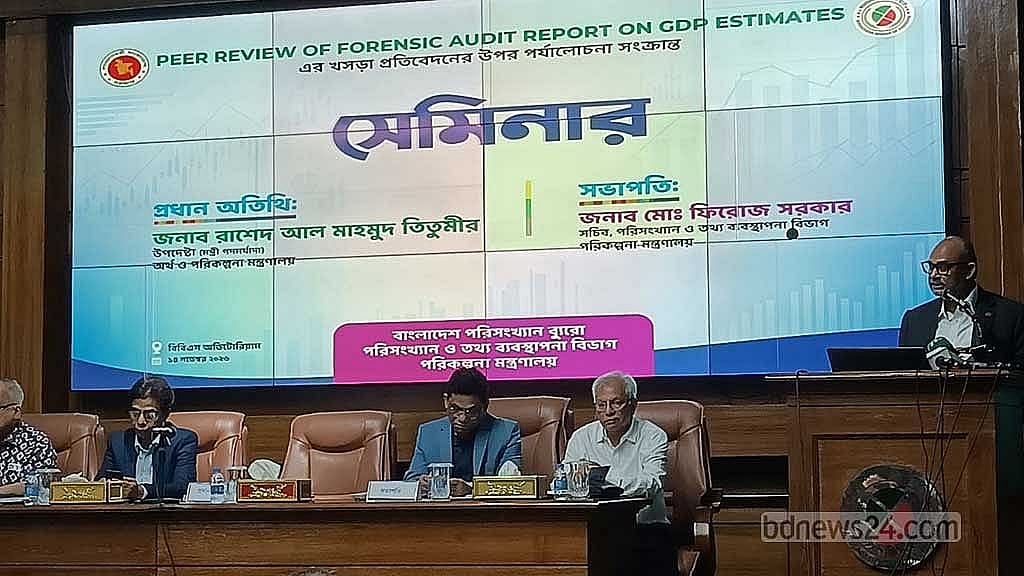
Bangladesh Institute of Development Studies (BIDS) Director General AK Enamul Haque, a committee member, presented the draft on Saturday at a seminar in Agargaon.
The planning ministry organised the event to gather feedback. The panel was formed in March on the instruction of Planning Advisor Rashed Al Mahmud Titumir, who said the review saw no administrative or political interference and went through peer review.
He added that the audit had faced no administrative or political interference and was intended to identify gaps in national accounts, not to assign blame.
Growth Jump, Data Flaws Questioned
Average real GDP growth rose from 6.27 percent in 2010-11 to 2013-14 to 7.39 percent in 2014-15 to 2018-19, a gain of 1.13 percentage points.
About 41 percent of the extra growth came from manufacturing, mostly large and medium industries.
Garments carry 34.84 percent weight in the production index, yet the sub-sector’s growth fell while cement, textiles, pharmaceuticals and leather products grew.
With garment growth unchanged, the overall manufacturing gain could have been nearly double, the committee found.
Petroleum refining grew 87.4 percent in 2015-16 and cement 61.6 and 51.7 percent in consecutive years. Shipbuilding showed 4,242.4 percent in 2014-15 and 497.6 percent the next year.
The data rest on administrative reports from a few big firms, so small changes can swing whole indices.
The panel also flagged heavy reliance on the 2005-06 base year, with fixed growth rates applied instead of fresh surveys, and a risk of double-counting.
Growth in taxes net of subsidies, 20.8 and 23.8 percent in two successive years, rests on fiscal data rather than surveys.
Checks on data from the National Board of Revenue (NBR), Export Promotion Bureau (EPB) and state enterprises are weak.
Four Reforms
The committee proposed modernising data collection and verification, conducting fresh surveys and updating the base year, ensuring BBS independence, and including more data from services and the informal economy.
It also recommended introducing income-based GDP estimates alongside production and expenditure methods.
Advisor Titumir said political interests and a narrative of development had driven the inflation of growth figures in the past.
He alleged that data in seven sectors had been manipulated to inflate GDP and growth.