Published : 13 Oct 2026, 05:01 PM
Updated : 13 Oct 2026, 05:15 PM


The International Monetary Fund (IMF) has cut its growth forecast for Bangladesh and warned that average inflation could rise to 10.9 percent in the 2026-27 fiscal year.
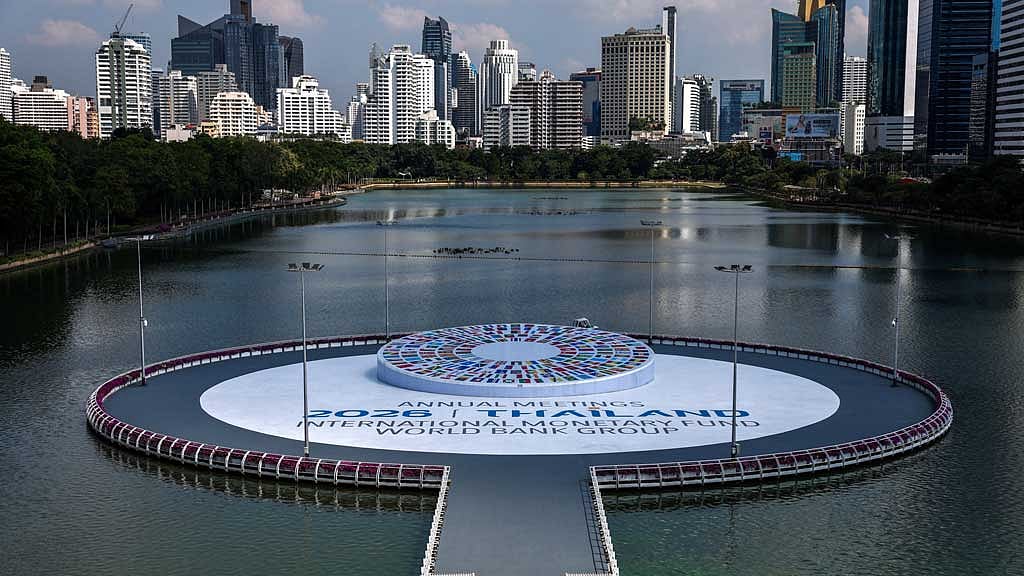
The projections appear in the October edition of the IMF's World Economic Outlook, released on Tuesday during the annual meetings of the World Bank and the IMF in Bangkok, Thailand.
The IMF's growth forecast is lower than those of the World Bank and the Asian Development Bank (ADB). It is also below the growth rate recorded during the COVID-19 pandemic, when Bangladesh's gross domestic product (GDP) grew by 3.45 percent in the 2019-20 fiscal year.
If the forecast is realised, Bangladesh would record its lowest annual growth rate in nearly four decades. Data from the Bangladesh Bureau of Statistics (BBS) show that the country last recorded a lower rate in the 1988-89 fiscal year, when growth stood at 3.11 percent.
In its forecast published last April, the IMF had predicted 4.3 percent growth for Bangladesh in FY26. The new projection represents a cut of 1.1 percentage points.
In the Bangladesh Development Update report published on Oct 6, the World Bank forecast growth of 3.4 percent for the current fiscal year. It also warned that inflation could rise but did not give a specific projection.
Earlier, in its Global Economic Prospects report published on Jun 16, the World Bank had forecast growth of 4.6 percent for Bangladesh in the current fiscal year, citing the impact of the war involving the United States, Israel and Iran.
In its Asian Development Outlook (ADO) report published on Sept 23, the Manila-based development agency ADB projected growth of 4 percent for Bangladesh, with inflation expected to rise to 9 percent.
The BNP government has targeted 6.5 percent GDP growth in FY27, well above all three institutions' forecasts.
On Jun 10, the BBS published the provisional GDP estimate for FY26, reporting growth of 4.14 percent year-on-year.
Three months of the current fiscal year, July to September, have passed, but the ADB has yet to publish its final GDP estimate for 2025-26.
The interim government had set a GDP growth target of 5.5 percent in the budget for the 2025-26 fiscal year.
The ousted Sheikh Hasina government had set a target of achieving 6.75 percent growth in the 2024-25 fiscal year. After the political changeover, the interim government reduced this target to 5.25 percent. In the end, Bangladesh's growth that year was 3.49 percent.
Bangladesh's GDP growth in FY24 was 4.22 percent.
The Awami League, ousted by a student-led mass movement in 2024 after a decade and a half in power, had frequently cited economic growth as one of its achievements.
In the 2008-09 fiscal year, the country achieved a GDP growth of 5.74 percent. In the 2018-19 fiscal year, it initially exceeded 8 percent, but the revised figure later fell to 7.88 percent, the highest growth rate recorded in Bangladesh.
The following year, growth fell to 3.45 percent due to the impact of the COVID-19 pandemic. In the 2020-21 fiscal year, it rose again to 6.94 percent. Although it exceeded 7 percent the following year, it fell to 5.78 percent in the 2022-23 fiscal year.
According to the IMF's forecast on Tuesday, the global economy could grow by 3.1 percent in 2026 and 3.4 percent in 2027.
Global average inflation is projected to reach 4.7 percent in 2026 before declining to 4.1 percent in 2027, the IMF said.
Although the report does not provide specific details about Bangladesh, previous IMF assessments have warned that slowing growth poses risks to the economy. Weak economic activity can limit new investment and job creation. If private investment falls short of expectations, industrial production, business expansion and income growth could suffer.
High inflation can also erode real incomes and purchasing power, with low- and middle-income households bearing the brunt.
The World Bank's latest report on Bangladesh says economic growth is slowing, while private investment and employment have weakened. Industrial production faces disruption from gas and electricity shortages, and the banking sector is grappling with rising default loans and capital shortfalls. High inflation continues to erode household incomes and purchasing power.
The report also says that much of the government's spending on social security and subsidies for electricity, fuel and fertiliser fails to reach the poor. Many of the most vulnerable families remain outside social protection programmes, despite the benefits available to others.
The World Bank identifies restoring stability in the banking sector, improving energy security and governance, and increasing tax revenue as key areas for reform. It also recommends gradually reducing general subsidies while expanding targeted support for poor and vulnerable households.
The ADB's latest Asian Development Outlook says strong remittance flows and a stable services sector are supporting Bangladesh's economy despite difficult global and domestic conditions. However, the report calls for macroeconomic stability, a better investment climate, stronger financial sector governance and reforms in energy and infrastructure to sustain long-term growth.
The ADB says these reforms could help attract private investment, create quality jobs and strengthen the economy's resilience.
It also warns that an intensification of the conflict in West Asia could push up fuel prices and transport costs, adding pressure on inflation and foreign transactions. New tariffs or restrictions on global trade, slower growth in major export markets, tighter access to foreign financing and climate-related risks could also weigh on Bangladesh's economy.
Inflation to Rise to 10.9%
The IMF’s latest report expressed concern about core inflation, an important and sensitive indicator of the Bangladesh economy.
The organisation said that the average inflation rate in Bangladesh in FY25 was 10 percent.
In FY26, it decreased to 8.7 percent. In the 2026-27 fiscal year, it could increase beyond 10 percent to reach 10.9 percent.
On Oct 7, the Bangladesh Bureau of Statistics (BBS) released updated inflation data. It shows that in the third month of FY27, September, on a point-to-point basis (monthly or monthly), overall, inflation in the country was 8.34 percent; in the second month, August, it was 8.26 percent. In the first month, July, it was 8.32 percent.
The government has set a target of keeping the annual average inflation at 7.5 percent in the 2026-27 fiscal year.
In 2024, during the July Uprising, overall inflation in the country rose to 11.66 percent. In that month, food inflation was 14.10 percent and inflation in the non-food sector was 9.68 percent.
In the months following the fall of the Awami League government, overall inflation fluctuated between 9 and 10 percent.
The interim government had set a target of reducing the annual average inflation rate to 6.5 percent in the budget for the 2025-26 fiscal year. However, that fiscal year ended with an average inflation rate of 8.68 percent.