Published : 26 Oct 2015, 02:29 PM
Updated : 29 Oct 2023, 09:28 PM


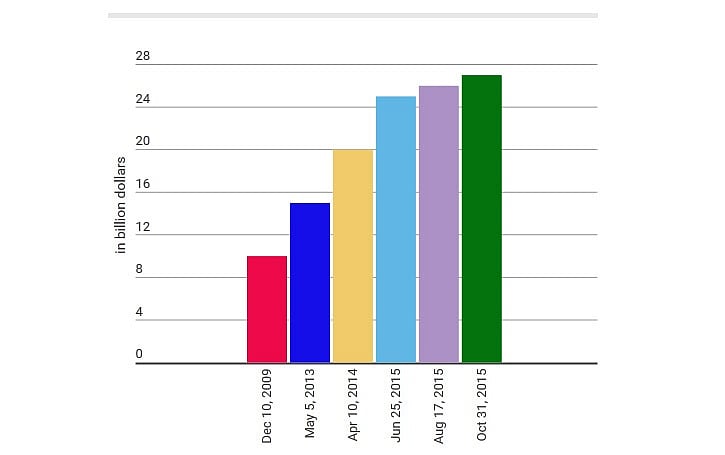
Now, the country's foreign exchange reserve is close to a landmark $27 billion—a whopping 27 times increase in 15 years.
Bangladesh Bank's Forex Reserve and Treasury Management chief Kazi Sayedur Rahman told bdnews24.com that the country’s foreign exchange reserves would cross the $27 billion mark this week.
Rahman said the forex reserves stood at $ 26.82 billion ending Sunday.
On Oct 30, the IMF will effect the fifth and sixth tranche of its Extended Credit Facility, adding another $258 million to the country's forex holdings.
But Rahman says that even before the IMF transfers, the forex reserves of Bangladesh may cross $ 27 billion.
Increasing remittances from expatriates abroad and rising export incomes have boosted the country's foreign exchange reserves over the years.
Dropping costs of imports, especially food and fuel, have also helped restrict forex outgo and boosted reserves.
“Bangladesh is facing no problems in paying up import costs for the Padma Bridge project due to the comfortable level of forex reserves,” Bangladesh Bank Governor Atiur Rahman told bdnews24.com.
Central bank officials said that at the end of the Awami League’s 96-01 term the reserves came down to nearly $1 billion and it was slightly higher than that when the Justice Latifur Rahman led caretaker government took office.
During that time, Bangladesh’s ACU dues of $200 million caused a few problems because it was felt important to maintain the $ 1 billion forex reserve for the sake of the country's global image.
It is expected that countries must have enough forex reserves to meet for imports for at least three months.
Bangladesh clears ACU bills every two months. The current forex reserve is good enough to clear import bills for seven months, going by an estimated monthly requirement of $4 billion.
The import bills for September and October will be cleared in November, which will bring down the reserve below $27 billion.
The ACU bills for the two months amount to $900 million, said Bangladesh Bank's Kazi Sayedur Rahman.
World Bank Chief Economist Kaushik Basu compares Bangladesh’s increasing forex reserves to India's during the ‘90s.
In an interview with bdnews24.com during the WB-IMF Annual Meeting in Peru this month, he said: “In the early 1990s, seven billion dollars was considered very good. Then, after the reforms in India, the reserves began to increase very quickly. That is evident in Bangladesh, too. Twenty-seven billion is a very handsome figure.”
“[It gives very little scope for] currency fluctuation. Speculators are wary of this because they know the central bank wields power, it has huge ammunition. So, it’s very good news,” said Basu.
Central bank figures say that remittance inflow in the 2014-15 fiscal stood at $15.31 billion, a 7.6 percent increase over the previous fiscal.
However, remittances in the first quarter of the ongoing 2015-16 fiscal dropped by 2 percent compared to the same period in the previous fiscal.