


Published : 22 May 2022, 11:58 AM
Updated : 18 Jul 2022, 02:56 PM


With most residents not allowed to leave their homesand restrictions tightening in parts of China's most populous city, commutersearly on Sunday needed strong reasons to travel.
Shanghai's lockdown and curbs in other cities havebattered consumption, industrial output and other sectors of the Chineseeconomy in recent months, prompting pledges of support from policymakers.
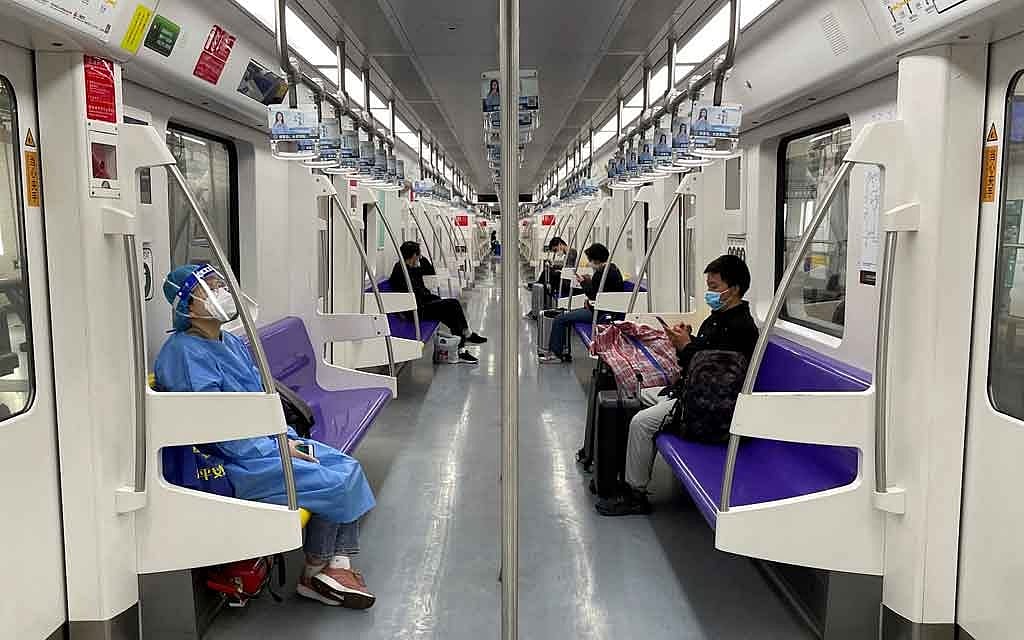
Many who ventured out in the commercial hub wore blueprotective gowns and face shields. Inside the carriages, passengers were seenkeeping some empty seats between themselves. Crowds were small.
Xu Jihua, a migrant construction worker, arrived at asubway stop before it opened at 7 am, hoping to get to a rail station, thenhome to the eastern province of Anhui.
"Work stopped on March 16," said Xu, addinghe had not been able to earn his monthly 7,000-8,000 yuan ($1,000-$1,100)salary since then and would only return to Shanghai once he was sure he couldfind work.
"Is the lockdown really lifting or not? It's notvery clear."
A woman who asked only to be identified by her surnameLi said she needed to visit her father in a hospital 8 km (5 miles) from herfinal stop.
"I'm going to the heart hospital, but I don'tknow whether there will be any cars or transport once I get to the railwaystation," Li said. "I might have to walk there."
Four of the 20 lines reopened, and 273 bus routes.Some had closed in late March, others later, although sporadic servicecontinued with a limited number of stops.
The city of 25 million expects to lift its city-widelockdown and return to more normal life from June 1. Most restrictions onmovement will remain in place this month.
Shanghai's 800-km metro system averaged 7.7 millionrides a day in 2020, according to the latest data, with an annual passengerthroughput of 2.8 billion.
Trains will run 20 minutes apart for limited hours.Commuters must scan their body temperature at the entrance and show negativeresults of PCR tests taken within 48 hours.
UNEXPLAINED CURBS
Shanghai has gradually reopened convenience stores andwholesale markets and allowed more people to walk out of their homes, withcommunity transmissions largely eliminated.
Still, parts of the city have recently tightenedcurbs, underlying the difficulty of resuming normal life under China'szero-COVID policy, which is increasingly at odds with the rest of the world.
Jingan, a key commercial district, said on Saturday itwill require all shops to shut and residents to stay home until at leastTuesday, as it carries out mass testing.
The use of exit permits, previously given to residentsthat allowed them to leave their homes for short walks will be suspended,authorities said without giving a reason.
Similar actions were announced on Friday in theHongkou district as well as on Saturday by Qingpu district's Zhaoxiang town,which said they wanted to "consolidate" the results of their epidemicprevention efforts so far.
Shanghai reported fewer than 700 daily cases onSunday. Significantly, none was outside quarantined areas, as they have beenthe case for much of the past week. The capital Beijing reported 61 cases, downfrom 70.
Beijing has been gradually tightening restrictionssince April 22, with many shops closed, public transport curtailed andresidents asked to work from home. But it still struggles to eliminate anoutbreak of dozens of new infections a day.
Tianjin, a key northeastern port, found 36 new caseson Saturday, CCTV reported.
Regulators said on Friday they will streamline theprocess of equity and bond issuance by companies hit by the pandemic, and urgedbrokerages and fund managers to channel more money into virus-hit sectors.












