


Published : 08 Mar 2022, 12:37 AM
Updated : 18 Jul 2022, 02:32 PM


Though many global coronavirus trends are rapidly improving as countries emerge from surges driven by the highly transmissible omicron variant, the grimmest metric hit a tragic milestone on Monday, The New York Times reported, citing data from the Center for Systems Science and Engineering at Johns Hopkins University.
“Six million is really unfathomable,” it quoted Beth Blauer, the data leader for the Coronavirus Resource Center at Johns Hopkins, as saying. “These are real lives.”
Public health experts agree that six million is a vast undercount and that the true devastation will never be precisely known. In Yemen, where a civil war has been raging for years, the government has reported only 2,100 deaths since the start of the pandemic while its population of 30 million is 99 percent unvaccinated.
“There’s a lot that we don’t know in places that don’t necessarily have the same infrastructure for fundamentally understanding the pandemic and reporting,” Dr Blauer said, according to the report.
Surges are still intensifying in Hong Kong, South Korea and New Zealand, but new death counts are dropping in many places as omicron recedes. The world is averaging more than 7,000 new confirmed deaths a day, down from almost 11,000 a day in early February and the known pandemic peak of more than 14,000 a day in January 2021.
The death rate was “still far too high in the third year of this pandemic,” said Dr Maria Van Kerkhove, a top World Health Organization official.
Even the United States, with ample vaccine supply, has suffered the highest known total — more than 950,000 deaths — and failed to inoculate as much of its population as other wealthy nations. The White House unveiled a plan to help transition to what some are calling a “new normal,” but an average of about 1,500 Americans are still dying each day, around a year after vaccines became readily available, according to a New York Times database.
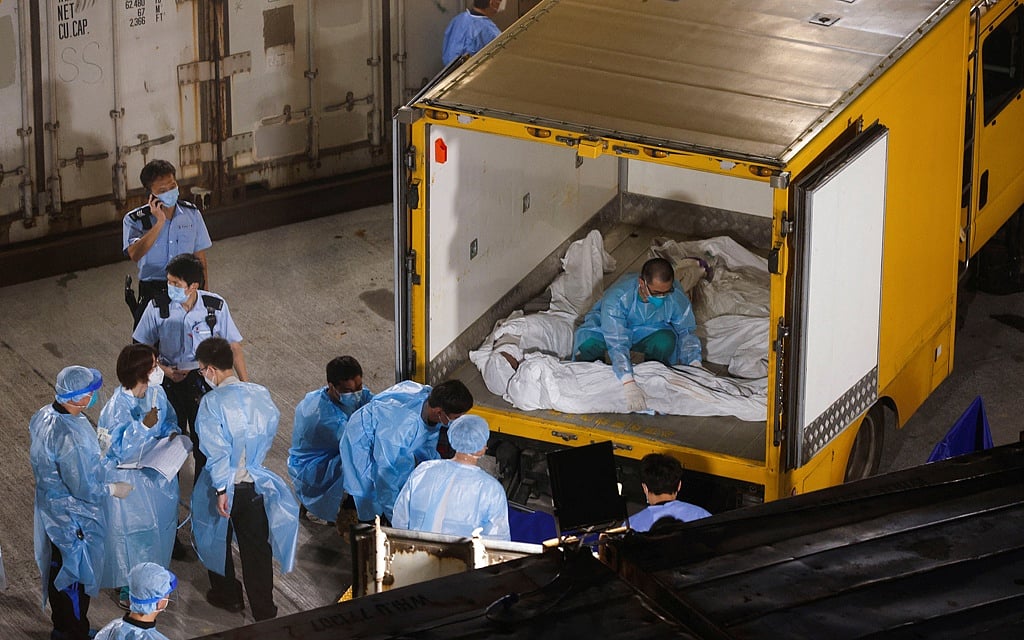
Hong Kong, which is going through its worst outbreak yet, has also fallen short on vaccinating its people, particularly older residents.
And stark vaccination disparities between countries remain, leaving the entire world vulnerable to the threat of a new, deadly variant. Vaccination rates continue to lag in low-income countries, where only 14 percent of the population has received at least one dose of a vaccine. In high- and upper-middle-income countries, 79 percent of the population has received at least one dose.
“Science has given us tools to fight this virus our ancestors could not even have dreamed of — the ability to track its evolution almost in real time, to test for it rapidly, to treat it, and, of course, to prevent it with safe and effective vaccines,” said Dr Tedros Adhanom Ghebreyesus, the WHO’s director general. “But the global failure to distribute those tools equitably has prolonged the pandemic.”












