


Published : 29 Apr 2019, 12:43 AM
Updated : 17 Oct 2022, 11:39 AM



They also called upon the government to take “practical action” to improve the ease of doing business.
They noted that the policy reform process in Bangladesh has proved “to be lengthy and complex”.
Regulatory unpredictability, uncertainty, and the lack of coherence in policy implementation are major barriers to doing business, as highlighted in recent international and domestic reports, they said in a statement after a dialogue with the government on Sunday.
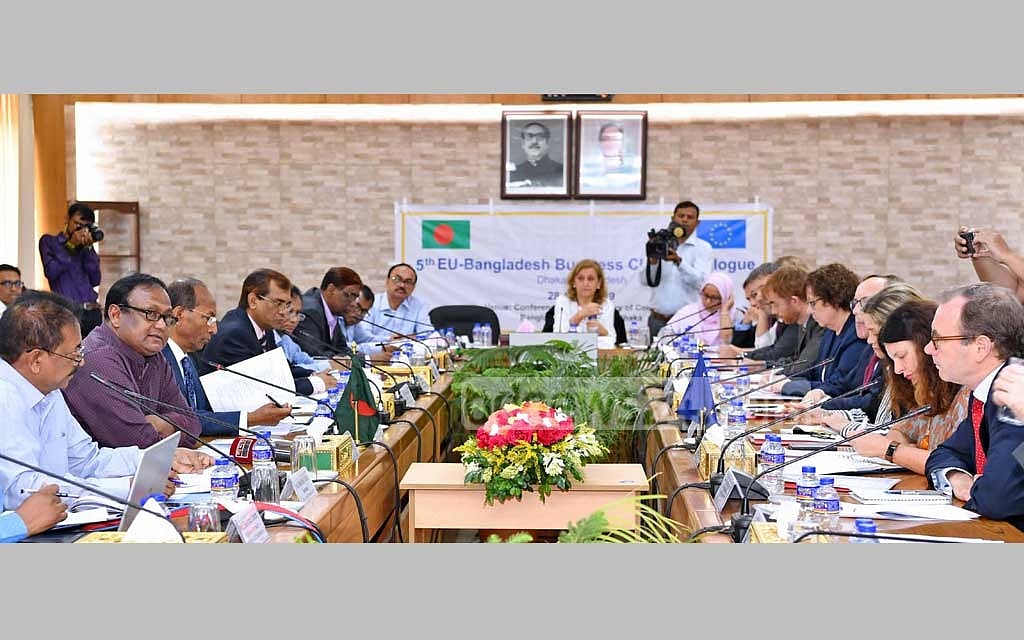
The heads of mission of the European Union, Denmark, France, Germany, Italy, the Netherlands, Spain, Sweden, and the United Kingdom participated in the 5th plenary of the ‘EU-Bangladesh Business Climate Dialogue’ at the commerce ministry with Minister Tipu Munshi in chair.
The dialogue was attended by senior officials from relevant government ministries and agencies as well as by the heads of diplomatic missions of the EU member states and representatives of the EU private sector in Bangladesh.
Photo: PID
Discussions take place in five joint working groups which have focus on business concerns in five key areas, namely: import duties/custom/trade facilitation; licenses and investment in services sector; financial flows; tax regime and pharmaceuticals.
The heads of mission underlined that the Business Climate Dialogue is a good opportunity for Bangladesh to seek feedback from important EU stakeholders on improving the business environment and, by doing so, attract more EU trade and investment to the country.
This would be beneficial both to Bangladesh and the EU. They called on the dialogue to be used by both sides as a vehicle to deliver improvements.
They said there is a need for action in favour of reform at all levels within the ministries.
“Political declarations should be accompanied with corresponding actions aimed at improving the modus operandi within the administrations.”
The heads of mission further suggested the government should take steps to make doing business “easy and fair” for all.
Among other issues, they also stressed that reducing any uncertainty in the current tax regime is crucial.
Keeping on the horizon the national visions to become middle income economy by 2021 as well as secure a sustainable LDC graduation in 2024, the EU heads of mission see great potential in Bangladesh for further bilateral trade and investment.
For this to happen, though, improved economic governance needs to be ensured which is a key prerequisite if Bangladesh’s recent economic gains were to be sustained, according to the statement.
“EU as Bangladesh’s largest trade, development and humanitarian partner will continue to work constructively with the government of Bangladesh towards better trade and investment relations.”
The next dialogue will be held in six months.













