


Published : 10 Oct 2016, 01:26 AM
Updated : 11 Apr 2022, 10:16 PM


The survey also found that Bangladeshi social enterprises are generating annual turnover of Tk 2.1 million on average and nearly three-quarters of the enterprises expect a substantial increase in turnover in the next financial year.
Most Bangladeshi social enterprises expect their venture to grow and they have wide-ranging growth plans – particularly expanding into new geographic areas.
They are developing new products and services through investment in their teams and by attracting capital to expand, it found.
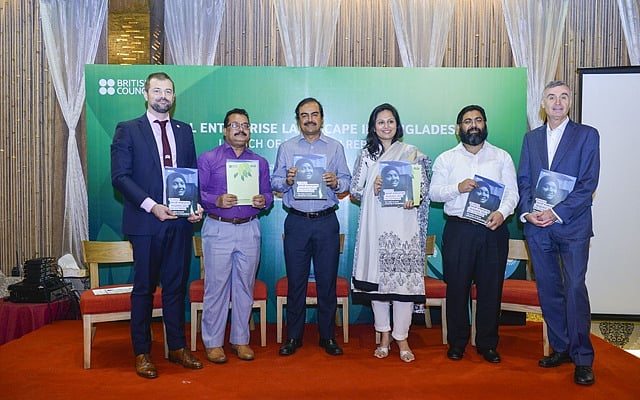
The report, launched on Sunday at a function, was first-of-its-kind attempt to understand the scale of social enterprise activity in Bangladesh, the UK education and cultural centre said.
The survey indicates that 77 percent of the social enterprises were registered between 2009 and 2015 in Bangladesh. Most leaders are aged under 35.
Social enterprises are businesses which trade for a social purpose, re-invest surpluses into their social objective, and make themselves accountable for their actions, rather than simply maximising profits for owners and shareholders.
They create jobs for disadvantaged groups, empowering women, and addressing social exclusion throughout the country.
The British Council with the help of the Overseas Development Institute conducted the research.
It also looked into the existing enabling environment for social enterprises in a separate study titled ‘Social Enterprise Policy Landscape in Bangladesh’.
British Council’s Director in Bangladesh Barbara Wickham said the survey was “an important step” in remedying the knowledge gap that will inform the delivery of its social enterprise programme in Bangladesh.
The report also shows that lack of technical skills is seen as the biggest barrier to growth, followed by access to debt finance, lack of social enterprise awareness and cash flow constraints.
Donations and grants are the most common sources of funding, with few social enterprises securing concessional loans or equity. Limited capital supply is seen as the primary funding constraint.
The survey found that 90 percent of social enterprises are working with individuals from socially and economically disadvantaged communities, creating employment opportunities especially for disadvantaged groups.
A third of respondents work in the education sector, although there are significant differences by gender of the leader.
The survey found that male-led enterprises are far more likely to work in this sector, 39 percent, than female-led enterprises which is 6 percent.
Other commonly selected sectors included services, business development services and entrepreneurship support, livelihoods and employment creations and health and social care.
The findings also revealed that a fifth of Bangladeshi social enterprises are led by women – significantly higher than in mainstream business which is 5 percent.
The survey was based on a range of sources including existing datasets as well as a specific survey that was developed and conducted for the research In Bangladesh.
A total of 149 organisations completed the survey.
Using these calculations, the survey makes an initial estimate that there could be around 150,000 social enterprises currently operating in Bangladesh and they have already reached approximately 207,397 beneficiaries.
The British Council acknowledged that the survey did not generate a sufficiently large dataset to allow for the results to be fully representative, but said it offers “an important sample pool to facilitate more scientific and robust research in future”.












