Published : 26 Jun 2023, 09:27 AM
Updated : 26 Jun 2023, 09:28 AM


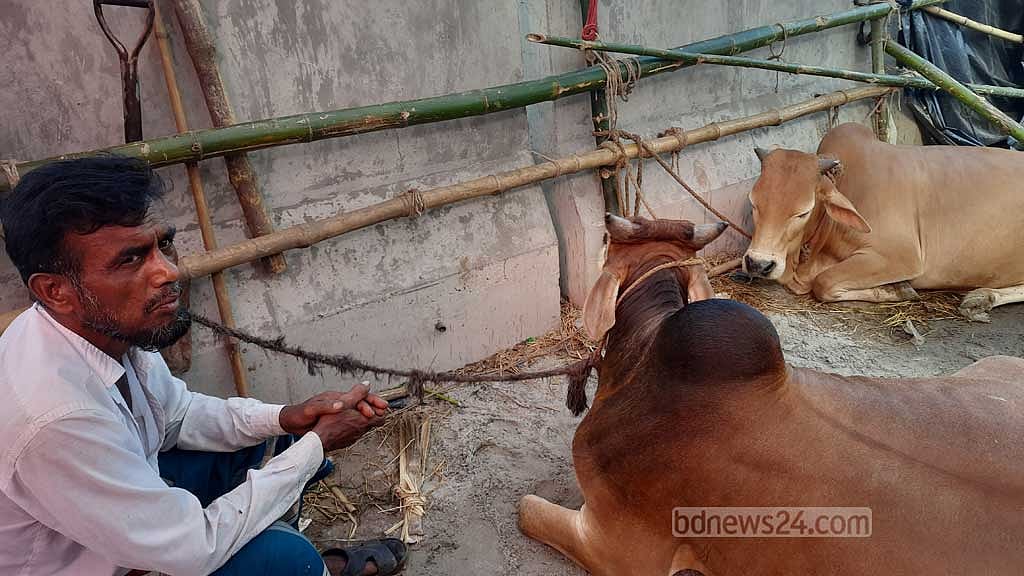
Faruk Hossain is a farmer from Madaripur's Pacchar. On Wednesday, he crossed the Padma Bridge with two cows to reach a makeshift market in Dhaka's Jatrabari ahead of Eid-ul-Azha.
To his relief, the opening of the landmark multi-purpose bridge last year has eliminated the usual high-stress and high-cost journey from his home to Dhaka.
This year, he spent only Tk 1,500 to bring the two sacrificial animals - one valued at Tk 150,000 and the other at Tk 185,000 - to the market in Dania.
However, not a single cow was sold as of Saturday afternoon. The Eid market has yet to heat up, leaving traders to tend to their animals for the last five days.
After spotting the moon for the month of Zil Hajj, Bangladesh announced that the Eid festival of sacrifice will be held on Jun 29.
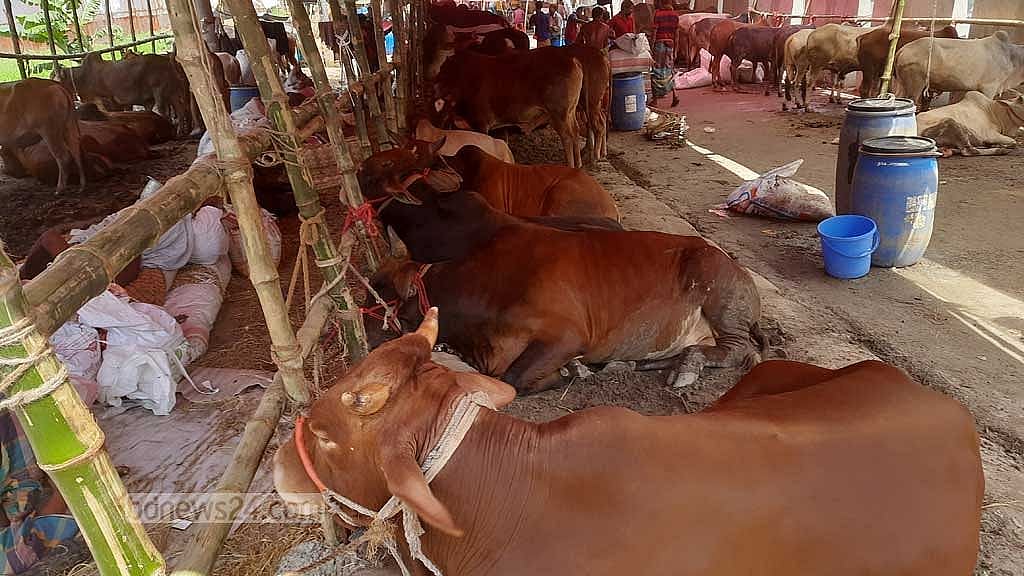
A large section of Dhaka residents are set to partake in the ritual of animal sacrifice during the religious holiday. Hoping to cash in on the expectedly high demand for sacrificial animals, traders from all over the country have converged on the capital with relatively high-priced cattle.
Typically, residents of Dhaka buy sacrificial animals just a day or two before Eid due to space constraints in the city and their lack of means to care for the animals.
Therefore, it falls on the traders to care for their stock until then. Consequently, the cattle markets in Dhaka tend to see a rush of customers two days before Eid.
Cattle markets have been set up in 21 areas within the jurisdictions of Dhaka's bifurcated city corporations. The authorities have approved leases on these grounds for a total of five days, including Eid. Only two of these markets are permanent.
The makeshift market in Jatrabari encompasses both sides of the Dania-Kajla Road adjoining the busy Dhaka-Chattogram-Sylhet highway.
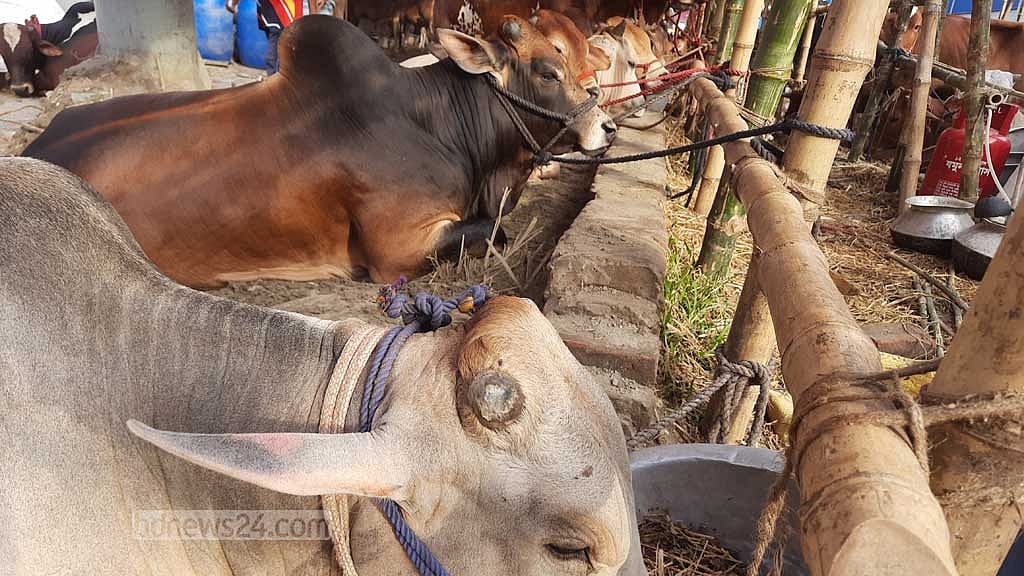
Many farmers and cattle traders made the trip to Dhaka early this year to avoid any hassle. One of them is Abul Kashem Sardar from Faridpur Sadar Upazila. He arrived on a truck with seven cows on Thursday.
"It used to take more than a day to get to Dhaka, but now the journey is just two hours long. Many people started bringing their cows over on Monday, too. It's possible to find good spots to keep the cattle if they come in early," he said.
Farmer Faruk has been setting up shop at the cattle market in Jatrabari for the last eight years. In years gone by, the animals had to be transported to Mawa or Shwashman Ghat in Postogola along the waterway, he said. From there, they would be loaded onto a vehicle and taken to Jatrabari or other parts of the city.
As a result of the strenuous journey, many animals suffered broken legs or other injuries. If a cow fell ill on the waterway, it would often be tossed into the river, according to Abul Kashem, a cattle trader.

But traders are no longer burdened by these concerns. Cattle can be transported directly from the shed to the market on vehicles via the Padma Bridge, according to Kuddus Sarkar, a trader.
"I have brought five cows that I bought with me. My cousin is accompanying me with three cows of his own. It is my responsibility to sell all of them," he said.
Most of the cows at the market were reared in Faridpur, Madaripur and Munshiganj. Some have also come from Narayanganj, Jhenaidah, Kurigram, Rangpur, Satkhira and Savar.
Trader Almas Haque highlighted the problems with transporting cows along the river routes, pointing out that it took a lot of work for the animals to be lifted from the banks of the river onto a tall trawler. "Those who do this also suffer. Sometimes, the cows get flustered."
"Subbing a cow takes quite a bit of time and effort. Plus, it's impossible to keep track of the number of times people get poked by their horns in the process. Now, the owner can put his cow on a truck at his homestead and head straight to the market."

Even as sacrificial animals began streaming in last week, work is still ongoing to prepare the market in Jatrabari ahead of Eid.
Sand is being laid to prevent the ground from getting muddy during the monsoon. At the same time, boundaries are being demarcated with bamboo fences. Work is also underway to set up pavilions using polythene and tarpaulin sheets to protect from the scorching sun and rain.
"Sales have not started yet, but it could begin soon. So, the animals were brought to the market early doors," said Hafiz Uddin, a member of the three-member committee for the market's leaseholders.
"We have always tried to ensure that the pathways are cleaned regularly so customers can move around without any hindrance. About 500 workers from the area and our team have volunteered to ensure cleanliness and security."
The rules set by the government entitle a lessee to bag a 5 percent commission on selling one of their animals at the market.
Over 12.5 million animals have been prepared nationwide for slaughter during Eid this year, according to the government. The number exceeds the demand for sacrificial animals, which currently stands at 10 million.
Around 4.8 million cows and buffaloes, 7.6 million goats and sheep, and 2,581 other animals will be on sale this time.
Last year, 12.1 million animals were available for ritual sacrifice, and only 9.9 million were slaughtered.