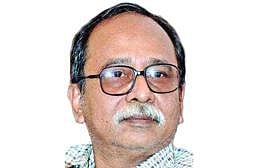
Moontassir Mamun testifies against Ghulam Azam
His deposition was followed by an hour's cross-examination which remains incomplete.
bdnews24.com News Service
bdnews24.com
Published :
01 Jul 2012, 02:59 PM
Updated :
09 Aug 2022, 03:57 PM
Tanim Ahmed
Dhaka, Jul 1 (bdnews24.com) — The first war crimes tribunal of Bangladesh saw the first prosecution witness against Jamaat-e-Islami guru Ghulam Azam take the stand on Sunday.
Moontassiruddin Khan Mamun, better known as Dhaka University history professor Moontassir Mamu, finished his deposition after lunch. It was followed by an hour's cross-examination which remains incomplete.
The professor, who was a student at Dhaka University in 1971 when the War of independence broke out, said Jamaat and Muslim League factions were among the more notable supporters of the Pakistani Military junta of the time.
The three-judge International Crimes Tribunal-1 of Bangladesh, set up to deal crimes against humanity during the 1971 War of Independence, indicted the former Jamaat chief on May 13 on five charges including conspiracy, incitement and planning.
The witness, a 61-year historian, noted for his work on Dhaka's history and the Liberation War, said among the political leaders backing the military junta in 1971, Ghulam Azam and Nurul Amin were considered the stalwarts.
It was at the recommendation and advice of these people that the Pakistani regime proceeded to establish the Peace Committee.
This committee was known as an anti-liberation platform that actively collaborated with the Pakistani Army.
The history professor said that even other such organisations founded during the Liberation War, like the vigilante militia outfits of Al Badr, Al Shams and Razakar, predominantly consisted of Jamaat members and its student activists because, "Of all the parties backing the military regime, Jamaat was the largest."
Mamun said that had it not been for the heinous role of these outfits, Bangladesh would not have suffered as much. "And perhaps we would have become liberated a lot sooner."
According to the historian, Rao Farman Ali, a senior Pakistani army officer working in East Pakistan in 1971, had said during an interview that the local vigilante groups harboured more hatred toward the liberation forces than even the Pakistani soldiers.
Mamun said during his deposition that one of the first indications that certain political parties were backing the Pakistani junta was when a dozen right-wing leaders met with General Tikka Khan in the first week of April in 1971, the martial law administrator for East Pakistan at that time.
As such General Tikka Khan is presumed to among the key people who approved and gave the go-ahead for actions like the 'Operation Searchlight' on the night of Mar 25 when the Pakistani Army descended upon the Bengali populace.
Noting that the meeting was held barely 10 days into that massacre, Mamun said, "This meeting was held at a time when people of the rest of the country were fleeing for their lives."
He said this clearly suggested collaboration of those politicians.
It is widely perceived that right-wing parties that had met with failure in the 1970 national elections sided with the military junta. The Awami League had swept those elections winning 167 or 169 constituencies in East Pakistan.
As head of the Jamaat-e-Islami in East Pakistan in 1971, it was also Ghulam Azam who Moontassir Mamun said must have been responsible for the atrocities carried out by the vigilante militia units like the Al Badr and Razakar.
But there was a clear distinction in their 'terms of reference', suggested the history professor. "While the Razakar and the Peace Committee murdered and tortured people indiscriminately, the Al Badr limited themselves to professionals. And by professionals, I mean intellectuals as well."
Mamun said this was done in order to ensure that there was an intellectual vacuum. As leader of Jamaat student wing, called the Islami Chhatra Sangha at that time, Matiur Rahman Nizami along with the party chief Ghulam Azam would have to be held responsible for all the crimes.
Mamun said numerous mass graves found around Bangladesh bore testimony to the fact that murder and torture were rampant. Furthermore, he said the fact that over 10 million people were forced to flee their homes and seek refuge in India testified to the persecution of Bengalis.
Malum's hiccups
Prosecutor Zead-Al-Malum, who deposed the witness, had to proceed through hiccups as he repeatedly asked 'leading' questions, which the defence promptly objected to. Even the tribunal became irritated at one point.
Malum had asked his witness Mamun whether he read the newspapers that came out regularly in 1971. Noting defence counsel Mizanul Islam's objection, Justice Huq said, "Is it at all necessary to ask that question?"
The tribunal chief then suggested that if needed the prosecutor could perhaps ask what the witness had read in the papers then. But he also indicated that this could not really go on and the tribunal could not go on prompting the prosecutor.
The tribunal had cautioned the prosecutor at the very outset that he should avoid asking leading questions.
Another time Mizanul Islam objected to a leading question and appealed to the tribunal that since the prosecutor had already indicated the desired answer to the witness he should not be allowed to ask that same question right away but perhaps a little later.
Malum, however, hardly appeared to be listening and stood still at the podium apparently at a loss. He could proceed with his line of questioning only after prosecutor Sultan Mahmud whispered into his ears. The tribunal chief merely shook his head as the prosecutor struggled to avoid his leading his questions during the deposition.
There was a brief spat between the prosecution and the defence soon after the defence had objected to one of the leading questions.
The dispute arose when Mizanul Islam objected to some of the prosecutors rephrasing the witness statement. The defence counsel said, "The witness certainly has the right to correct his own statement. But the prosecution cannot correct his answers to their liking."
The prosecution was up in arms protesting that it was not correcting the witness answers at all.
Justice Huq raised his voice to say, "This submission of Mr Mizanul Islam is absolutely correct."
Mizanul Islami continued to submit to the tribunal when chief prosecutor Ghulam Arieff Tipoo's voice could be clearly heard protesting against what he was saying.
The defence counsel lost his cool and said this behaviour was unacceptable quite loudly. "I am submitting before the court with your lordship's leave. He should not obstruct my submissions."
Justice Huq said, "Please calm yourself Mr Mizanul Islam. Please!"
Prosecutor Malum was about to proceed when the situation seemed to have calmed down somewhat when defence counsel M Tajul Islam's voice could be heard muttering something.
Malum proceeded to apprise the court of his delicate nerves as the tribunal judges could not help being amused. Even the observers, and there were quite a few who had come to see the first witness deposition, were laughing.
"My lord, I have told you about my delicate nerves and how it really affects me whenever there are noises from the back." Malum also reiterated his oft-repeated point saying that it was the tribunal's responsibility to ensure security of the witnesses.
The tribunal chairman said, "You might have heard something, but we did not, Mr Malum."
Mizanul Islam, again with the leave of the court, said, "How can the witness be threatened with something that your lordships could not even hear?"
The witness deposition resumed soon and continued with Malum asking a couple more leading questions through the rest of the day.
NIAZI'S MEMO
The witness had mentioned a memo of General Amir Abdullah Khan Niazi, who led the Pakistani Army in East Pakistan. In the memo, apparently Niazi's reflections, the general had suggested that they should try and turn Bengalis into a minority.
This clearly suggested widespread massacre so that the Bengali populace ceased to be a factor. It was the huge number of people that had turned the tide in Awami League's favour in the 1970 elections.
A large portion of Mizanul Islam's cross-examination, which began around 3pm, dwelt upon that memo.
Mizanul Islam began asking whether that memo was handwritten. "No it was typed," said Moontassir Mamun.
Defence Counsel: Was it signed?
Mamun: No.
Defence Counsel: Where did you collect it from?
Mamun: From Heritage Archive in Rajshahi.
Defence Counsel: Where is it?
Mamun: One Dr Mahbubur Rahman has established this archive on his own initiative. It is located in Kazla area of Rajshahi.
Defence Counsel: When did you collect it?
Mamun: The archive began about four or five years ago. I was present at the inauguration.
Defence Counsel: When was your 'Muktijuddher Chhinno Dolilpotro' published? (The witness had said that he mentioned this memo in that book)
Mamun: Most probably the year before last. So that would be 2010.
Defence Counsel: And what does Dr Mahbubur Rahman do?
Mamun: He is a history professor at Rajshahi University.
Defence Counsel: When did he begin teaching at the university?
Mamun: I can't say.
Defence Counsel: Is he younger or older than you?
Mamun: Younger.
Defence Counsel: Can you tell me whether Mahbubur Rahman was involved with any other organisation before joining Rajshahi University?
Mamun: I can't tell. But as far as I know he was not really involved anywhere else before joining the university.
Defence Counsel: Did he mention any source of the memo?
Mamun: No. I did not ask.
Defence Counsel suggests: General Niazi had given up all his belongings when he surrendered to his opposite number General Jagjit Singh Aurora.
Mamun: I cannot say really.
Defence Counsel: How old was Mahbubur Rahman in 1971?
Mamun: I can't say.
Prosecutor Malum stood up to ask the court what relevance this line of questioning had with the memo. "What is the relevance my lord? I really cannot understand."
The tribunal heard him quietly and once the prosecutor was done, Justice Huq said, "Mr Malum, we have five more minutes to go for the day and you have just wasted two minutes of the tribunal's time."
Defence Counsel: Did Mr Mahbubur Rahman ever meet Niazi?
Mamun: I really can't say.
Defence Counsel: Did he ever meet any Pakistani general or any commanding officer in 1971 or later?
Mamun: I don't know.
Defence Counsel: This memo you mentioned, could you tell me in what context it was written? Did you investigate that?
Mamun gave a long explanation in this regard without answering the question directly.
Justice Huq intervened to have the stenographer note the answer as, "No, I did not make any queries in that regard."
Jamaat Guru in ICT-1
On Dec 12, 2011, the prosecution brought a 52-point charter of charges against Azam and appealed for his arrest. Later, following the tribunal order, charges were re-arranged and presented to the tribunal on Jan 5.
He was produced before the tribunal on Jan 11 and sent to jail the same day. Since that evening, Ghulam Azam has been kept at the prison cell of the Bangabandhu Sheikh Mujib Medical University for better treatment considering his delicate health.
The prosecution's numerous charges against him mainly consist of incitement, conspiracy, complicity and command responsibility for crimes against humanity. The former Jamaat chief was indicted on May 13 on five charges.
A former chief of Jamaat-e-Islami, Azam is allegedly among the key people who pioneered anti-liberation efforts in 1971 colluding with the Pakistani military junta of that time.
He is widely perceived to have been among core group of right-wing supporters of the Pakistani Army, who came out strongly in support of a united Pakistan.
Ghulam Azam, then chief of Jamaat, was instrumental in setting up the infamous Peace Committee at the national level. The Razakars, an auxiliary force set up mainly to actively thwart the liberation forces, are said to have been mobilised through the Peace Committees across Bangladesh.
Among the most notorious vigilante militia are the Al Badr, whose membership is said to have been mainly dominated by the Jamaat's student wing called the Islami Chhatra Sangha at that time.
The Al Badr is alleged to have spearheaded execution of the intellectual elites of Bangladesh just days before the victory on Dec 16, 1971.
Azam also spoke in favour of Pakistan to the Middle Eastern countries during the war, according to the prosecution.
He stayed in London for seven years after 1971 and returned to Bangladesh in 1978 during military strongman and BNP founder Ziaur Rahman's rule. Having led Jamaat for long, Azam retired from active politics in 1999.
His party remains a key ally of the main opposition BNP. Two Jamaat leaders, also behind bars for war crimes charges, have even served as ministers during the BNP's last tenure in government between 2001 and 2006, when Azam's party was part of the ruling coalition.
bdnews24.com/ta/bd/2010h