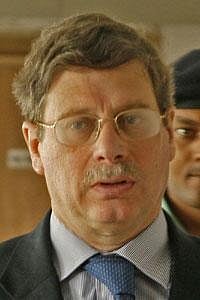
UK envoy denies diplomats' role in 1/11
British high commissioner in Dhaka Stephen Evans on Wednesday refuted allegations that the diplomatic community in Bangladesh had a hand in "calling the army out of barracks" during the Jan 11, 2007 changeover. Evans said the state of emergency was imposed at the time as an "internal dynamic" in Bangladesh
bdnews24.com News Service
bdnews24.com
Published :
15 Jul 2009, 08:01 AM
Updated :
12 Aug 2022, 01:27 PM
Dhaka, July 15 (bdnews24.com)—British high commissioner in Dhaka Stephen Evans on Wednesday refuted allegations that the diplomatic community in Bangladesh had a hand in "calling the army out of barracks" during the Jan 11, 2007 changeover.
He mounted a strong defence of his predecessor Anwar Choudhury who is seen by many political analysts and parties as one of the brains behind the changeover.
Evans said the state of emergency was imposed at the time as an "internal dynamic" in Bangladesh.
The high commissioner's statement came at a time when some leaders of the ruling and the opposition parties have been talking to sue the heroes of so-called 1//11 events that installed a two-year military-installed caretaker government.
He also praised the Fakhruddin ahmed-led interim government and the military for holding the Dec 29 general elections being true to pledges.
"I don't think that the UK representative in this country or any of his colleagues in the diplomatic community had a role in the events that led to the suspension of democracy and the appointment of the caretaker administration," he told a news conference at the Dhaka Reporters Unity office, marking his one year stay in Dhaka.
"The appointment of the caretaker administration came as a result of the internal dynamics within this country.
"It has not come about as a result of the external interference," said Evans who replaced Bangladesh-born British high commissioner Anwar Choudhury on June 23 last year.
The news media on Jan10, 2007, reported that Choudhury had parleys with then the army chief General Moeen U Ahmed at Dhaka Cantonment violating diplomatic norms.
The next day, army tanks came out of the barracks onto the streets and emergnency was clamped with the suspension of all fundamental rights and all political activities for about two years.
Former World Bank official and former central bank governor Fakhruddin Ahmed and his 10 member council of advisers, reportedly chosen by the army, took office on Jan 12.
Evans said there were "red lines" for the diplomats while working as envoy in a country.
"I do not cross them and I do not believe my predecessor ever crossed them; neither do I believe that any of his diplomatic colleagues crossed the red lines."
The envoy said he had very good working relations with Fakhruddin and Mooen.
"History will judge the caretaker period," he said.
The UK high commissioner said the interim administration provided the environment for free, fair and peaceful general elections ith the participation of all political parties.
"And then they stayed back. Once the people have spoken, once parliament has been elected, once a government is formed, the caretakers withdrew.
"But in the end they did what they pledged to do which was to return the country to democracy.
"History will judge whether caretaker period should have been six months, three months or two years," he said.
Evans said the UK wanted to see "stronger democratic institutions" in Bangladesh and called on the main opposition BNP to return to parliament to properly challenge the government's policy decisions.
"We want to see sustainable democracy, with strong institutions and protection of human rights, flourish in Bangladesh," said the UK envoy.
He said his country welcomed the government move for establishing the national human rights commission to guarantee human rights, one of vital components of democracy.
BNP dismisses
Main opposition BNP, which saw plans for the Jan 24 national elections under its nominated president and caretaker head Iajuddin Ahmed torpedoed by the events, has dismissed the envoy's contention.
"People know that they (diplomats) were involved in the declaration of the state of emergency and creating the so called 1/11 events," Khandker Delwar Hossain, the BNP secretary-general, told journalists in afternoon.
bdnews24.com/krc/rah/bd/1400h.