
Published : 21 Nov 2026, 01:23 AM
Updated : 21 Nov 2026, 01:23 AM


“When I returned from the office and did housework, I would leave YouTube or games on to keep her calm. I thought, at least my child is sitting safely in front of my eyes.
“This has been a habit since she was young. But now she is in eighth grade, and she doesn’t want to engage with anything except her mobile phone. She doesn’t want to mingle with anyone. I can’t send her to school. She just sits there with her phone all the time.”
A female bank official made the remarks after a counselling session for her only daughter at the Child Guidance Centre of the National Institute of Mental Health and Hospital.
Recently, her child has been undergoing treatment and counselling at the centre. She is suffering from a “behavioural disorder”.
To highlight the change in her daughter's behaviour, the mother said that one day she was “forced” to turn off the WiFi router because she was constantly on her phone.
"I was really scared when I saw her reaction. She started breaking things near her and was shouting as if I was her biggest enemy!"
Expressing her lack of awareness of the issue, the mother said: "I didn't realise that my calm 13-year-old daughter could become so aggressive due to screen addiction.
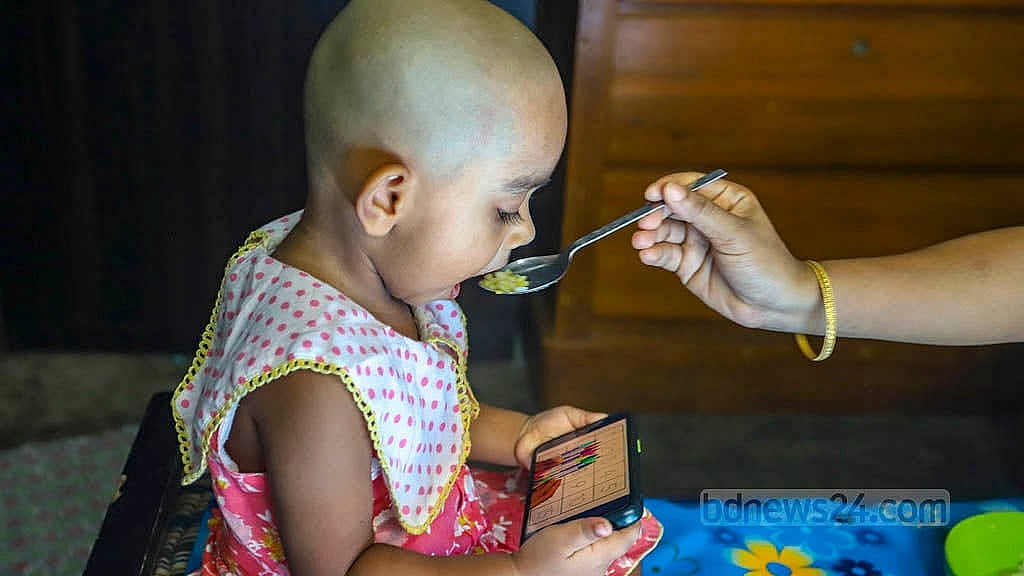
"She is undergoing treatment now. I now realise that I myself poisoned her to get some momentary peace."
The 13-year-old girl is among hundreds of children and adolescents across Bangladesh suffering from this silent addiction and behavioural crisis.
Experts say that digital devices are taking up a large part of people's lives, causing problems with focus and concentration. They argue that, beyond raising awareness, there is no alternative but to take multifaceted social and government initiatives on the matter.
Parents' Experiences
Another couple, both of whom are employed, have faced similar worries and feelings of helplessness as the bank officer. Their five-year-old son spends most of the day with his grandparents. The child wants to watch cartoons on his phone as soon as he wakes up in the morning. He also wants his phone with him while eating.
The child's mother said, "If we don’t give him the phone, his crying increases. We bought a television as an alternative, and only educational cartoons are shown on it.
"He plays at home all day, since there are no parks or playgrounds for children in our area. We have been forced to raise him like this since he was young."
While children can experience device addiction, it can be even more terrifying in the case of teenagers.
The father of one teenager said, "I don't understand all the algorithms on smartphones. My son is in eighth grade, has his own phone, and has been using it for two years.
"He goes to school, goes for tutoring, and bought a phone to keep in touch. He studied online, so I would see my son using his phone most of the time. He also plays games on his phone."
The father, a businessman by profession, said: “One day, my son suddenly brought his phone to me. I saw that it was showing all kinds of video ads, the kinds of videos even adults can find uncomfortable.
“I started questioning him about it, and he said that they came while he was playing games. He didn’t search for them; they just came up. I kept the phone with me and tested it. After some time, I gave it to him again and saw that the ad was showing. How come these flashy videos keep coming up on a 14-year-old’s phone? How can we understand this algorithm? We can’t keep guarding their screens all the time.”

However, not everyone has had such concerning experiences. A mother of two students aged 4 and 5 at Nalonda High School in Dhanmondi has managed to keep her children away from mobile phones by employing a series of strategies.
She said, “Once upon a time, my children used to bother me to watch something on the phone. I encouraged them to watch TV instead. If nothing else worked, we would take them outside for a walk.
“Now, even when a mobile phone is in front of them for quite some time, they don’t want to look at it. In other words, they have realised the harm that can come from looking at a mobile. That’s why they don’t want it themselves.”
A study by Jahangirnagar University has provided a statistical picture of how widespread the device-dependence of children in the country is.
The study, by three people under the supervision of Prof Mohammed Nazmul Huq of the Department of Statistics and Data Science, was published in the Journal of Affective Disorders.
Prof Nazmul said that in 2023, they conducted a study on mobile or media addiction among preschool children (aged 3-5) in Dhaka city. The study revealed that about 86 percent of preschool children in Dhaka are addicted to smartphones, of whom 29 percent have a severe smartphone addiction.
The study found that 92 percent of children use their parents’ smartphones, and 8 percent of children have their own smartphones.
That study was only Dhaka-centric, but he said that no national-level survey or research has been conducted on this subject in the country since then.

Regarding the results of the study, Nazmul said: “We found a tendency for aggressive behaviour, or behavioural disorders, and sleep problems among these children.
“The main reason that emerged was parental anxiety. The level of addiction was found to be high, particularly in families where both parents are working. In addition, the lack of playgrounds in the country was also identified as a major reason.”
Three years later, he believes that the problem has gotten worse.
He said, “This has now become a big problem not only for children, but also for young people in general. In the case of school-going children, it is occupying a large part of their lives. As a result, focus and concentration problems are being created, which were also found in our research.”
Save the Children Bangladesh Deputy Country Director ASM Rahmat Ullah Bhuiyan has spoken about the “serious risks” of online abuse in addition to the dire consequences of children’s device addiction.
Citing the organisation’s recent research on Bangladeshi adolescents, he said the use of the internet, smartphones and social media has increased rapidly among children and adolescents in Bangladesh. While this has opened up new doors for learning and communication, it has also created “extreme risks of online sexual abuse and exploitation”.
According to his research, about 53 percent of adolescents using the internet in the country have been victims of at least one type of online sexual abuse.
Of the victims, 53 percent have been victims of online grooming, 38 percent of cyber flashing (the sending of genital images), 35 percent of sexting-related abuse, 18 percent of sexual proposals or unwanted propositions, and 12 percent of sextortion or blackmail.

Rahmat said that gangs are taking advantage of the increased activity of children on social media to engage in crimes such as harassment, online blackmail, sextortion, grooming, catfishing, image-based abuse, and the dissemination of child sexual abuse material.
Crimes such as live-stream exploitation and tech-based trafficking networks are more recent developments.
How Device Addiction Grows
Many children and their parents have recently sought treatment for device addiction and behavioural addiction disorder in children and adolescents, starting from the time they are toddlers, according to Prof Saifun Nahar, director of the National Institute of Mental Health and Hospital.
The psychiatrist said, “Mobile or smartphone addiction, social media addiction, internet addiction—these can be used synonymously.
“Online gambling addiction is also seen in a large number of adolescents these days; drug addiction is also found in this group. Any addiction affects the same pathway in the brain.”
She spoke about a natural tendency through which device addiction begins in children.
“Small children are often fed meals as they listen to stories on YouTube. A mother sees that when a story is told, the child eats quickly. But they don't think about the consequences. In this way, an association is created. If you don't [allow them to listen next time], the child will not eat. It becomes difficult to get out of this loop.”

The director of the National Institute of Mental Health believes that few opportunities to overcome loneliness are another reason for the increase in addiction.
Saifun Nahar said, “Current single families usually have one or two children, and both parents work. As a result, children have a lack of playmates or people to talk to. There are also fewer opportunities and less time for children to go to playgrounds or spend time outdoors.
“To overcome this emptiness or loneliness, children turn to screens as a source of pleasure. Then they get used to it.”
Referring to the COVID-19 pandemic, she said: “Due to the long-term closure of schools, children had to get free access to devices for online classes. But even after returning to normal life, children could not overcome these habits.”
Prof Saifun Nahar said, “They have had a form of exposure, and they have been tested. Various studies have shown that now children use screens for six to eight hours.”
Income and Impact on the Brain
Prof Saifun Nahar believes that the development of income opportunities on social media is also a reason for increasing device dependence.
He said, “A source of income from TikTok and Facebook is another reason for the increased attraction to devices. Although many parents initially forbid it, when they see that their child is earning income from their ID, they also agree. Many parents do not understand what the long-term consequences of this can be; as soon as they get likes, they think that their child has become a big star.
“The content of online gaming, TikTok or social media is created in such a way that it affects the dopamine and control systems of the brain. Hours of device use lead to negative changes in the prefrontal cortex of the brain, which reduces the child's self-control and makes them completely dependent on the device mentally."

Highlighting the physical and mental effects of long-term device use, she said: "Headaches, eye problems, and attention span problems occur. Many children become impulsive and lose the ability to control themselves.
"Various studies have shown that significant negative changes occur in the prefrontal cortex of the brain, especially in children and adolescents. However, parents do not understand this change."
The doctor said that most parents cannot identify the problem in the beginning.
Instead, when things get to an “extreme stage” - when children start vandalising the house, or even attempt suicide - then the parents seek help.
Some parents look for doctors when a child is easily angered by their words, becomes rude, or even violent against their parents.
"If they are even slightly aware of the issue, parents can identify the problem. But most of them come at a late stage."
Asked how parents should act, Prof Saifun Nahar emphasised a “preventive role”, saying: "Parents need to know when their child could develop this issue, what the symptoms are and what the remedy is. The child should be given quality time. It’s not just about sitting in the same room, but connecting without putting pressure on them, and through narratives.
"When children think of their parents as friends, they automatically share everything. But if a comfortable relationship does not develop, children cannot share things out of fear. A good, comfortable relationship is the best solution to overcome this problem. The child should be given a lot of time. They should be involved in sports and various activities."
Highlighting the importance of awareness training and workshops, Saifun Nahar said that the National Institute of Mental Health has a child psychiatry department, where a child outpatient department is run every day, and a child guidance clinic is run once a week.
“Counselling is done here, an explanation of the disease is provided, and management guidelines are given. Seminars and workshops are very important. If these can be increased, people will be more aware.”
How the Algorithm Works
Does the online algorithm recommend content according to age?
Asked this question, Saiful Hoque, an associate professor of mass communication and journalism at Dhaka University who works on social media and digital convergence, said that the algorithm does not enforce the age limit policy for content. He says this is because “age limits” can easily be avoided and there is “big business” involved in this moderation, so a variety of advertisements are sent to the phones of people of all ages.
Expressing doubt about how effective the age limit (13+) policy of Facebook, TikTok and Instagram is in reality, he said: "The maturity levels of 13-year-olds in Bangladesh and 13-year-olds in Europe and America are not the same, because schooling is different. Therefore, a specific age limit should not be applicable to all regions globally.
"Personally, I think that the limit should be at least 15-16, considering net literacy. However, it does not matter whether the age limit is 13 or 15. Because we are getting children used to the net from the age of 6-7.”
Moreover, the age limit can easily be circumvented when opening a social media account, Saiful said. “Accounts are not opened with a national identity card or birth certificate, so there is no verification process.
“With a human’s touch, 2016 can easily be made into 2000 or 2002; it doesn’t cost anything.”
Saiful said that children getting uncomfortable advertisements on their phones is nothing new.
Asked why children get romantic or adult content on their phones, he said: “Even if the parents have their phones, the child can access things when they use it. Now, IDs are required to get access on all platforms.
“Children don’t log in with their own IDs; they log in with their parents’ IDs. As a result, the algorithm shows content based on the normal content of that ID.”
Explaining the “business” behind content moderation, he said: "It's completely a business, worth billions to trillions of dollars. The more exposure or engagement, the more advertising revenue.
"So, the platform sets the algorithm in such a way that the viewer stays on the screen for more time. There is no logic other than the logic of money here."
Asked what a healthy device usage policy could be, Saiful said: "There is no such thing as healthy device use. It is algorithm-based, so it is difficult to determine which is healthy and which is unhealthy."
In response to a question on device addiction, Saiful said: "A massive, rigorous and all-round national action plan is needed - where parents, school-college teachers, social organisations and the government will all be involved.
"A lot of sensitisation is necessary. The government cannot enter a house and take away a child's phone. The parent is the agent inside the house."
He suggested sensitisation workshops in schools and colleges and setting up a digital counselling cell in every school as effective steps. He also suggested increasing co-curricular activities.
Meanwhile, Asoke Kumar Saha, a professor in the Department of Psychology at Jagannath University, sees device dependence as a problem in the “social fabric” rather than a tech problem.
He said that there is no country in the world where people do not have phones, but there is a subtle issue of parenting there. Accessibility of devices has become easier due to the lack of proper parenting and net literacy.
Highlighting the structural changes in society, he said: "Previously, even if the father was busy, the mother would look after the children. Now both parents are busy. Should the child be left in the hands of household aides or in the hands of a device?"
"Parents also have no options. They are busy because of the demands of life. So, it is not so much a problem of technology, but a problem of social structure."
Save the Children Bangladesh Deputy Country Director Rahmat said that there is a “lack of awareness” on children’s device use and online-centric risks.
He said, “Unfortunately, a large number of our children lack the necessary awareness and digital skills regarding safe online behaviour. On the other hand, parents, teachers and service providers are also struggling to adapt to this rapid change in technology.”
“Under the circumstances, increasing online safety awareness, creating digital tolerance, strengthening easy reporting systems and taking multi-dimensional social and government initiatives to protect children’s digital safety is what we need now.”