SPECIAL: People from Monga-hit north in search of livelihood
Hordes of poor people from the 'Monga' prone northern region are leaving for other districts everyday in search of livelihood, though the government claims that there is no Monga (hunger) anywhere in the country. Golam Mortuza Antu writes
bdnews24.com News Service
bdnews24.com
Published :
01 Nov 2009, 04:45 AM
Updated :
12 Aug 2022, 02:00 PM
Dhaka, Nov 1 (bdnews24.com) – Hordes of poor people from the 'Monga' prone northern region are leaving for other districts everyday in search of livelihood, though the government claims that there is no Monga (hunger) anywhere in the country.
Fourteen year-old Md Rafiqul, of Nageswari in Kurigram, was heading for Comilla to find a job when bdnews24.com correspondent Golam Mortuza Antu came across him in the capital's Gabtali Bus Terminal early on Friday while he got down there to change bus for Comilla.
"Ask the government to go and see in Nageswari where people are starving. I borrowed some money and I am going to find a work in Comilla," said a disgruntled Rafiqul.
Thousands of people of the northern region, particularly the greater Rangpur area, are coming to Dhaka or going elsewhere in search of livelihood.
Monga is a yearly cyclical phenomenon of hunger and poverty in Bangladesh's northern region. It is also called 'Mora Kartik' which means the month of death and disaster. Monga usually appears in September continues until November.
Food minister Abdur Razzak told parliament on Thursday: "There is no indication of Monga even at the end of October.
We have achieved sufficiency in food under the leadership of our prime minister. There will be no Monga in the country this year," he said.
Rafiqul is the third of his five siblings. He was a cowboy in the village, but he lost his job since the owner sold all the cows ahead of the Eid-ul-Azha.
As there is no job in the area, his father, who has no work either, sent him to Comilla borrowing Tk 500.
"I have to repay Tk 650 on return home after the Eid," Rafiqul said.
Out of a group of nine people coming from Kurigram, Rafiqul is the youngest.
Md Sirajul, a middle-aged member of the group, came to Dhaka to find a job. He became penniless after marrying off her two daughters.
"I want to pass the month of Kartik (the seventh month of the Bengali year) away from home, trying to find a means of livelihood elsewhere," he said.
The spell of Monga usually takes place in Ashwin and Kartik – the sixth and seventh months of Bengali year. The Monga usually ends in Agrahayan, the eighth month after Kartik which means mid-November, as paddy ripens in this month.
People have to wait till the end of November to take the harvest to home.
Wahidul Haque and his sister Anwara came to Dhaka from Dimla in Nilphamari. They will take shelter at a relative's house at Kamrangirchar and search for employment.
Wahidul comes to Dhaka during this period for the last three years and works as rickshaw puller.
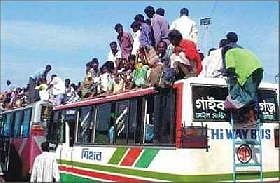
Mukul, a worker of Molla Paribahan of Dhaka-Kurigram route, said hundreds of people take their bus to come to Dhaka each year during Ashwin and Kartik. There is no seat in the bus this time.
There are 60-65 Dhaka-bound buses from northern districts every day, each having 60 seats on an average.
"We have to take additional 30/35 people who manage to travel standing inside the bus and 60/65 travelling on the rooftop," Mukul said.
According to his estimate, some 80/85 passengers (chair coach and normal) come to Dhaka, which means 5000 to 6,000 people arrive in Dhaka everyday.
Half of these people come from Lalmonirhat to Dhaka, said Dhanpati Roy, a bus driver of Lalmoni Express that runs on the Dhaka-Lalmonirhat route.
A resident of Hatibandha's Gaochulka village, Dhanpati said the youths of his area always request him to take them to Dhaka, but they cannot always pay the fare. "We have to bring one or two of them without ticket," he said.
The prices of essentials in the northern villages are very high during this period. Dhanpati said he last bought rice at Tk 20-24 per kg, potato at Tk 35 and lentil at Tk 100.
"People cannot even manage to buy their staples—rice and lentil. The project of 'food for work' is ongoing. But local political leaders distribute the work," he complained.
"The extreme poor do not get cards. That's why they have to come to Dhaka in search of work," said Dhanpati.
These poor, unskilled people manage their living during 'Monga' period by pulling rickshaws and working as day labourers in Dhaka, Gazipur, Narayanganj, Comilla and Chittagong.
Bangladesh Institute of Development Studies research director Dr M Asaduzzaman told bdnews24.com: "It is not possible to remove Monga overnight.
"A new breed of paddy is now being cultivated in the northern region which will be harvested one month ahead and it is a hope for us. It should help to deal with Monga situation.
"Since the paddy is being harvested one month ahead some people are getting work. But all people are not getting work. Some are bound to come to Dhaka," Asaduzzaman said.
In his reaction to food minister's statement, he said: "The minister might have said right from his position. He has nothing to do if he is provided wrong information.
"Wrong information is provided from the field level. Since it is a political government they have a party. The government should use its party at the field level. It needs to collect information from its party workers to understand the ground reality."
bdnews24.com/gma/su/ec/1030 hrs