The government plans to implement there a cluster of projects, including power plants and liquefied natural gas (LNG) terminal to boost the Bangladesh’s economy.
It has also planned to build a deep seaport at Sonadia Island in the Bay of Bengal. Besides, it proposes to turn the island into a township and set up industries there to create ‘huge’ employments.
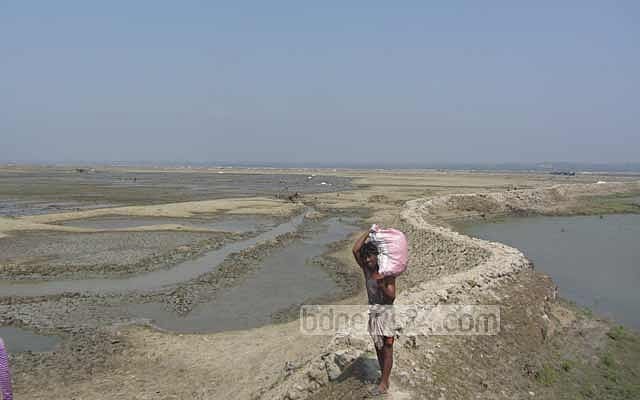
Currently, nearly 400,000 people reside at Maheshkhali and its adjacent islands. Many of them are labourers and work at nearby salt farms. Some also work in prawn farms.
A section of islanders, including workers and farm owners, are protesting the government move, saying it will leave them jobless and their businesses will be lost.
The ruling Awami League is determined to turn Bangladesh into a developed country by 2041 by utilising its natural and human resources.
To achieve the goal, the government has targeted to increase the electricity generation capacity by three folds to 34,000 megawatts by 2030 under a master plan. Almost half (17,000 megawatts) of this will be generated from coal-based power plants.
Currently, gas-driven plants are generating about 75 percent of Bangladesh’s power, while less than three percent comes from coal-based plants.
The Ministry of Power, Energy and Mineral Resources is eyeing to build several coal-fired power plants to generate around 10,000 megawatts (MW) of electricity at Maheshkhali after dividing it into several blocks.
According to the country's Power System Master Plan 2010, the demand for electricity would be 19,000 megawatts by the year 2021 and 34,000 megawatts by 2030.
Power Secretary Monwar Islam told bdnews24.com: “As per our plan, several power plants with a total capacity of 10,000-12,000 megawatts of electricity will be set up in Maheshkhali by 2030.”
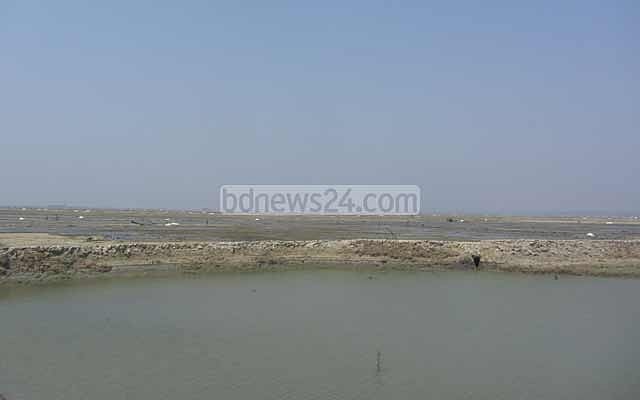
To implement the plan, the government has started acquisition of some 6,500 acres of land from six moujas of Maheshkhali along the coastal belt of the Bay of Bengal. Salt is produced on these lands in the summer season and prawns are cultivated there in the rainy season.
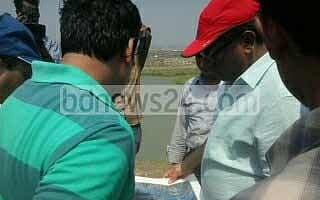
On Saturday, State Minister for the Power, Energy and Mineral Resources Nasrul Hamid Bipu, Monwar Islam, local MP, the Power Development Board (PDB) chairman, a delegation of journalists and other high officials visited the island.
The junior minister also launched a mass contact campaign with the locals.
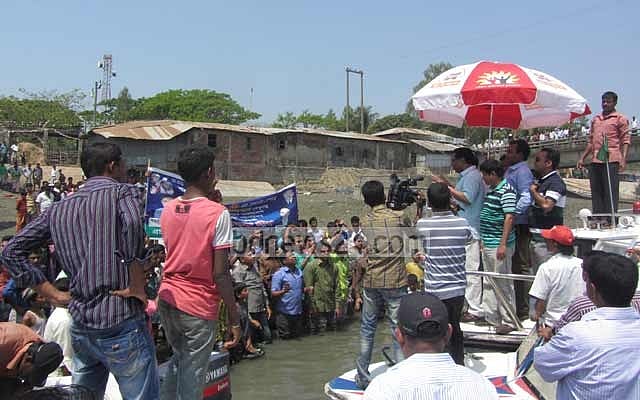
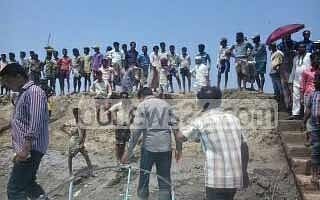
It takes about an hour to reach Matarbari Union from Cox’s Bazar town by speedboat through the Bokkhali River. Hundreds of people were waiting at the trawler terminal at Matarbari Bazar, adjacent to Kutubdia channel.
After reaching the terminal, the state minister told the crowds, “We’ve a master plan for Maheshkhali’s development. Power plants and LNG terminal will be set up here. A deep seaport will also be built here. Besides, a township will be developed here.”
“Factories, schools and colleges will be set up; and there will be foreign investment. A huge number of jobs will be created here.”
“Matarbari will be the best model (of development) for rest of Bangladesh. We don’t want to victimise anyone. So, we’ve come to see you,” Nasrul Hamid Bipu said.
After a brief roadside rally, the minister started for Tiakhati – where the government plans to set up coal-fired power plants with a total capacity of 10,000-12,000 megawatts.
After an hour, Bipu reached Tiakhati – a coastal belt area – where salt was being cultivated on hundreds of bighas of land.
The first coal-fired power plant of Maheshkhali is planned to be set up here. The government has already started acquisition of 1,500 acres of land from two moujas in the area.
Some salt farmers expressed their anxiety to the state minister when he arrived at the vast salt field.
Delwar Hossain has been engaged in salt production for the last 25 years. When the salt production comes to a halt in the rainy season, he then switches over to shrimp cultivation to earn livelihood.
He fears that the government move to acquire the 6,500 acres of land in Maheshkhali will jeopardise his business and will ultimately render him jobless.
Like him, many other salt farmers have a similar apprehension, even though the government has assured them that they will be compensated if their businesses and jobs are affected.
Hossain told bdnews24.com: “We don’t want the government to acquire the land here. We have never had any other occupation other than salt production and shrimp cultivation.”
Bangladesh Salt Farmers’ Welfare Association President Mostafa Kamal Chowdhury echoed his concerns.
“One person is needed per acre of land for production of salt . Shrimp cultivation also needs the same kind of manpower. Workers are also needed for transportation. If these lands are acquired, these people will become jobless.”
Chowdhury said salt is cultivated on some 70,000 acres of land across the country. Of this, Maheshkhali alone accounts for 25,000 acres.
Cox’s Bazar-based Bangladesh Lobon Chashi Sangram Samity President Anwar Pasha Chowdhury said, “If the government acquires our land, we’ll become landless. Then what will we do?”
Regarding the issue, Nasrul Hamid Bipu told bdnews24.com: “We’ll not only pay the owners for the acquired lands, but also compensate them for the loss of their businesses, if any.”
“Moreover, salt production is a back-breaking task. There will be huge employment opportunities once the LNG terminal and power plants start operating here. We’re also considering how to engage unskilled workers in these plants.”
He said the locals should realise that Maheshkhali will become a potential commercial hub in the future, and they would mostly be benefited from it.
He said that it would cost about $4 billion to implement the coal-fired 1,200 megawatt power plant and that the process to bring in foreign investment for the projects had already begun.
The state minister visited different areas of Kalarmarchharha, Hoanok, Amabashyakhali and Panirchhara moujas – which are salt field areas. The government is supposed to acquire some 5,000 acres of land from the four moujas.
Asked why the government had earmarked Maheshkhali to set up the largest site for coal-fired power generation, Secretary Monwar Islam said, “We’ll have to depend on imported coal for the power production. It will be easier to carry coal to the site as it is a coastline area. There’s also vast amounts of fallow land here.”