DHAKA-DELHI TIESRao sounds positive on ticklish issues
The Indian foreign secretary refuses to discuss the Teesta river water-sharing deal or the share of water Bangladesh may get. Full Report
bdnews24.com News Service
bdnews24.com
Published :
07 Jun 2011, 03:57 PM
Updated :
10 Aug 2022, 04:55 PM
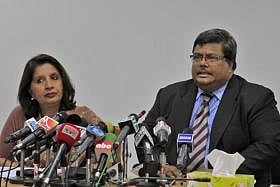
Dhaka, June 7 (bdnews24.com) – An optimistic Indian foreign secretary has touched upon several issues of mutual concern, including some contentious ones.
However, what Nirupama Rao won't discuss now is the Teesta river water sharing issue and the related details.
Despite being pestered by the media at a joint press briefing at the foreign ministry on Tuesday, she refused to disclose the percentage of share Bangladesh would get in the proposed river water deal.
"This is a sensitive issue. I will not discuss the framework or percentage of water share Bangladesh will receive from Teesta river," she said.
Bangladesh foreign secretary Moahmed Mijarul Quayes also attended the press briefing after holding a day-long joint foreign secretary-level consultation meeting.
"Water resources secretaries of both countries held a meeting in Delhi over the sharing of Teesta water, and after a consensus is reached at political level, the issue can be discussed publicly," she said.
"We have to go through a certain process to reach the final solution," she said, adding, "Obviously we are working for an agreement."
Quayes in his introductory remark said there was progress in Teesta water sharing agreement.
REGIONAL CONNECTIVITY
Rao said Delhi had no objection in allowing Nepal and Bhutan to use Indian territory to have trade in Bangladesh.
"India allows Nepal and Bhutanese trucks to enter 200 yards of Bangladesh territory at Banglabandha border," she said.
Quayes said new protocols need to be signed to have comprehensive regional connectivity in place.
"Connectivity is not a bilateral issue, rather a regional issue," he said adding, "We are working on developing mechanism to connect Bangladesh, India, Nepal and Bhutan."
Citing example, he said Bangladesh and India had railway protocol, but to include Nepal, an addendum would be needed in the protocol.
About the transit fees, he said the assessment was being done and after completion of the process, details could be discussed.
INDIAN LINE OF CREDIT
The Indian foreign secretary said Delhi has finalised some projects and the rest would be finalised within couple of months.
"There are some positive developments in procuring buses, railway locomotives, wagons and engines under the Indian line of credit and the rest of the projects will be finalised within a couple of months," she said.
When asked about the conditionality of procuring 85 percent man and material from India under the line of credit, she said, "The issue can be and will be discussed to resolve any dispute."
Quayes said India had already given a signal to move forward for some of the projects and the rest would follow the suit.
MARITIME BOUNDARY DISPUTE
There would be no mineral resources exploration in the disputed blocks in the Bay of Bengal until the matter was resolved, said foreign secretary Quayes.
"There are some overlaps in the disputed blocks and it is needed to reach a generous agreement to settle the issue," he said.
"Bangladesh has opted for arbitration to settle the maritime dispute with India and also negotiate with them to solve the matter amicably," he said.
"When we reach a solution, then Bangladesh and India can explore natural resources in their respective territories," he added.
MANMHOAN'S VISIT
The Indian foreign secretary refused to specify the date of visit of Indian prime minister Manmohan Singh to Bangladesh.
"It will be highly unprofessional if I tell the date. It will be disclosed through proper diplomatic channel," she said.
When asked about the outcome of the visit, she said it would be difficult to say about the result.
"Some historic agreements will be signed during the visit," she said without any elaboration of the deals.
"Both governments are working together to make it a good visit," she added.
Quayes said foreign offices of both countries were in touch and had regular follow-up meetings.
BORDER KILLINGS
Rao said Border Security Force (BSF) and Border Guard of Bangladesh (BGB) would together stop border killings.
"There is a plan to use non-lethal weapons in the border area," she said adding, "We are against any violence and curfew could be imposed at the borders."
LAND BOUNDARY DISPUTE
Officials of both countries are working hard to settle land boundary disputes, she informed.
"Joint Boundary Working Group had had its fourth meeting in Delhi in November and the outcome of the meeting was welcomed," she said.
When asked if the decision on the dispute would be announced during Manmohan's visit, she said, "I am eternally optimistic."
SECURITY COOPERATION
Both countries had agreed on cooperating in security issues to eliminate threats to peace and prosperity of the people, the visiting official said.
"The challenges are similar in nature for both countries," she observed.
Quayes said both countries agreed not to allow domestic and foreign elements to use their territories to disturb peace in the region.
CONSULTATION MEETINGS
Quayes said the consultation meeting was not a formal one but very crucial for strengthening relationship between the countries.
"We have reaffirmed our commitment for further expansion of our bilateral relationship and pursue the issues primarily detailed in joint communiqué declared during the visit of prime minister Sheikh Hasina to New Delhi in January last year," he said.
Rao said sky was the limit for cooperation and new areas would be explored to cement the ties between the two countries.
bdnews24.com/ssz/nir/2345h