


Published : 04 Dec 2012, 07:11 PM
Updated : 09 Aug 2022, 04:35 PM


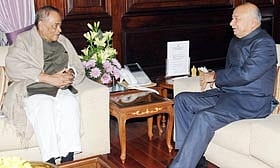
Home Minister MK Alamgir and his Indian counterpart Sushil Shinde on Tuesday agreed to sign the extradition treaty in January.
"It was agreed that Revised Travel Agreement as well as extradition treaty will be finalised and signed in January 2013 during my proposed visit to Dhaka," Shinde said after a meeting in New Delhi.
Alamgir told Shinde that Dhaka would expect that New Delhi would ratify the 1974 Land Boundary Agreement and its September 2011 protocol at an early date. Shinde, however, said that the process would take some more time as it would require an amendment to the Constitution of India.
India and Bangladesh have since long been holding negotiations on the extradition treaty, which would complete the legal framework for bilateral security cooperation. The two countries had earlier signed the Agreements on Mutual Legal Assistance on Criminal Matters, Transfer of Sentenced Persons and Combating International Terrorism, Organized Crime and Illicit Drug Trafficking.
The Revised Travel Agreement is expected to liberalise the bilateral visa regime.
Both countries also agreed to allow development works within 150 yards of the zero line on the Bangladesh-India border.
This was the first meeting between Alamgir and Shinde after they took over as Home Ministers of Bangladesh and India respectively.
Bangladesh raised the issue of frequent firing by India's Border Security Force along the border and the deaths caused by such actions. The two ministers agreed that the border guarding forces would not "resort to firing along the border unless fired upon or attacked by terrorists or armed criminals".
"Incidents of deaths and loss of life on the border are extremely unfortunate and regrettable. We have put in place mechanisms which have greatly reduced the scope for such incidents and have strengthened mutual trust and goodwill among the border guarding forces and people living in the border areas. The number of such incidents has steadily come down in the last few years. However, even one loss of life is too many," read the joint statement issued after the meeting.
Alamgir and Shinde agreed that Dhaka and New Delhi should work jointly to avoid killing of innocent persons due to firing by the BGB and BSF.
They also stressed on cooperation between the two border guarding forces to eliminate illegal trans-border activities.
Alamgir and Shinde noted that the action was being taken for repatriation of sentenced prisoners to either country under the agreement for transfer of sentenced prisoners which was signed during Prime Minister Sheikh Hasina's visit to Delhi in January 2010.
On the issue of handover of ULFA leader Anup Chetia, who is currently in a Bangladesh prison, Alamgir told journalists in the joint news conference that Dhaka stood by its commitment to consider New Delhi's request to send him back to India. But at present his plea for asylum in Bangladesh is pending with the Supreme Court.
Responding to Alamgir's request for tracking, apprehending and handing over of the fugitive killers of nation's founding father Bangabandhu Sheikh Mujibur Rahman, Shinde reassured him that New Delhi would extend all possible cooperation to nab the assassins if they were in India.












