'Cancel leases to reclaim Buriganga riverbanks'
A key member of the government's taskforce on the river Buriganga has asked authorities to cancel land lease contracts to reclaim riverbanks from encroachers.
bdnews24.com News Service
bdnews24.com
Published :
26 Oct 2008, 03:19 PM
Updated :
24 Apr 2022, 08:52 PM
Dhaka, Oct 26 (bdnews24.com) – A key member of the government's taskforce on the river Buriganga has asked authorities to cancel land lease contracts to reclaim riverbanks from encroachers.
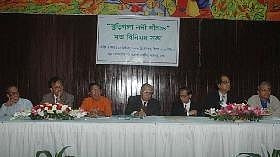
"No more lease of land along the Buriganga, Dhaka's lifeline. Cancel all lease contracts to save the river," Hashem Sufi, a member of the government's Taskforce on Buriganga, told a meeting on "Sustainability of Buriganga" on Sunday.
The taskforce, formed by the interim government, organised the public consultation meeting at the Bangladesh Agricultural Research Council auditorium.
"The Buriganga's banks were freed from trespass in the past. But illegal occupiers intruded the same again," taskforce chairman Inam Ahmed Chowdhury told the meeting.
He said they had prepared a report on Buriganga in line with reports made by three commissions on the Buriganga.
"Some 2,600 illegal structures have so far been demolished along its banks," said Chowdhury.
He said not only the Buriganga all the six rivers passing through in the capital would be freed from illegal occupation.
"There are no adequate legal instruments to eradicate the illegal structures along the river. There should be a law so that the taskforce could clean up both sides of the river," Inamul Haque, an engineer of the Water Development Board (WDB) told the meeting.
Stressing immediate action, another WDB engineer Saidur Rahman said, "Solid wastes are being dumped into the Buriganga. The river is already dead. It would be almost impossible to live along the river during the next 10 to 15 years."
"The branches of the Buriganga from Babupura to Aminbazar have been encroached on. The pollutants from the tanneries have made waters so poisonous that hens die if those fall in it," Shukur Salek of Amra Dhakabashi, an organisation of Old Dhakaites, said at the meeting.
The tin-shed homesteads in the vicinity of the river are decaying because of the poisonous air, he said.
"There is no institution to protect the violators of the rivers," said Salek.
He said the previous governments formed many commissions to save the river, but their recommendations remained unimplemented.
The recommendations of the meeting would be sent to the government for necessary actions.
The interim government in June formed the 11-member taskforce.
"Solution lies in participation of people, who have much bigger stake in the river, and not just in expensive engineering projects," said Salek
"These are fantastic recommendations," he said, "but who's going to implement them."
"Get the local people involved.
"We have been campaigning since 1997... we brought together people, untainted and with good track-record. We peacefully demonstrated under the scorching sun, trying to bring the issue to everyone's attention.
"But nothing has worked," he said with a heavy tone.
Abdul Haque, an FBCCI director and reconditioned car vendor, stressed public-private partnership in developing the river banks and spoke of huge investment opportunities.
"There must not be any establishment on the embankments," Haque said.
An estimated 16 million people live along the river's coast.
Experts have identified nine industrial areas in and around Dhaka as the prime sources of river pollution. Most industrial units have no effluent treatment plants.
More than 60,000 cubic metres of toxic waste (textile dying, printing, washing and pharmaceuticals) enter the Dhaka canals and river system every day. Nearly four million people directly suffer the consequence of its poor water quality.
Industrial waste accounts for 60 percent of the total river pollution followed by municipal waste and improper handling of other pollutants, according to a taskforce member.
bdnews24.com/mrf/krc/bd/2143hours