Annular solar eclipse Friday
Bangladesh will witness an annular solar eclipse lasting for eight minutes and 29.6 seconds at the peak on Friday.
bdnews24.com News Service
bdnews24.com
Published :
14 Jan 2010, 03:26 PM
Updated :
10 Aug 2022, 08:41 PM
Cox's Bazaar, Jan 14 (bdnews24.com)-- Bangladesh will witness an annular solar eclipse lasting for eight minutes and 29.6 seconds at the peak on Friday.
It is the last eclipse to be visible from Bangladesh until 2014 and will be visible in Bangladesh only from Saint Martin's Island and Cox's Bazaar.
The Sun will cast Moon's silhouette in a root which would be some 300 km in width, whereas the path travels a half of the Earth's circumference. Literally, this means that the moon's shadow will travel more than 20,000 km across the earth, giving the earthlings a fine chance to witness a solar eclipse.
Starting at around 12:45pm, the eclipse will end at about 4.01pm.
Shahjahan Mridha, president of Onusanditshu Chakra Bigyan Sangathan, at a media briefing on Thursday said they had set up over 20 camps for people across the country to watch the eclipse.
The main observation camp will be set up in Cox's Bazar sea beach's Shugandha point while there will be one for the scientists at Chhenra Dwip in Saint Martin's Island, Mridha said.
In Dhaka, two camps will be set up at the premises of Bangabandhu Novo theatre and at the gymnasium ground of Dhaka University, Mridha said.
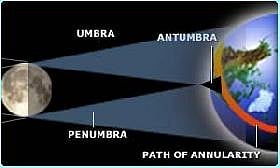
An annular solar eclipse occurs when the Sun and Moon are exactly in line, but the distances are such that the apparent size of the Moon is smaller and does not blanket the whole of the Sun as viewed from Earth. The Sun appears as a thin bright ring, or annulus, surrounding the silhouette of the Moon.
The eclipse starts on Jan 15 at Uganda, passes through Nairobi, enters the Indian Ocean where the longest eclipse will be seen mid-ocean. After that it enters Maldives, where the second longest eclipse occurs with 10.8 minutes of viewing. It will then enter India at Thiruvananthapuram (Trivandrum), Kerala and exit at Rameswaram, Tamil Nadu, the only place under the eclipse on the Indian mainland.
After Rameswaram, it will enter Sri Lanka at Delft Island, exits at Jaffna in Sri Lanka, cross Bay of Bengal and end on the Myanmar - China border.
According to the NASA Eclipse website, the annual eclipse of the Sun will be visible from within a 300-km-wide track that traverses half of Earth. The path of the Moon's antumbral shadow begins in Africa and passes through Chad, Central African Republic, Democratic Republic of the Congo, Uganda, Kenya, and Somalia.
After leaving Africa, the path crosses the Indian Ocean where the maximum duration of annularity reaches 11 min 08 s." It will be visible as a partial eclipse in much of Africa, Eastern Europe, Middle East and Asia. It will be seen as annular within a narrow stretch of 300 km width across Central Africa, Maldives, South Kerala, South Tamil Nadu, North Sri Lanka, Burma and China.
The next annular solar eclipse will be visible in Bangladesh on Feb 17, 2014.
The Sun can be viewed safely with the naked eye only during the few brief seconds or minutes of a total solar eclipse. Partial eclipses, annular eclipses, and the partial phases of total eclipses are never safe to watch without taking special precautions. Even when 99 percent of the Sun's surface is obscured during the partial phases of a total eclipse, the remaining photospheric crescent is intensely bright and cannot be viewed safely without eye protection.
The Sun can be viewed directly only when using filters specifically designed for this purpose. Such filters usually have a thin layer of aluminum, chromium or silver deposited on their surfaces that attenuates ultraviolet, visible, and infrared energy. One of the most widely available filters for safe solar viewing is a number 14 welder's goggles, available through welding supply outlets.
bdnews24.com/corr/ra/msb/adk/bd/2023h.