Published : 24 Jun 2023, 02:49 AM
Updated : 24 Jun 2023, 02:49 AM


The quantity of spawn released by mother fish in the Halda river of Chattogram this year has beaten expectations, but mismanagement in the hatcheries has left fry collectors worried about their business in the peak season.
Insufficient wells and negligence in maintaining cleanliness have led to a significant loss of eggs.
Halda, which flows through Hathazari and Raozan upazilas of Chattogram, is one of the world's major natural freshwater fish spawning spots. It is also the only source of carp fiss fries like Ruhi, Katol, Mrigel and Kalbaush in Bangladesh.
The quantity of spawn released by the mother fish this year could be double the amount collected in each of the past two years, said Md Manzoorul Kibria, an assistant professor of zoology at Chattogram University who specialises in Halda river.
Fingerling producers have also acknowledged that some fish fries have been damaged due to an excessive number of eggs being deposited in the wells.
The Department of Fisheries said it was working to double the number of wells in the four government hatcheries before the next season.
May and June are the months for the mother fish to release eggs, depending on water temperature, strength of current, rain and thunder.
The indigenous fish species started releasing eggs at various points of the river after Sunday midnight during the last high tide of the current season as the new moon phase began.
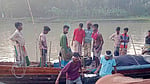
After waiting in their boats in the river all day while the sample eggs were released on Monday morning, hundreds of spawn collectors riding over 285 boats started collecting eggs at midnight.
They reported obtaining three to five buckets of eggs per boat from different bends of the Halda River, while some were able to collect 8-10 buckets.
A shortage of wells prevented them from collecting more eggs in the morning.
QUANTITY OF WELLS AND SPAWNS
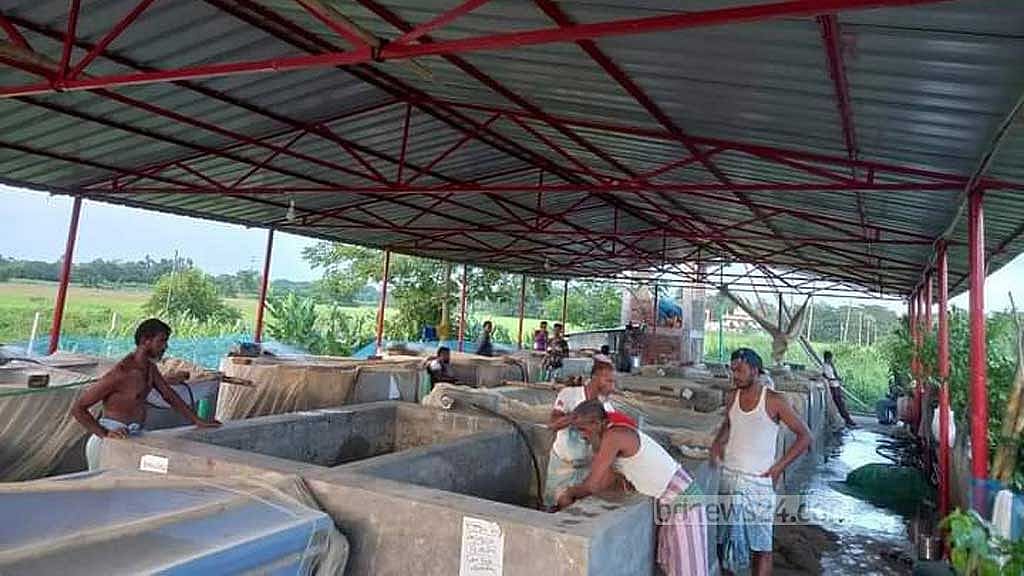
There are four government hatcheries located in the Madunaghat, Machuaghona, and Shahmadari areas of Hathazari Upazila, as well as in the Mubarak Khil area of Raozan Upazila, along the bank of the Halda River.
Integrated Development Foundation (IDF), a non-governmental organisation focused on the Halda River, operates its hatchery in West Gohira of Raozan Upazila.
Out of the four government hatcheries, three in Hathazari have a total of 117 wells, while the Mubarak Khil hatchery has 50 wells. On average, each of these 167 wells can accommodate five buckets, resulting in the release of approximately 10 kg of eggs.
A combined total of 7,120 kg of eggs have been stored in the four hatcheries.
According to the egg collectors, not all wells in the hatcheries are suitable for storing eggs.
If all the wells were in good condition, the total capacity of the four government hatcheries would be 8,350 kg of eggs, they said.
"Our hatchery keeps 1,300 kg of eggs in 15 wells," IDF hatchery manager Abdullah An Noor told bdnews24.com.
According to him, another 1,190 kg of eggs were collected in 10 mini hatcheries on both sides of the Halda and 3,430 kg in 71 mud wells of 30 entrepreneurs.
The combined collection of eggs from government hatcheries, private hatcheries, and private wells amounts to a total of 13,040 kg.
Shaukat Ali, an egg collector from the Machuaghona area, said they collected nine buckets of eggs using their three boats. However, they decided not to gather any more eggs because the wells allotted to them in the hatchery were already full and could not accommodate additional eggs.
“People chose to collect the eggs they found instead of leaving them, but the scarcity of wells led to overcrowding at the Machuaghona Hatchery. This resulted in the unfortunate loss of many eggs. More wells would have prevented this problem.”
Kamal Saudagar, an egg collector from the Garduara area, said, "Using our five boats, we obtained 25 buckets filled with eggs.”
This year, there is a greater quantity of eggs compared to the previous two years, he added.
“I placed my eggs in the IDF hatchery with hopes of obtaining a yield of 5-6 kg of fish fries.”
The management at this hatchery is efficient, well-regarded and commendable, he said.
According to the Department of Fisheries, Hathazari had 73 private water wells, and Raozan had 68 mud wells in 2020.
However, the IDF survey conducted this year found only 12 earthen wells in Hathazari and 50 in Raozan.
The Halda river expert Manzoorul told bdnews24.com that the number of earthen wells decreased to around 100 in 2016-17.
“However, thanks to the IDF's initiative, the count increased to 167 after some wells were renovated.”
During the construction of the embankment on the riverbanks of Halda, several earthen wells were destroyed as they were situated in the affected area, he said.
MANAGEMENT SHORTCOMINGS
Md Salim, who oversees the wells at the government hatchery in Barua Para of Madunaghat, used to raise goats. When the egg collectors arrived at the hatchery on Monday morning with the collected fish eggs, they were dismayed to find goat waste present in the well.
According to Ratan Barua, who spoke to bdnews24.com, the goat's waste has ended up in a nearby pond, resulting in the loss of eggs.
Following the complaint, officials from the government's fisheries department visited the site and witnessed the situation.
Mohammad Faruk Moiduzzaman, a senior fisheries officer in Hathazari, told bdnews24.com, "The well should have been cleaned before the eggs were brought in. This was a result of ignorance. The well was later cleaned.”
Moiduzzaman claimed that the hatcheries are in better condition than in the past.
Locals also reported that some well eggs were damaged at Shahmadari and Masuaghona hatcheries.
Halda research centre coordinator Manzoorul said, "We have repeatedly asked to increase the number of wells.”
He believes additional wells would prevent egg collectors from returning eggs to the river.
According to him, the shortage of wells has led to overstocking of eggs, resulting in the death of fish fries.
District Fisheries Officer Farhana Lovely held the producers responsible for the egg loss, saying that their lack of awareness led to improper practices such as using mosquito nets in the wells, overcrowding them with extra eggs, and inadequate cleaning.
“We have initiated projects to expand the number of wells, pending ministry approval. The goal is to double the number of wells in each of the four government hatcheries by next year.”
FISH FRIES SELLING PRIOR TO EGG COUNTING
Two years ago, the government set up a committee to address discrepancies in egg collection and fish fry production data between public and private sources.
On Monday, after the mother fish released eggs in Halda, the committee members conducted a thorough survey, going from boat to boat in the river, to gather information. Then, on Friday morning, they visited several hatcheries to collect data on fry production.
The producers started selling fish fries on Friday morning, even though the local upazila administration was expected to set the price in the afternoon.
Fish fry seller Kamal explained that due to the delayed spawning in Halda, some fish farmers were unprepared with their ponds.
Moreover, he said some buyers had already released the fish fries they bought.
“However, the fish farmers who breed mother fish were still waiting, resulting in a slightly lower number of buyers this time.”
Farhana says fries have already been sold in Shahmadari and Mubarak Khil. The average price for one kilogram of fry is between Tk 80,000 and Tk 90,000.