Published : 12 Apr 2023, 03:54 PM
Updated : 12 Apr 2023, 03:54 PM


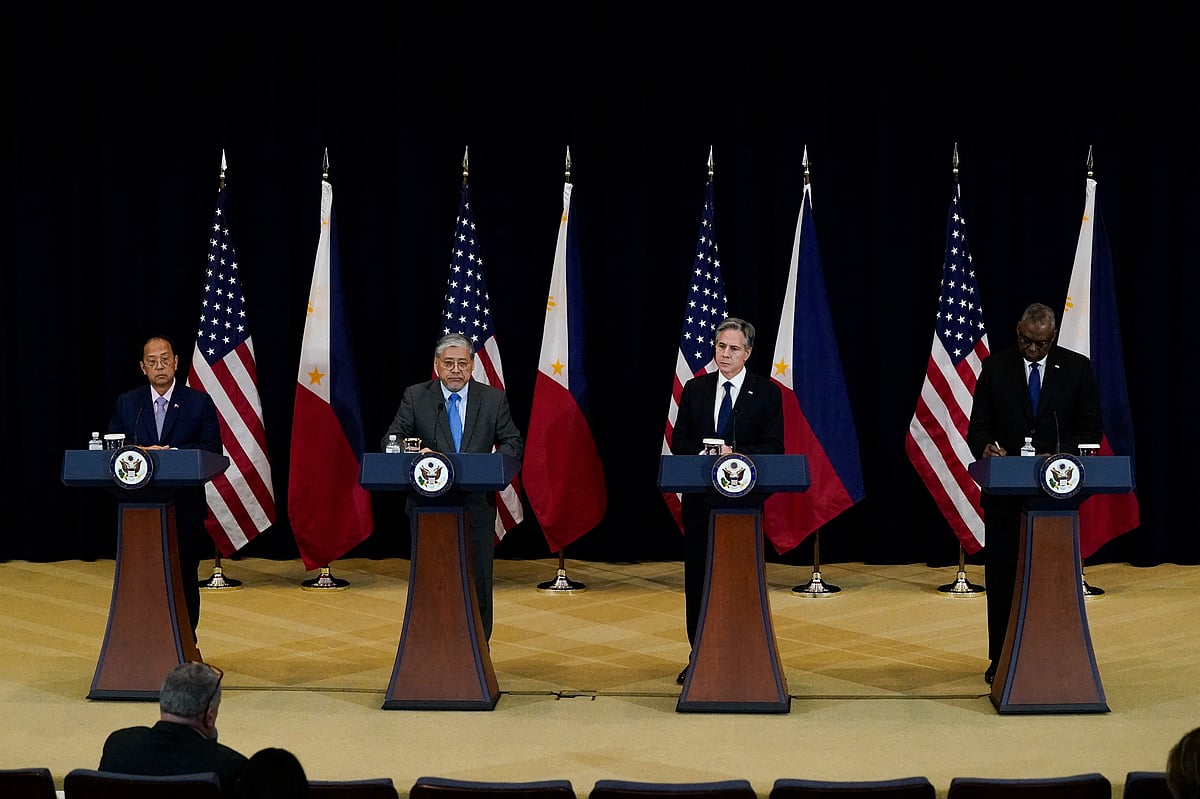
Top defence and diplomatic officials of the United States and Philippines agreed on Tuesday to complete a road map in coming months for the delivery of US defence assistance to the Southeast Asian nation over the next five to 10 years.
US Defence Secretary Lloyd Austin said the long-time allies, who share concerns about an increasingly assertive China, discussed delivery of "priority defence platforms", in a move that prompted China to express concern.
Platforms from radars to drones, military transport aircraft and coastal and air defence systems figured in the so-called "2+2" meeting in Washington that also involved US Secretary of State Antony Blinken and Philippine counterparts.
"Adoption of a security sector assistance roadmap in the coming months will guide shared defense modernisation investments and inform the delivery of priority platforms over the next 5 to 10 years," the two sides said in a statement.
Philippines Foreign Minister Enrique Manalo told the same news conference the two sides "redoubled" their commitment to modernising the Philippines-US alliance.
That step, he added, recognised that "Our partnership will need to play a stronger role in preserving an international law-based international order."
On Wednesday, China's foreign ministry said it was "seriously concerned and strongly dissatisfied" with the joint statement, adding that the document "distorts and smears China's legitimate maritime law enforcement actions".
"We are willing to properly resolve maritime disputes through negotiation and consultation," said ministry spokesperson Wang Wenbin at a regular briefing.
"But we will firmly uphold our own territorial sovereignty and maritime rights and interests."
Experts say the United States sees the Philippines as a potential location for rockets, missiles and artillery systems to counter a Chinese amphibious invasion of Taiwan, which China claims as its own territory.
Austin said it was "too early" to discuss what assets the United States would like to station at Philippine military bases under a recently expanded Enhanced Defense Cooperation Agreement (EDCA).
Manalo said the EDCA sites were mainly aimed at improving military interoperability, tackling humanitarian disasters and perhaps "respond to other types of security challenges," but did not elaborate.
The Pentagon has not specified the use of the additional sites, except that work would include airport expansion and training involving naval assets.
Manalo said on Monday Washington and Manila will need to discuss what the US may do with its access to the EDCA sites.
"We remind the relevant countries in the region that relying on extraterritorial forces will not only fail to maintain their own security, but will instead increase tension and will certainly harm themselves," said Wang, the Chinese official.
EDCA allows US access to Philippine bases for joint training, pre-positioning of equipment and building of facilities such as runways, fuel storage and military housing, but not a permanent presence.
The joint statement said the United States expected to boost its allocated spending for EDCA sites to more than $100 million by the end of 2023, up from a previous $80 million.
Both agreed to fast-track new two-way defense guidelines.
Such guidelines aim to provide strategic direction and to lay out each side's responsibilities, said Greg Poling, a Southeast Asia expert at Washington's Center for Strategic and International Studies.
"The US and Japan negotiated defense guidelines in 1978 for the Cold War, 1998 focused on North Korea, and 2015 focused on China, whereas the US and Philippines have never done so," he said.
The Washington meeting came after more than 17,000 Philippine and US soldiers began their largest ever joint military drills on Tuesday, highlighting their shared concern about China, which has rival territorial claims to the Philippines in the disputed South China Sea.
US-Philippine ties have warmed under Philippine President Ferdinand Marcos Jr, and the 2+2 meeting underlined that, as the first of its kind in seven years. But Manila treads a delicate path with China, the region's economic powerhouse.
Marcos assured China on Monday that military bases accessible to the US would not be used in offensive action, stressing that the deal with Washington was designed to boost his country's defences.