


Published : 10 Oct 2014, 03:25 PM
Updated : 08 Aug 2022, 07:14 PM


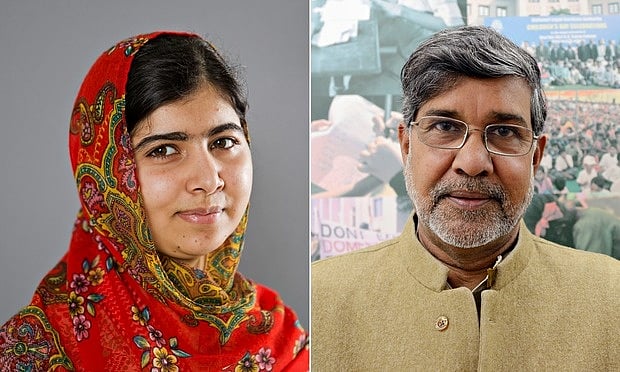
Yousafzai, aged 17, becomes the youngest Nobel Prize winner and 60-year-old Satyarthi the first Indian-born winner of the accolade.
They were picked for their struggle against the oppression of children and young people, and for the right of all children to education, the Norwegian Nobel Committee said.
The sharing of the award between an Indian and a Pakistani came after a week of hostilities along the border of the disputed, mainly Muslim region of Kashmir - the worst fighting between the nuclear-armed rivals in more than a decade.
"The Nobel Committee regards it as an important point for a Hindu and a Muslim, an Indian and a Pakistani, to join in a common struggle for education and against extremism," said Thorbjoern Jagland, the head of the Norwegian Nobel Committee.
Satyarthi said he now hoped to work with Malala for peace.
"I will invite her to join hands to establish peace for our subcontinent, which is a must for children, which is a must for every Indian, for every Pakistani, for every citizen of the world," he told reporters at the New Delhi office of his organisation, Bachpan Bachao Andolan, or Save the Childhood Movement.
Kristian Berg Harpviken, head of the Peace Research Institute in Oslo, described the joint award "an innovative prize that brings attention to the problems of the young".
"A breath of fresh air" amid violence
Yousafzai was attacked in 2012 on a school bus in the Swat Valley of northwest Pakistan by masked gunmen as a punishment for a blog that she wrote for the BBC's Urdu service as an 11-year-old to campaign against the Taliban's efforts to deny women an education.
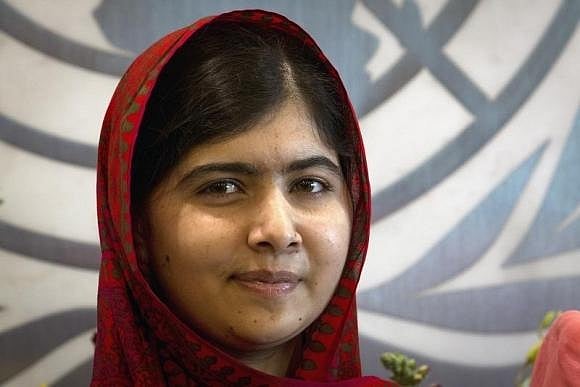
"Those who oppose her, extremist elements or whoever else, they have been rendered irrelevant. They are a weak minority."
Yousafzai addressed the UN Youth Assembly last year at an event Secretary-General Ban Ki-moon called "Malala Day".
This year she travelled to Nigeria to demand the release of 200 schoolgirls kidnapped by the Islamist group Boko Haram.
"To the girls of Nigeria and across Africa, and all over the world, I want to say: don't let anyone tell you that you are weaker than or less than anything," she said in a speech.
"You are not less than a boy," Yousafzai said. "You are not less than a child from a richer or more powerful country. You are the future of your country. You are going to build it strong. It is you who can lead the charge."
Fighting child slavery
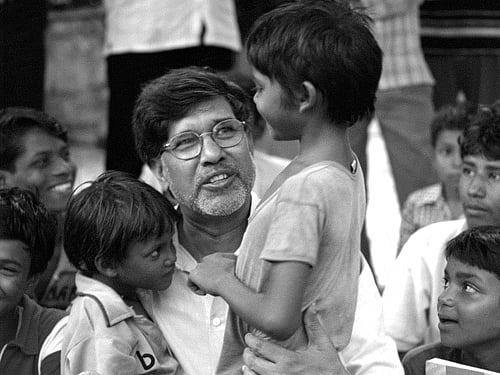
Satyarthi, who gave up a career as an electrical engineer in 1980 to campaign against child labour, has headed various forms of peaceful protests and demonstrations, focusing on the exploitation of children for financial gain.
"It is a disgrace for every human being if any child is working as a child slave in any part of the world," Satyarthi said.
"I feel very proud to be an Indian that in India I was able to keep this fight on for the last 30 years or so. This is a great recognition and honour for all my fellow Indians."
The Dalai Lama, the exiled Tibetan spiritual leader who won the prize in 1989, resides in India.
Many commentators say that the omission of Gandhi from the list of laureates is the biggest error in the history of the Prize, first awarded in 1901.
"Maybe there is a little nod to Gandhi there," Harpviken said of the award to India's Satyarthi.
The United Nations' Childrens' Fund in South Asia said the joint award recognised "their struggle against the suppression of children and young people" in a region where nearly 17.5 million girls aged between 5 and 13 are out of school and over 12 percent of children between 5 and 14 are engaged in labour.
The prize, worth about $1.1 million, will be presented in Oslo on Dec. 10, the anniversary of the death of Swedish industrialist Alfred Nobel, who founded the award in his 1895 will.
The previous youngest winner was Australian-born British scientist Lawrence Bragg, who was 25 when he shared the Physics Prize with his father in 1915.
Also Read:
Malala 'honoured' to win NobelAlso Read:
Previous winners of Nobel Peace Prize












