


Published : 09 Aug 2019, 11:52 PM
Updated : 05 Aug 2022, 05:57 PM


As Pakistan marks its independence day next week, it increasingly feels like a nation with its back against the wall, with few options to protect its existential interests. Its economy is teetering on the brink of collapse, and its international allies have either stayed silent over Kashmir or defected in support of India.
A conventional military reaction is probably too costly as Pakistan seeks to tighten its belt to shore up its finances. And one of the most effective strategies Pakistan has traditionally employed — using an array of militant groups as proxies to keep neighbours in check — has become a liability, amid the threat of international sanctions. (Pakistan has denied that it uses militant groups to achieve its foreign policy objectives.)
“The economy is hindering Pakistan’s options. As they head to a recession can they really afford a war right now?” said Arif Rafiq, the president of Vizier Consulting, a consulting firm on South Asian political and security issues. “Their capacity to bear the cost of a full-fledged conflict with India over Kashmir, whether via insurgent networks or conventionally — there just are not a lot of options Pakistan has.”
Even Afghan Taliban leaders, who have long been sheltered in Pakistan, seem to have turned their backs on their ally of late.
Last year, Pakistan, in an effort to end it global isolation, agreed to help the United States end its war in Afghanistan by delivering the Taliban leadership to the table for peace talks. In doing so, Pakistan employed one of its greatest sources of leverage with the United States. Those talks are now nearing a conclusion, with American negotiators sitting across the table from their Taliban counterparts and aiming to reach a settlement soon.
In recent days, several Pakistani government officials have demanded that their country end its cooperation in the peace talks to protest US silence over India’s elimination of Kashmir’s autonomy. But the Taliban on Thursday issued a forceful statement warning against any meddling.
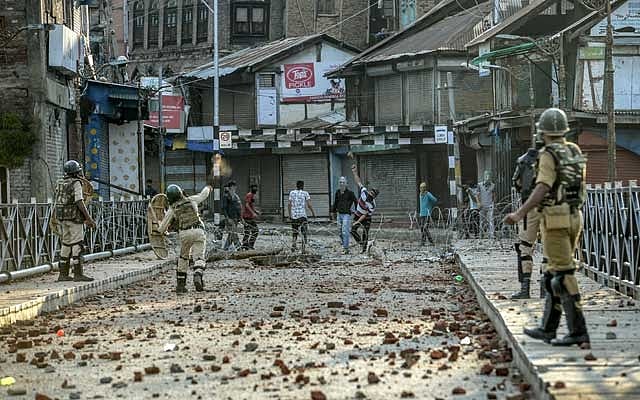
Protestors throw rocks in the streets of Srinagar, where a strict curfew has been implemented following protests against Indian Prime Minister Narendra Modi's decision to revoke Kashmir's autonomy, in India, Aug. 8, 2019. (Atul Loke/The New York Times)
The outcome of the peace talks and Pakistan’s role in them will likely influence whether the country finds itself blacklisted internationally over its continued support of terrorist organisations, a move that could make or break its faltering economy. The Paris-based group that monitors terrorism financing, the Financial Action Task Force, will vote in October on whether Pakistan has done enough to crack down on militant networks at home.
Pakistan hopes to make the case that it has moved against militant groups and should be taken off the grey list on which the watchdog placed it last year. Pakistan deeply fears it could be blacklisted, denied access to international financial markets at a time when it desperately needs loans to stay afloat. If Pakistan is blacklisted, it could tip the economy into recession.
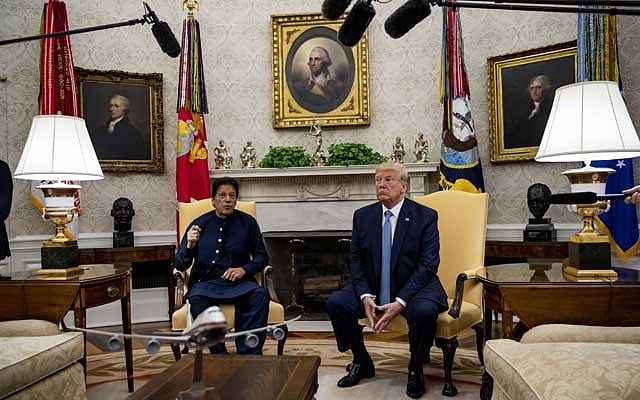
Prime Minister Imran Khan of Pakistan seemed worried about the lack of options to force India to walk back its new Kashmir policy.
Meeting with Pakistani journalists Thursday, Khan dismissed using “jihadi organisations” against India in Kashmir. “There are more disadvantages than advantages,” Khan said, according to Amber Rahim Shamsi, a reporter for Samaa TV who attended the meeting.
The possibility of international sanctions also seemed to weigh on Khan.
“Pakistan has taken every step to get itself out of the baggage of the past,’’ the prime minister told the group of journalists, according to a second account of the meeting.
He said the government had undertaken “a complete cleansing operation” against terrorist groups. “My government has ensured there is a complete and sincere effort to bring Pakistan out of FATF,” Khan added, referring to the Financial Action Task Force.
Pakistan’s foreign minister has said he would raise the issue of Kashmir to the United Nations Security Council for a vote. But so far, the country’s closest allies have remained silent on the matter.
c.2019 New York Times News Service













