Published : 15 Apr 2017, 11:13 AM
Updated : 19 Oct 2022, 03:33 PM


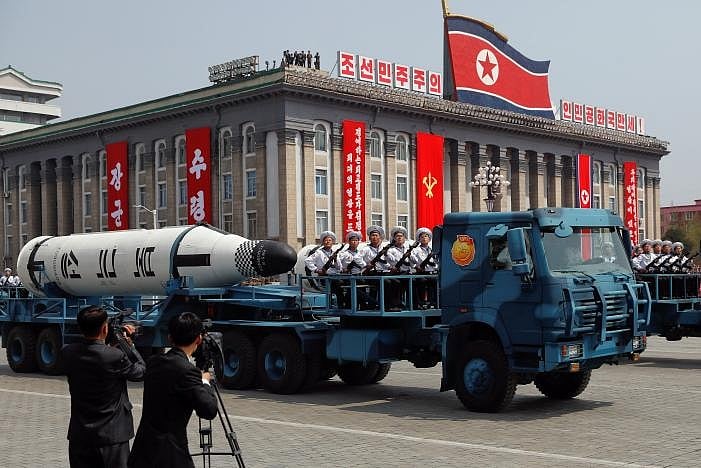
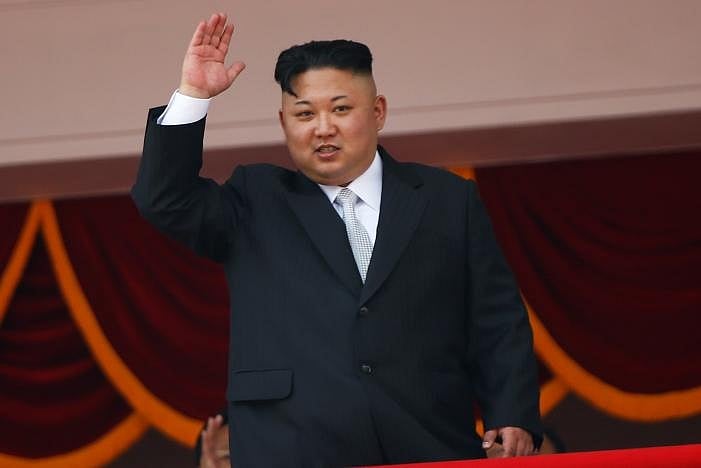
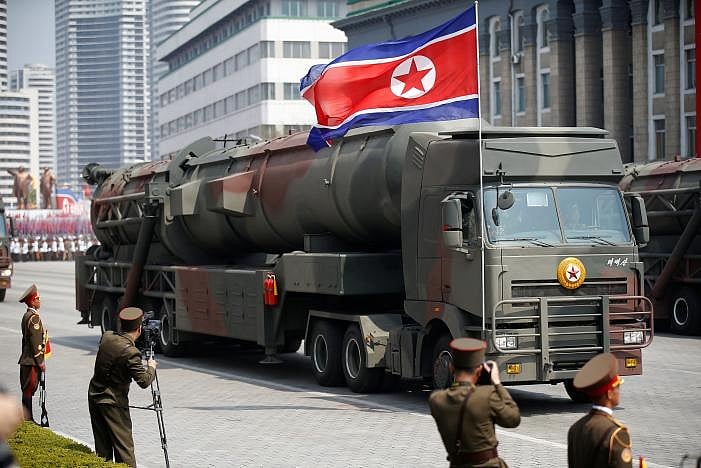
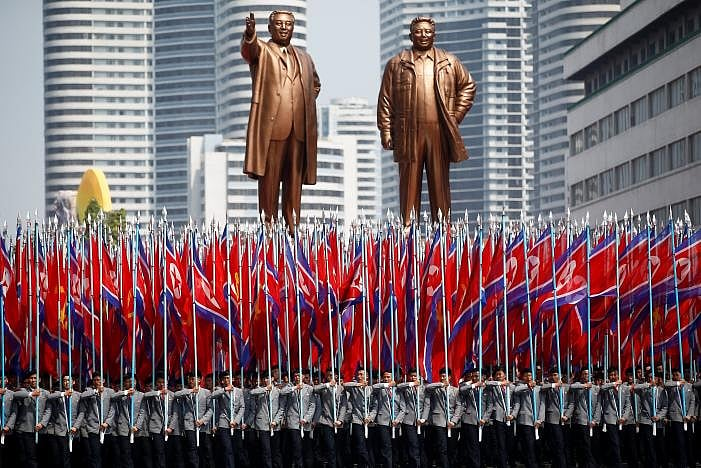
Missiles appeared to be the main theme of a giant military parade, with Kim's grandson, leader Kim Jong Un, taking time to greet the commander of the Strategic Forces, the branch that oversees the missile arsenal.
A US Navy attack on a Syrian airfield this month with Tomahawk missiles raised questions about US President Donald Trump's plans for reclusive North Korea, which has conducted several missile and nuclear tests in defiance of U.N. sanctions, regularly threatening to destroy the United States.
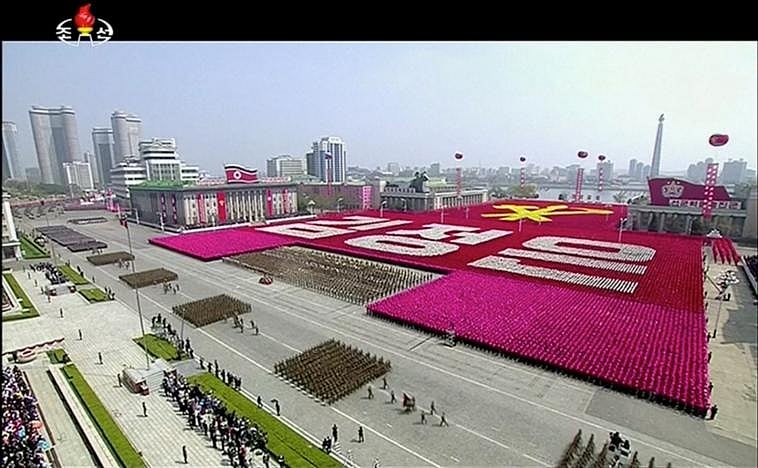
Kim Jong Un, looking relaxed in a dark suit and laughing with aides, oversaw the festivities on the "Day of the Sun" at Pyongyang's main Kim Il Sung Square.
A view of a military parade marking the 105th 'Day of the Sun', the birth anniversary of the state's founder Kim Il Sung, in Pyongyang, North Korea, in this still image taken from video released by North Korea's state-run television KRT on April 15, 2017. KRT via Reuters
Single-engine propeller-powered planes flew in a 105 formation overhead.
Unlike at some previous parades attended by Kim, there did not appear to be a senior Chinese official in attendance. China is North Korea's lone major ally but has spoken out against its missile and nuclear tests and has supported U.N. sanctions. China on Friday again called for talks to defuse the crisis.
Weapons analysts said they believed some of the missiles on display were new types of intercontinental ballistic missiles (ICBM).
The North has said it has developed and would launch a missile that can strike the mainland United States but officials and experts believe it is some time away from mastering all the necessary technology.
'Early days'
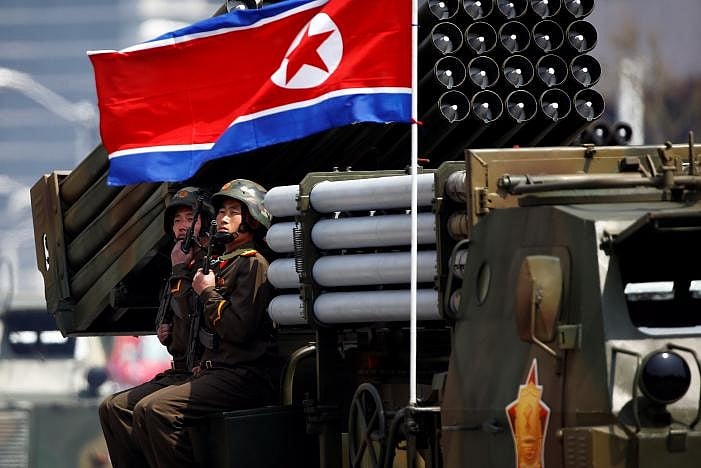
North Korea showed two new kinds of ICBM enclosed in canister launchers mounted on the back of trucks, suggesting Pyongyang was working towards a "new concept" of ICBM, said Melissa Hanham, a senior research associate at the US-based Middlebury Institute of International Studies at Monterey, California.
Soldiers hold weapons while seated on a vehicle carrying rockets as it drives past the stand with North Korean leader Kim Jong Un during a military parade marking the 105th birth anniversary of country's founding father Kim Il Sung, in Pyongyang April 15, 2017. Reuters
"It is still early days for these missile designs."
The Pukkuksong submarine-launched ballistic missiles (SLBM) were also on parade. It was the first time North Korea had shown the missiles, which have a range of more than 1,000 km (600 miles), at a military parade.
North Korean leader Kim Jong Un waves to people attending a military parade marking the 105th birth anniversary of country's founding father, Kim Il Sung in Pyongyang, April 15, 2017. Reuters
"It suggests a commitment to this programme," said Pollack. "Multiple SLBMs seems like a declaration of intent to advance the programme."
North Korea, still technically at war with the South after their 1950-53 conflict ended in a truce but not a treaty, has on occasion conducted missile or nuclear tests to coincide with big political events and often threatens the United States, South Korea and Japan.
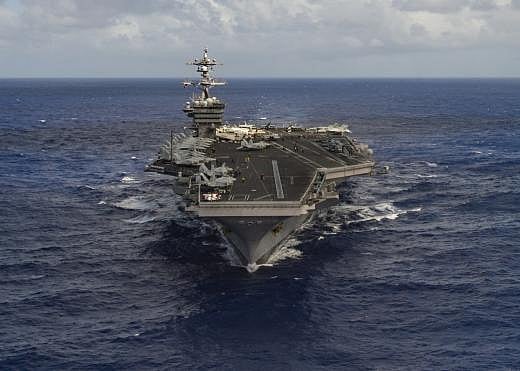
Aircraft carrier USS Carl Vinson transits the South China Sea while conducting flight operations on April 9, 2017. The Carl Vinson Carrier Strike Group is on a scheduled western Pacific deployment as part of the US Pacific Fleet-led initiative to extend the command and control functions of US 3rd Fleet. Picture taken on April 9, 2017. US Navy/Handout via Reuters
"If the United States wages reckless provocation against us, our revolutionary power will instantly counter with annihilating strike, and we will respond to full-out war with full-out war and to nuclear war with our style of nuclear strike warfare," he said.
Pence to visit south
State news agency KCNA said the Trump administration's "serious military hysteria" had reached a "dangerous phase which can no longer be overlooked".
The United States has warned that a policy of "strategic patience" with North Korea is over. US Vice President Mike Pence travels to South Korea on Sunday on a long-planned 10-day trip to Asia.
China has also stepped up economic pressure on North Korea. It banned all imports of North Korean coal on Feb. 26 under UN sanctions, cutting off the North's most important export product.
China's national airline, Air China, weeks ago cancelled some flights to Pyongyang due to poor demand but it has not suspended all flights there, it said on Friday, denying a report by Chinese state broadcaster CCTV that all flights run by the airline between the two cities were to be suspended.
China's Global Times newspaper, which is published by the People's Daily, the Communist Party's official paper, said North Korea must have felt the shockwave from the 11-ton "mother of all bombs" dropped by US forces on Islamic State-linked fighters in Afghanistan on Thursday.
"It would be nice if the bomb could frighten Pyongyang, but its actual impact may just be the opposite," it said in an editorial.
North Korea on Friday denounced the United States for bringing "huge nuclear strategic assets" to the region as the USS Carl Vinson strike group with a flag-ship nuclear-powered aircraft carrier steamed closer.
In Dandong, China's main border post with North Korea, hundreds of North Koreans gathered at a cultural centre carrying floral displays.
With the men wearing pins adorned with photos of Kim Il Sung, and the women in brightly coloured traditional dress, crowds lined up to bow to portraits of their state founder before touring an exhibition of photos and North Korean paintings.
KCNA was gushing in its praise of Kim Il Sung, recalling the time he met former US president Jimmy Carter in 1994.
"Former US President Jimmy Carter was so fascinated by his personality as to say that Kim Il Sung is greater than that George Washington, Thomas Jefferson and Abraham Lincoln put together, eulogizing him as the great sun god of human destiny." it said.