


Published : 13 Nov 2019, 02:02 PM
Updated : 17 Oct 2022, 11:48 AM


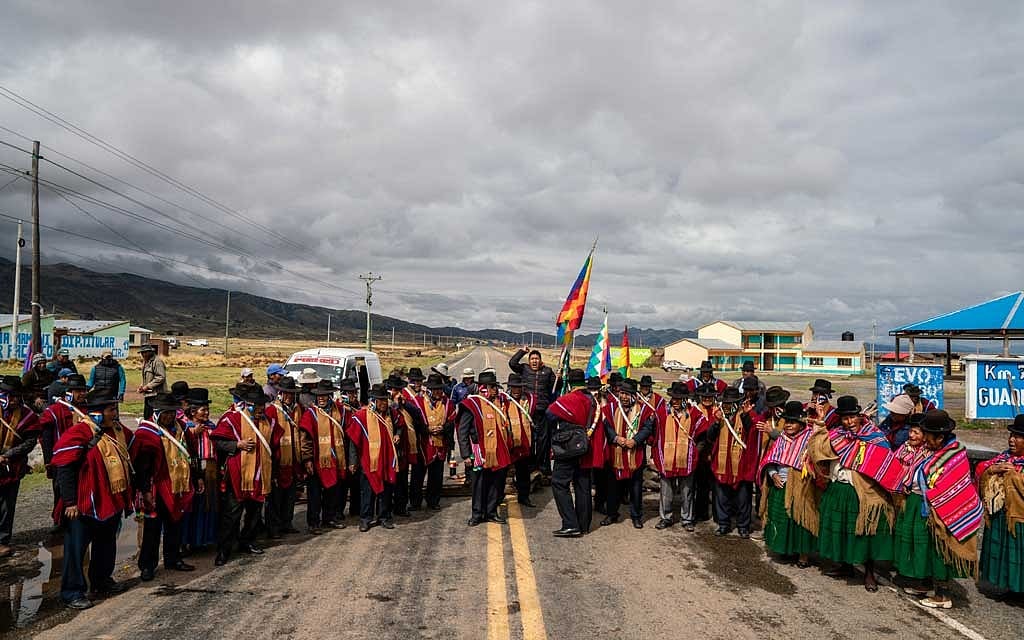
Morales stepped down Sunday after a disputed election that touched off weeks of protest by furious Bolivians who accused him of subverting democracy to prolong his presidency. His departure, and the resignation of several top officials, left his country polarised and leaderless.
Opposition leaders hoped to assemble a quorum of the Legislative Assembly on Tuesday to formally accept Morales’ resignation and choose an interim president, but it was unclear whether Morales’ political party, which holds majorities in both chambers, would allow that to happen.
Morales, who was granted refuge by Mexico “for humanitarian reasons,” has described his ouster as a coup.
Jeanine Añez Chavez, a senator who is next in the chain of command to become interim president, said the Legislative Assembly would meet later Tuesday. Attempting to dispel concerns that the assembly would be deadlocked or not reach a quorum to proceed, she said that most supporters of Morales were planning to attend the session.
“If they don’t, they will have to face the people,” she said in a news conference while surrounded by other lawmakers. “They have a responsibility, along with us, to lead the country.”
A former media executive and leader of a conservative coalition, Añez said she intended to lead a transition that would focus on selecting an honest electoral commission and holding elections as soon as possible.
“This is simply a transitory moment,” she said. “There is an urgency.”
As looting and violence spread across several cities Monday, Añez appeared rattled, sobbing while calling for calm. But by evening, she projected strength and demanded that the army accept the national police’s call to jointly patrol the streets of La Paz to restore order.
The army quickly responded, sending troops into the streets and setting up defensive positions around vital infrastructure like electricity and waterworks. By Tuesday morning, the streets of La Paz were tense, but largely quiet.
As Bolivians awaited the naming of an interim president, they remained sharply divided over their political views and hopes for the future. Morales, first elected more than a decade ago, was the first indigenous president of Bolivia, where about two-thirds of the population are of indigenous descent.
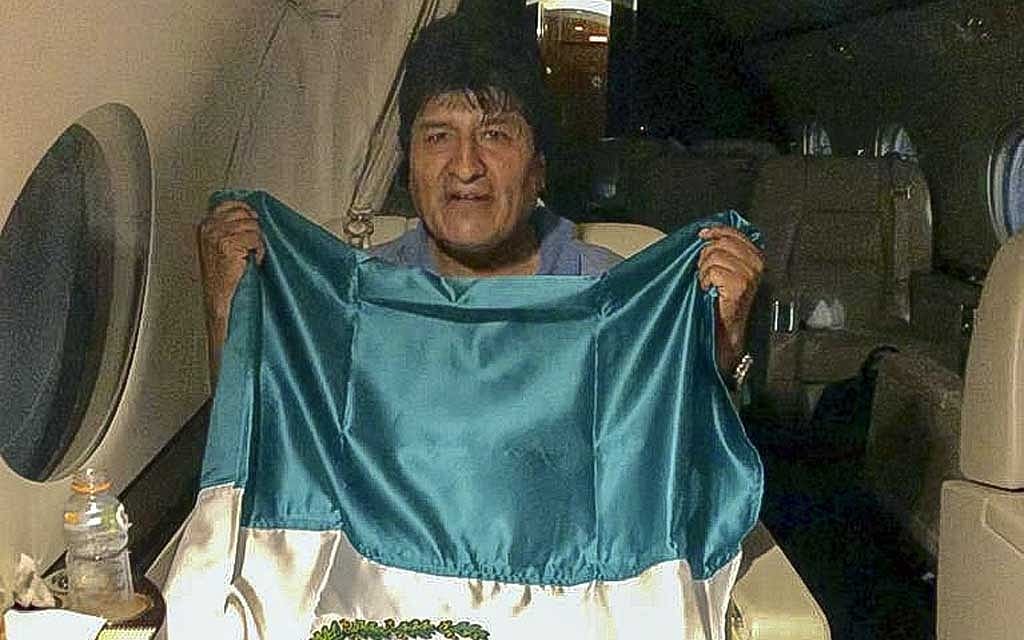
In a photo provided by the Foreign Ministry of Mexico, Bolivia’s ousted president, Evo Morales, holds his nation's flag on a Mexican Air Force plane bound for Mexico on Monday, Nov 11, 2019. The New York Times
“Evo was the best president we ever had,” said Rosario Siñane, 39, who sold individually wrapped candies. “Now we have no more hope.”
José Ariel Blanco, the 25-year-old owner of a stationery store two blocks from the legislature, was thankful for Morales’ achievements — chief among them, tackling the racism the indigenous had suffered for centuries.
“My grandmother couldn’t walk into a bank in her indigenous clothes until Evo became president,” he said. “Now she can, and that won’t change.”
But he said Morales went too far in bending the rules of democracy. “The Venezuelan and Cuban models don’t work over time,” he said.
Down the street from Blanco’s store, Victor Huancollo, a 24-year-old computer science university student, stood guard at a makeshift barricade designed to keep supporters of Morales from approaching the legislature. He was hopeful new elections would be held in a few months, he said, and that “a transparent president who is not corrupt will emerge, not like what we had over the last 14 years.”
On Tuesday morning Morales was met by Marcelo Ebrard, Mexico’s foreign minister, at the presidential hangar of Mexico City’s main airport.
In comments to the news media, Morales remained defiant, vowing to continue his involvement in politics and his fight for social justice, Bolivia’s indigenous populations and the poor.
“Our sin is that we are ideologically anti-imperialist, but this coup won’t make me change ideologically,” he said.
Morales, who was flanked by Bolivia’s former vice president, Álvaro García Linera, also thanked his hosts, the Mexican government.
“We are very grateful to the president of Mexico because he saved my life,” he said.
Morales left office after weeks of growing unrest over a disputed presidential election and after the military indicated it would support the people in the streets who were calling for him to step down.
In his audio message, which was released by the Mexican news media and broadcast in Bolivia, Morales called on the military to “stop the massacre.” Photographed draped in a Mexican flag aboard a Mexican air force plane, Morales also told his supporters: “We’ll work together for Bolivia.”
During a news conference Tuesday morning, Ebrard said the Mexican government had encountered numerous difficulties in securing permission to land its plane in Bolivia to retrieve Morales and in getting cooperation from other countries in the region to facilitate the plane’s return to Mexico with the former Bolivian president aboard.
Among the obstacles, he said, the government of Peru had forbid the plane from landing on Peruvian territory to refuel during its return trip to Mexico, and Ecuador had blocked passage over its territory, forcing the plane to take a path over the Pacific Ocean and further delaying Morales’ arrival in Mexico City.
© 2019 New York Times News Service













