Published : 29 Aug 2021, 03:37 AM
Updated : 14 Oct 2022, 06:57 PM


Britain planned to end the evacuation of its citizens Saturday and to begin bringing its remaining troops home, Gen. Nick Carter, chief of the defence staff, told the BBC’s Radio 4. More US troops have also begun getting on planes and leaving. A military official said Saturday that there were around 4,000 US troops in Kabul, down from 5,800 a few days ago. The official’s comment came just as President Joe Biden was warning that “an attack is highly likely in the next 24 to 36 hours.”
The troop departures signalled a tumultuous end to a 20-year war that has left the country awash in grief and desperation, with many Afghans fearing for their lives under Taliban rule and struggling with cash shortages and rising food prices.
“We haven’t been able to bring everybody out and that has been heartbreaking,” Carter told the BBC. “There have been some very challenging judgments that have had to be made on the ground.”
France, too, has ended its evacuations, French officials said Friday.
Three days remain before Biden’s Aug. 31 deadline for withdrawing US troops from Afghanistan. As the date nears, the evacuation mission has been shifting its focus, from vetting and airlifting Afghan civilians to bringing home US troops and military personnel.
Children ride in the back of a vehicle near the Hamid Karzai International Airport in Kabul, Afghanistan on Saturday, Aug. 28, 2021. Hundreds of thousands of Afghans are still thought to be seeking to flee the country, but President Joe Biden and other global leaders have acknowledged that many will not get out before the deadline. (Victor J. Blue/The New York Times)
About 117,000 people, most of them Afghans, have been evacuated since the Taliban seized Kabul on Aug. 15, Pentagon officials said. On Saturday, about 1,400 people were still at the airport, and had been screened and booked for flights, Pentagon officials said.
About 350 Americans have told the State Department that they were still seeking to leave the country, the department said Saturday, adding that it believes some may have already left Afghanistan.
Hundreds of thousands of Afghans are still thought to be trying to flee the country, yet Biden and other global leaders have acknowledged that many will not get out before the deadline.
Outside Kabul’s airport Saturday, roads remained closed and the large crowds that had strained to push inside had largely dissipated in the aftermath of Thursday’s suicide bombing, which killed 13 American service members and as many as 170 civilians.
At the Abbey Gate, near where the bombing occurred, only two families and two young men still waited.
The airport’s South Gate remained open, and there was a growing backlog of buses carrying some 500 to 1,000 people, as US military personnel screened for suicide vests and other explosives. The Taliban, which was manning checkpoints around the airport, also turned away dozens of buses. Few people, if any, were getting through the airport gates.
Among those still hoping to leave were two brothers who said they had traveled 26 hours from Herat, a city in western Afghanistan, and had managed to sneak past guards outside the airport’s perimeter to reach the Abbey Gate. One of them said he had been selected by a US visa lottery.
The brothers knew of the deadly explosion at the gate two nights ago, “but what can we do,” one of them said Saturday. “This is our only way out.”
Thursday’s airport attack was one of the deadliest in the nearly two decades since the US-led invasion.
“The situation on the ground continues to be extremely dangerous, and the threat of terrorist attacks on the airport remains high,” Biden said in a statement Saturday. “Our commanders informed me that an attack is highly likely in the next 24-36 hours.”
Crowds outside a currency exchange facility in Kabul, Afghanistan, as Taliban fighters stand guard, Thursday, Aug. 26, 2021. (Victor J. Blue/The New York Times)
Defense Department officials said one of the drone targets was an ISIS-K “planner,” and one was a “facilitator.”
The strike was carried out by a single MQ-9 Reaper drone flying out of a base in the United Arab Emirates, according to a senior US military official. The targets were struck in Jalalabad, the capital of Nangarhar province, roughly 90 miles east of Kabul.
The “planner” who was killed was believed to be involved in future plots against targets in Kabul, including the airport, but there was no evidence so far that he was involved in the suicide bombing near the airport on Thursday, the official said.
“I said we would go after the group responsible for the attack on our troops and innocent civilians in Kabul, and we have,” Biden said in his statement. “This strike was not the last. We will continue to hunt down any person involved in that heinous attack and make them pay.”
An assistant to Taliban spokesman Zabihullah Mujahid said Saturday of the drone strike: “We have heard the reports about the Nangarhar incident, but we are trying to find the type of the incident and the casualties. After an investigation, we will react to that.”
For the first time, Pentagon officials publicly acknowledged the possibility that some people killed outside the airport Thursday may have been shot by US service members after the suicide bombing.
Pentagon officials had previously acknowledged that there was gunfire after the bombing, but had said they were unsure where it came from. Investigators are looking into whether the shots came from Americans at the gate, or from the Islamic State.
“We can’t confirm that,” Pentagon press secretary John F. Kirby said of reports that Afghan civilians may have been fatally shot by US troops. “And we’re certainly not in a position to deny it, either. We are investigating this.”
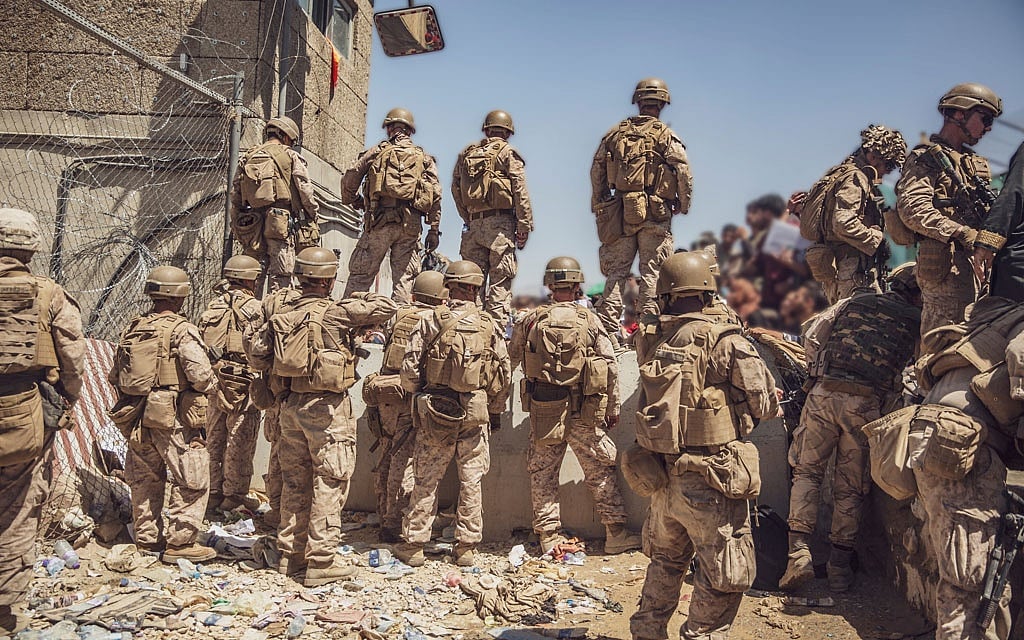
US Marines with Special Purpose Marine Air-Ground Task Force - Crisis Response - Central Command assist with security at an Evacuation Control Checkpoint (ECC) during an evacuation at Hamid Karzai International Airport, Kabul, Afghanistan, August 26, 2021. Staff Sgt. Victor Mancilla/US Marine Corps/Handout via REUTERS
Many Afghans are struggling to support their families, and people have gathered outside banks and ATMs in the hope of withdrawing money, only to return home cashless and in despair.
On Saturday, hundreds protested outside one bank branch in Kabul and scores more marched through central Kabul to demand the reopening of banks that had closed after the Taliban takeover.
“Islamic government, give us our rights!” they chanted.
One of the country’s largest banks, Azizi Bank, issued a statement to customers saying that it was waiting for Afghanistan’s central bank to resume operations before reopening.
A representative of the central bank said that it would reopen Sunday, but that to prevent bank runs, it might not begin distributing money until a new government was established.
The Taliban have indicated that Hajji Mohammad Idris, a member of the movement, will serve as acting head of the central bank. News reports have indicated that Idris has no formal financial training.
Despite ending its presence in Afghanistan, the United States still has control over billions of dollars belonging to the Afghan central bank, money that Washington is making sure remains out of the reach of the Taliban.
Concern is also growing about the plight of farmers and herders, who form the backbone of Afghanistan’s rural economy. The country continues to be hit hard by a worsening drought that threatens the livelihoods of more than 7 million people who rely on agriculture or livestock, the UN Food and Agriculture Organization warned Saturday.
“Farmers and livestock owners must not be forgotten in today’s humanitarian crisis,” said Qu Dongyu, the organisation’s director-general. “Urgent agricultural support now is key to counter the impact of the drought and a worsening situation in Afghanistan’s vast rural areas in the weeks and months ahead.”
© 2021 The New York Times Company