


Published : 23 Apr 2022, 09:41 AM
Updated : 03 Aug 2022, 10:05 AM


He likened the choice confronting him in France’s presidential runoff Sunday — featuring Macron and Marine Le Pen, whose far-right party has a long history of anti-Muslim positions, racism and xenophobia — as “breaking your ribs or breaking your legs.”
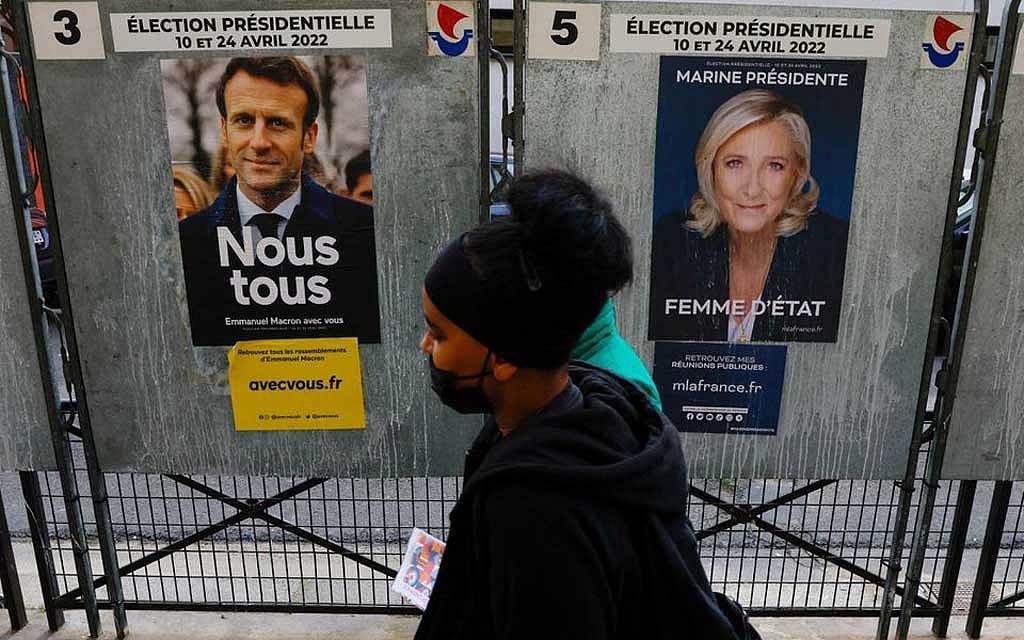
Macron and Le Pen are now fighting over the 7.7 million voters who backed Jean-Luc Mélenchon, the leftist leader who earned a strong third-place finish in the first round of the election. Were they to break strongly for one of the candidates, it could prove decisive.
Nearly 70% of Muslims voted for Mélenchon, the only major candidate to have consistently condemned discrimination against Muslims, according to the polling firm, Ifop.
By contrast, Macron garnered only 14% of Muslim voters’ support this year, compared to 24% in 2017. Le Pen got 7% in the first round this year. Nationwide, according to Ifop, the turnout of Muslim voters was a couple of percentage points higher than the average.
As the two candidates battle it out in the closing days of a tight race, Macron’s prospects may rest partly on whether he can persuade Muslim voters like Bouadla that he is their best option — and that staying home risks installing a chilling new anti-Muslim leadership.
In Bouadla’s telling, however, that will take some doing.
“If I vote for Macron, I’d be participating in all the bad things he’s done against Muslims,” Bouadla, 50, said over the course of a long walk in Bondy, a city just northeast of Paris. He vacillated between abstaining for the first time in his life or reluctantly casting a ballot for Macron simply to fend off someone he considered “worse and more dangerous.”
Most polls show that Macron’s lead, about 10 percentage points, provides a comfortable path to reelection, but it is far narrower than his 32 percentage-point margin of victory over Le Pen in 2017.
But as Éric Coquerel, a national lawmaker and a close ally of Mélenchon, said, the turnout by Muslim voters could tip the balance if the race “becomes extremely tight.”
Much of Muslim voters’ anger toward Macron centers on his pushing a widely condemned 2021 law and the subsequent closing of more than 700 Muslim institutions that authorities say encouraged radicalisation, a charge that many Muslims and some human rights groups dispute. But it remains unclear how this resentment might be transformed into a political force.
France’s estimated 6 million Muslims account for 10% of the population, but their political influence has long been undermined by high abstention rates and divisions based on class and ancestry. Given that history, Mélenchon’s strong Muslim backing may have signaled a shift, analysts say.
Julien Talpin, a sociologist at the National Center for Scientific Research, said that the mobilisation by Muslims behind a single candidate was “something entirely new.”
“In the past, there were only vague calls to vote for candidates favorable to Islam,” he said.
Mélenchon scored his biggest victories nationwide in Bondy and in the rest of Seine-Saint-Denis, the department just north of Paris that has strong concentrations of the capital region’s poor, immigrant and Muslim populations.
The source of much of the service workforce of the capital, the department also inspires fear and anxiety, especially among older French people, whose feelings about immigration and crime are fanned by the right-wing news media and politicians. Éric Zemmour — the far-right TV pundit who came in fourth in the first round, following a campaign focused on attacking Islam — described the department as a “foreign enclave” suffering from “religious colonisation.”
In Bondy, a strong turnout was reported in the first round in neighbourhoods with historically low voting levels.
“The number of young people, families and especially the people waiting in line — something was happening,” said Mehmet Ozguner, 22, a local organiser for Mélenchon’s party.
Many imams, social media influencers and other community leaders called on Muslim voters to unite their ballots in favor of Mélenchon.
“There was no formal organisation but many ad hoc alliances, mobilisation by union activists and anti-racism activists,” said Taha Bouhafs, 24, a journalist with a large online following and a member of Mélenchon’s party, who is planning to run in the election for Parliament in June.
In 2017, Macron had reassured many Muslims that he would be more open on issues of French secularism, known as “laïcité, diversity and multiculturalism,” said Vincent Tiberj, a sociologist at Sciences Po Bordeaux university who has studied the voting patterns of French Muslims. Macron even called colonisation a “crime against humanity” during a visit to Algeria.
In a major speech on what Macron described as an Islamist-driven separatist movement in French society, Macron acknowledged that successive governments had encouraged the trend by settling immigrants in areas of “abject poverty and difficulties,” like Seine-Saint-Denis.
But Tiberj said that there was a gap “between what he said as president and what his government did in his name.”
Macron hardened his positions after the beheading of a middle school teacher, Samuel Paty, by an Islamist fanatic angry that the teacher had shown caricatures of the Prophet Muhammad in a class on blasphemy.
In response, Macron pushed forward his anti-separatism law despite widespread criticism from international and national human rights organisations, including the government’s National Human Rights Commission. The law gave the government greater power over religious establishments, schools and other associations.
Following the law’s adoption in August 2021, authorities carried out 24,877 investigations through last January, according to the government. They closed 718 mosques, Muslim schools and associations for encouraging separatism, seizing assets worth 46 million euros.
But many establishments have been closed for vague, unwarranted reasons, according to an investigation of 20 cases by an umbrella group of academics and rights groups, the Observatory of Associative Liberties.
Talpin, the sociologist and a co-author of the report, said that the law “and the debate surrounding it contributed to stigmatising Muslims.”
In a TV debate over the law, the interior minister, Gérald Darmanin, tried to outflank Le Pen on the right, accusing Le Pen of being “soft” against Islamism. The minister overseeing public schools further alienated Muslims by saying that the hijab, or headscarf, was “not desirable in society.” And the minister of higher education ordered an investigation into what she called “Islamo-leftism” in academic research.
Feeling betrayed, some Muslims have even voted for Le Pen as a way to punish Macron.
“I vote against Macron,” said Ahmed Leyou, 63, a taxi driver in Trappes, a city southwest of Paris, who voted for Le Pen in the first round and planned to do it again Sunday. “I’m Muslim, an Arab, but French. Marine Le Pen can’t tell me to go back home. She can’t do anything against me.”
In Bondy, Muslims were not the only ones to criticise Macron’s policies.
“The law against separatism is dangerous,” said the Rev. Patrice Gaudin, 50, the priest of the Roman Catholic parish in Bondy. “We have to acknowledge that Muslims don’t feel welcome in France because they’re Muslim. This law can provoke feelings that lead to radicalisation.
“You can’t humiliate people,” Gaudin said, referring to the 2021 law and criticising the recurring political debate over whether Muslim women should be allowed to wear headscarves and in what circumstances.
At a campaign stop last week, Macron praised a young Muslim woman’s decision to wear a headscarf as a feminist choice made of her own volition — a change from 2018 when he described it as not “in keeping with the civility in our country” and against the equality between men and women. In a TV debate between the two candidates Wednesday, Macron said that Le Pen’s position on the hijab — to ban it in public — would lead to “civil war.”
Put on the defensive, Le Pen said in the past week that the issue was a “complex problem” that the National Assembly would have to debate and that she was not “close-minded.” Her top aides eventually said that banning the wearing of the hijab was not a priority.
The candidates’ quickly shifting positions on the headscarf can be explained by the presence of voters like Islam Menyane, 29, who was buying sweets from a bakery near Bondy’s train station to break the Ramadan fast.
Menyane, who works in food service, voted for Mélenchon in the first round and was now leaning toward Macron, though she felt France had “stagnated” during his presidency.
Menyane does not wear a headscarf, but Le Pen’s positions on Islam worried her. Otherwise, she liked Le Pen’s economic policies and her focus on helping working-class and young voters like her. She also preferred the personality of Le Pen, who has succeeded in softening her image in the past couple of years.
“She’s a human being. She’s a mom. She seems to want to defend her country,” Menyane said, adding that she did not fear a Le Pen victory. “Maybe it could be a nice surprise.”
©2022 The New York Times Company













