Published :
13 Jul 2013, 03:53 AM
Updated :
09 Aug 2022, 10:54 AM
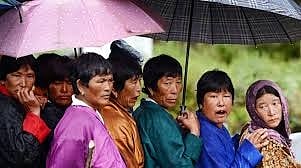
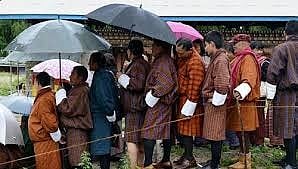
Polls to the 47-member National Assembly in Bhutan has started on Saturday.
Ninety-four candidates belonging to the country's two major political parties are in the fray.
"It is a free and fair election. We expect the polling will be peaceful," Bhutan Chief Election Commissioner Kunzang Wangdi told the media in capital Thimphu on the eve of the poll.
The polls are now a straight contest between the ruling Druk Phuensum Tshogpa (DPT), which won 45 seats in the 2008 polls, and the People's Democratic Party (PDP), the major opposition but with only 2 seats in the last Assembly.
In the first stage of the polls on May 31, two parties, the Druk Nymrub Tshogpa (DNT) and Druck Chirwang Tshogpa (DCT), lost out leaving the DPT and PDP to contest the final stage of the polls tomorrow.
Bhutan has a tri-cameral parliament of the King, National Council and the National Assembly.
Elections to the 20-member National Council was held in April. Each member represents one of Bhutan's 20 dzongkhags (districts) in the Upper House.
But these members are not supposed to belong to any political party. The King (Druk Gyalpo) nominates five more members to the National Council, bringing its strength to 25.
Representatives to both houses were elected first in 2008.
"The polling centres will become counting centres when the voting ends. We expect all results to be out by 9 pm tomorrow," Chief Election Commissioner Wangdi said.
The fate of 94 candidates in 47 constituencies will be decided by 3,81,790 registered voters, including 187,917 female voters.
In addition, there are 48,000 postal voters.
Highest number of voters are in Satse, 41,769, followed by Trashigang, 41,510.
Capital Thimphu has 12,453 voters.
Lowest number of voters are in Gasa, 1,842 voters.
About 10,000 officers, including security personnel, have been deployed for election duty.
There are 850 polling stations, including 215 temporary polling stations. India has provided 1,935 electronic voting machines to Bhutan for the elections to be held tomorrow.
The CEC said Bhutan was grateful to India for its support in carrying out democratic exercise, in successfully holding the first national elections in 2008 and now in conducting the second national elections.
"We would like to thank the people of India and the Government of India in their help in Bhutan's democratic process," Wangdi said.
He said the Bhutan Election Commission is honoured to have India's Chief Election Commissioner V S Sampath to oversee the election process in the Himalayan nation.
"India is the only country whose CEC has been invited to oversee the Bhutan elections," he said.
But the polls campaign has been influenced by India's decision to cut down on subsidies it has so far provided to Bhutan for cooking gas and fuels like kerosene.
Delhi's decision has been criticised as "unfortunate" with some commentators describing it as "bullying tactics" because it is uncomfortable with Bhutan's recent efforts to warm up to China.
Under a 1949 treaty, Bhutan has been conducting its foreign relations under "Indian guidance". But that treaty was amended in 2008, the year Bhutan became a democracy, to allow the tiny Himalayan nation conduct its foreign relations independently.
But Delhi was upset when Bhutan's Prime Minister Jigme Thinley met former Chinese premier Wen Jiabao on a sidelines of a global summit three years ago, amidst speculations that Thimphu may allow Beijing open a mission in the country.
Bhutan is committed to India not to allow any of the Big 5 – permanent members of UN Security Council – open missions in Thimphu.
At the moment, Bangladesh is the only country other than India to have a diplomatic mission in Thimphu.