Published : 27 Feb 2019, 02:15 PM
Updated : 08 Apr 2022, 02:03 PM


Nothing was resolved, and it appeared that if anything, the meeting illustrated how antagonists have hardened their positions over the crisis afflicting Venezuela, once Latin America’s most prosperous country, now in an economic free fall.
The meeting was requested by the Americans to protest the Venezuelan government’s refusal to permit humanitarian aid into the country this past Saturday, when convoys of supplies were stalled at its borders with Colombia and Brazil.
At least four people in Venezuela were killed and dozens injured in border clashes between anti-government protesters and loyalists of President Nicolás Maduro.
Maduro called the convoys a publicity stunt and a pretext for an US-backed invasion to replace him with Juan Guaidó, the opposition leader who declared himself president a month ago. Guaidó, who contends Maduro won elections by fraud, has been recognised as Venezuela’s legitimate leader by the United States and roughly 50 other countries.
Little aid got through Saturday, the opposition’s hope for mass desertions by Venezuelan security forces fizzled, and Maduro’s government called the attempt a failed coup.
By Tuesday evening, it was unclear whether Guaidó, who broke a travel ban to help direct the aid effort from Colombia, would be allowed back into Venezuela or arrested if he returned.
Elliott Abrams, a conservative former diplomat tapped by the Trump administration to be its special envoy in the Venezuela crisis, opened the Security Council meeting by accusing Maduro and his aides of mobilising “armed gangs, thugs and criminals released from prison” to stop the aid convoys.
“While Venezuelans were shot and beaten and killed as they tried to bring food and medicine into their country, Maduro literally was dancing in Caracas,” Abrams said.
A mirror-opposite appraisal of what happened Saturday was presented by Vasily Nebenzia, the ambassador from Russia, which has become Maduro’s principal defender and a critical supplier of economic assistance.
He accused the United States of having caused the crisis in Venezuela through years of economic sanctions, which President Donald Trump has escalated sharply since Guaidó declared himself president.
“Let’s call a spade a spade,” Nebenzia said of the US-backed effort to bring aid into Venezuela. “This is not humanitarian assistance.”
He called the US strategy a plot to “oust an inconvenient regime” that should serve as a warning to Cuba and Nicaragua, which also have been the target of Trump administration criticism.
Responding to Nebenzia, Abrams said the Russian diplomat had espoused “a lot of Cold War rhetoric” that recalled the era when his seat was occupied by diplomats from the Soviet Union. Abrams also said Russia was owed billions by Venezuela and was “no doubt worried” that the money will never be repaid.
Visibly agitated, Nebenzia responded that Abrams had been “an active participant in the Cold War, underground operations in the Cold War.”
This was an apparent allusion to Abrams’ own entanglement in secret efforts to aid right-wing Nicaraguan rebels during the Reagan administration in what was known as the Iran-Contra scandal. Abrams pleaded guilty to two misdemeanor counts of withholding information from Congress but was pardoned by President George HW Bush.
Before the meeting, Abrams told reporters he hoped a US resolution demanding that Venezuela permit humanitarian aid into the country would be presented to the Security Council this week. Diplomats have said Russia would likely veto such a resolution.
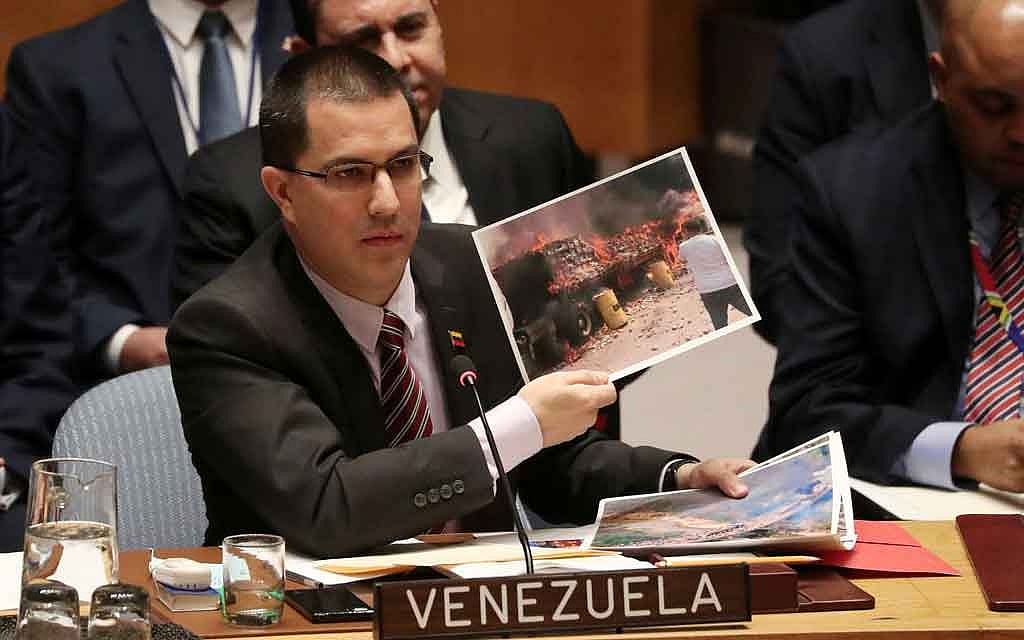
Venezuela’s foreign minister, Jorge Arreaza, who attended the Security Council meeting and has met with Abrams at least twice since the crisis escalated last month, said the humanitarian aid effort had been manipulated by the United States to malign Maduro and create a false basis for a military intervention.
“Mr Abrams: The coup failed,” Arreaza said. “That was the last chapter of the coup on Saturday. Read my lips. It failed. Now is the time for us to return to sanity and international law.”
© 2019 New York Times News Service