


Published : 24 Dec 2021, 12:10 PM
Updated : 03 Aug 2022, 01:52 PM


One of us, Thomas “TM” Gibbons-Neff, a correspondent from the Kabul bureau of The New York Times, had moved with the troops to the gate in the hours before dawn. The other, Mujib Mashal, a Times correspondent who grew up in Kabul, carefully approached TM in the darkness. The Marines would not move toward him onto de facto Taliban turf.
“We cannot go any further, Mujib. We cannot,” TM, a former Marine who had served two tours in Afghanistan, said into his phone.
Moments later, the Americans saw Mujib step into the eerie half-light under a flickering street lamp, along with his escort: three Taliban fighters who clutched their rifles nervously.
Behind them was a group of more than 120 people: current and former Times employees and their family members.
It was the early morning of Aug 19, after days of chaos and terror; days when Afghanistan fell to the Taliban; days of tens of thousands of people rushing the airport to escape; days of trying, and failing, again and again, to evacuate the Times families.
When the Taliban went on their blitz through Afghanistan’s cities in August, many of The Times’ Afghan employees and their family members did not yet have passports, let alone visas to anywhere. Some of them were just days away from receiving their documents when the Taliban walked into Kabul uncontested on Aug 15, and senior Afghan officials fled the country.
In the days that followed, a chartered plane had closed its cabin door in our Afghan colleagues’ faces, its crew panicking and taking off with empty seats. The Times group, including dozens of children, had huddled under the open sky all night and all through the next day near the runway as food and water ran out. They had been charged and beaten by Taliban fighters trying to clear the crowds.
But now the Taliban were helping our group navigate the chaos of desperate crowds at the airport. After days of deal-making and rushed coordination, it had all come down to this: forging an unsettling collaboration between Marines and the insurgent fighters, and bridging the yards between a former American Marine and an Afghan native who had become friends and colleagues, to usher the Times group to an evacuation flight and new lives in another country.
Mujib coaxed his Taliban escorts — led by a senior field commander who had directed insurgent units and suicide bombers — toward the Marines.
The groups came together in a surreal scene: men wearing the uniform TM once wore, waiting to greet dishevelled insurgents they had battled for years. One of the fighters was clutching an American M4 carbine.
Suddenly, the war between them was over. And in the strange light of our cooperation, it almost felt for a minute as if it had never happened.
The Fall of Kabul
Aug 15
We woke up on Sunday morning with the conviction that we no longer had a few days to prepare to leave — we barely had a few hours
Just the morning before, we had gathered all our staff members — the team of reporters, drivers, house staff and security advisers that works every day with our correspondents and photographers — together at the Kabul bureau to tell them that the Times was looking for ways to evacuate them.
As rumors circled that the Taliban were coming, the streets took on a fevered air. Crowds of people scurried around, blank-faced, clutching whatever documents they had, rushing to make one more bank withdrawal or clambering for a place in line for a passport or visa that would never come.
As our Western staff members moved to the American fortification in the Green Zone, we made the call to our Afghan staff and families to gather at the airport parking lot. The hope was that our Western and Afghan staff members could meet at the airport and wait together for a plane out.
On another side of the city, the Taliban were already arriving. While our staff was in transit, a caravan of insurgent fighters, packed into pickups and seized American Humvees, began entering Kabul. Times photographer Jim Huylebroek was there as the Taliban drove in, and he called to alert us.
Inside the once heavily fortified airport, it was as if the Afghan government’s whole top echelon, left behind by the helicopters that had whisked President Ashraf Ghani out of the country, had descended on the terminal and tarmac.
Ministers, directors, lawmakers, generals — an elite cohort accustomed to VIP treatment — now elbowed their way for seats on the last of the planes. They competed with young men who had rushed in from the streets without passports or privilege. For once, they were all equals.
Fahim Abed, a Times reporter, ushered a group of 37 colleagues and family members from the parking area into the airport terminal, on their way to the Ukrainian jet. Fahim was communicating directly with the Ukrainian flight attendant onboard who had the manifest. Then, the unthinkable: As Fahim and our families approached the plane, the crew pushed the steps away and began moving for takeoff without them.
Our Afghan group reassembled at a parking lot near the tarmac and waited together in the chaos of the airport all night, their food and water gone.
Tarmac in Turmoil
Aug 16
In a city made frantic with fear, it seemed that everyone was willing to take their chances at the airport, not even caring where they might land.
That morning, our group was joined by more than 100 others from other Western news outlets, looking for help and direction.
All morning, Mujib and his colleagues tried to negotiate with the Marines to let the group cross to the military side of the airport, where planes were still able to land and take off. But in the growing chaos our unwieldy band managed only to move from the airport parking lot to the base of a tower guarded by the Marines on the edge of the runway. There, our group waited in the scorching sun.
Times officials in New York were on the phone with top officials in Washington, who said they would help get our group to the military side of the airport. And TM, from a bunkhouse in Qatar, was in contact with the Army and Marines at the Kabul airport, who assured him they would do what they could.
But their assurances could not change the reality at the gate — even putting senior military leaders from US Central Command on the line with the Marines at the airport wasn’t helping. The only people the Marines would wave through to the military side were people with Western passports.
Crouched on the ground near the tower where the Marines kept guard, the children in our group were fading from dehydration, and panic was etched in the faces of their parents.
The Marines would not let us in, but some tried to help. One exhausted Marine quietly brought eight bottles of water. “Pretend this didn’t come from me,” he said, and walked away.
Mujib became increasingly certain that if we couldn’t make it to the military side by 5 pm, everyone would have to disperse to find food, water and protection at home. The Marines suggested that we try to cut through the crowd and walk to their side in a single file, which was impossible — we would be rushed by thousands.
As we waited for some operation that might clear part of the crowd, the Taliban made our choice easier, in a way: They came to clear everyone away, including us. This was the first time many of our people had come face to face with the Taliban. It was chaos and crying as the fighters fired into the air and started beating people to get them moving.
“We are moving toward the Marines,” Mujib wrote, warning the Marines and Times leaders on the joint WhatsApp group as the gunfire continued. “We have no other choice.”
And then, just as we were trying to figure out whether to try to push our way through, the Taliban cut right into the middle of our line.
The fighters started pushing, swinging clubs and rifle butts into us. Automatic weapon fire hammered out right beside us as the Taliban began firing into the air. The crowd erupted into random motion.
Our colleagues fell to the ground, family members and children were trampled, screaming in terror and pain. One of our longtime bureau drivers, Farid Rahimi, went down with a broken arm. Even some of the children bore deep bruises.
“It’s a mass stampede — we are leaving, we are leaving,” Mujib told the WhatsApp group in an audio message, his voice hoarse. “We got beaten by the Taliban — they came in the middle and they started beating everyone.”
Our escape from the airport was almost as hazardous as being there: As thousands of people were being driven out, thousands of others were trying to push their way in.
In the chaos of the two crowds pushing against each other, almost all of our suitcases were lost — bags packed with critical belongings for people who were fleeing their homes and country.
We had made it out of the airport alive. But the airport had become close to impossible to get into directly.
The next morning, TM boarded a US military transport plane in Qatar and flew back to the Kabul airport. We needed someone there on the military side dealing directly with American forces.
We readied for a second attempt, but this time with a detailed plan — or so we thought — devised after discussions with officials from the governments of the United States and Qatar, and with the Taliban.
Return to Airport
Aug 18
We had to find a way to get to the airport, and to a plane, while protecting the families. And that meant we had to work with the city’s new rulers.
To calm the panic of our staffers now stuck at home, we began talking with Taliban leaders. They promised that they had instructed their fighters not to pursue anyone, let alone journalists, and that if anyone in their ranks harassed us, we had specific numbers to call for help.
Qatari officials had agreed to take our people on a military transport flight to Doha. From there, we planned to take a charter flight to Mexico, which had agreed to admit even those without passports while they waited to be processed into the United States.
But gathering at the airport was too unsafe. We needed an alternative.
We asked all our families — back down to our core group of 128 — to gather at the Serena Hotel, about 5 miles from the airport. It had become a hub of diplomatic meetings, and Taliban fighters guarded its outer ring. Qatari state security was in charge within.
Our group began trickling to the hotel compound, where Mujib was standing with the Taliban guards to help wave them in and assure them.
Around 11 pm, the Qatari ambassador introduced Mujib to our Taliban escort. The ambassador, Saeed Mubarak al-Khayarin al-Hajri, was the most in-demand diplomat in Kabul. When not personally escorting delegations to the airport, he was using the Serena as a venue to help mediate between the Taliban and many governments.
Mujib told him that the plan was to make it to the airport’s Abbey Gate, near the main entrance. Ambassador al-Khayarin warned that a diplomatic convoy was still stuck there in the crowd. But the Marines, through TM, insisted that it was the best option. Our group began boarding buses at the hotel.
Before he arrived in Kabul as a conqueror, the leader of our Taliban escort — a senior commander at just 29 years old — had never been to the Afghan capital, he told Mujib.
The Taliban commander shook his head repeatedly at the absurdity of it all, of helping strangers flee a triumph he had fought for more than a decade to achieve.
Crossing the Gate
Aug 19
As our buses approached Abbey Gate just after midnight, we were stopped by a churning wall of people.
At first, from the window of his pickup, the Taliban commander tried to order any Taliban foot soldier he could see to help clear the crowd. The fighters, who appeared exhausted, looked shocked by the naivete of the order.
“It’s, like, 20,000 people,” one fighter told the commander, frustrated with the lack of understanding.
At the airport, TM spoke with Col Eric Cloutier, commander of the 24th Marine Expeditionary Unit, a group of 2,000 or so Marines at the airport — and the same unit he had deployed with to Afghanistan in 2008. The colonel said he would try to find a Marine unit to link up with our group at the domestic terminal.
The Taliban commander’s negotiation with the airport guards took about 20 minutes, during which a crowd built around our buses — dozens at first, then hundreds.
The Talib in charge of security was trying to sleep and kept declining calls, and they couldn’t figure out how to move a Humvee blocking the main entryway. The second entryway appeared too small for the buses to fit.
As the crowd swelled, gunshots filled the air as the Taliban tried to break it up. The Taliban commander said he had given his word to make this happen. Mujib urged him to drive away before people were killed.
The buses drove off. Failed again.
When our convoy finally made it back to the airport entrance, the crowd had been pushed back by a ring of armed Taliban. The escort vehicle and the buses easily drove right to the entrance, but the Humvee still hadn’t been removed . So we tried the second entry, but it was too narrow, and the vehicles got stuck.
The crowd started pushing. The Taliban guards pushed back, shooting into the air. The window on our most promising opportunity was closing, and Mujib feared the Taliban would start shooting into the crowd.
Mujib asked everyone to disembark from the buses and make a run for it through the gates while there was still an opening. As gunfire intensified, our group crossed the barrier one by one, hurrying to the protected stretch of the airport. About 20 others from the crowd sneaked in with us.
Then the gates shut again.
The Taliban at this stretch of airport started barking at us, ordering everyone to the ground and pointing their weapons. Our escort rushed in to reach the airport guards. Once he established his seniority, things got easier. The Taliban checked the names against the list, and it was time for our group to go to the American side.
But the Taliban would not move to where the Marines and TM were waiting for the group. Ask the Americans to come get you, one of the Taliban guards told Mujib. “They have said ‘we will shoot anyone who comes toward us,’” the Talib said.
The compromise: Mujib would walk over with a few Taliban to talk to the Marines and TM
A Meeting of Former Foes
Mujib and the Taliban walked the final stretch toward the Marines, calling TM to head off any potentially fatal misunderstandings. TM watched as they stepped forward into the flickering light.
Mujib called out to the Marines: “They are asking do you guys have a translator, or should I do it?” The Marines didn’t have one.
Then, in an unforgettable moment, Marines and Taliban reached across the barrier to shake hands.
“Now that the problem is solved, may God have mercy on all humans, let alone Afghans and Muslims,” one Talib said.
“I wish the best for the Afghan people,” said the Marine who shook his hand.
“I will visit the US one day!” the fighter said.
“I hope so,” the Marine said. “I hope so.”
Days of tumult were yet to come: scenes of panic and desperation at the airport as the US evacuation began shutting down; scenes of carnage as hundreds of people were killed at the Abbey Gate by an Islamic State suicide bomber.
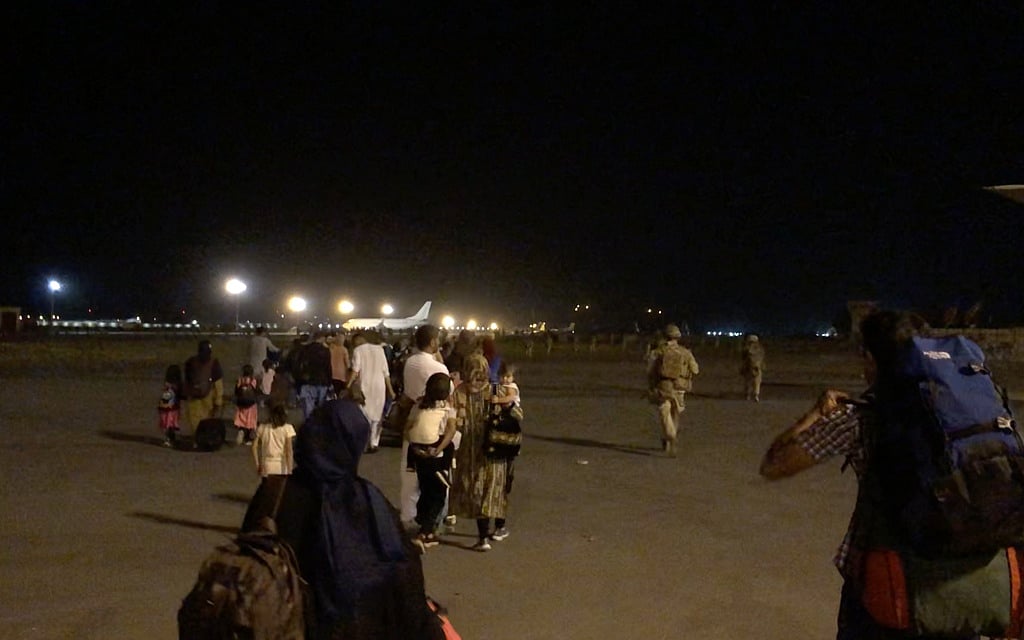
But that morning, as we moved into the military side of the airport, we could finally feel some relief.
There was still heaviness, though. The families walked slowly, toward floodlights that cast long shadows from the parked planes ahead of us. They had shed their belongings, while bearing the unshakable weight of leaving their homes and all they had known. And the path ahead was still painfully unclear.
No one comes through a passage like that unchanged — not people, not countries.
©2021 The New York Times Company












