


Published : 02 Sep 2021, 09:49 AM
Updated : 08 Apr 2022, 01:10 PM


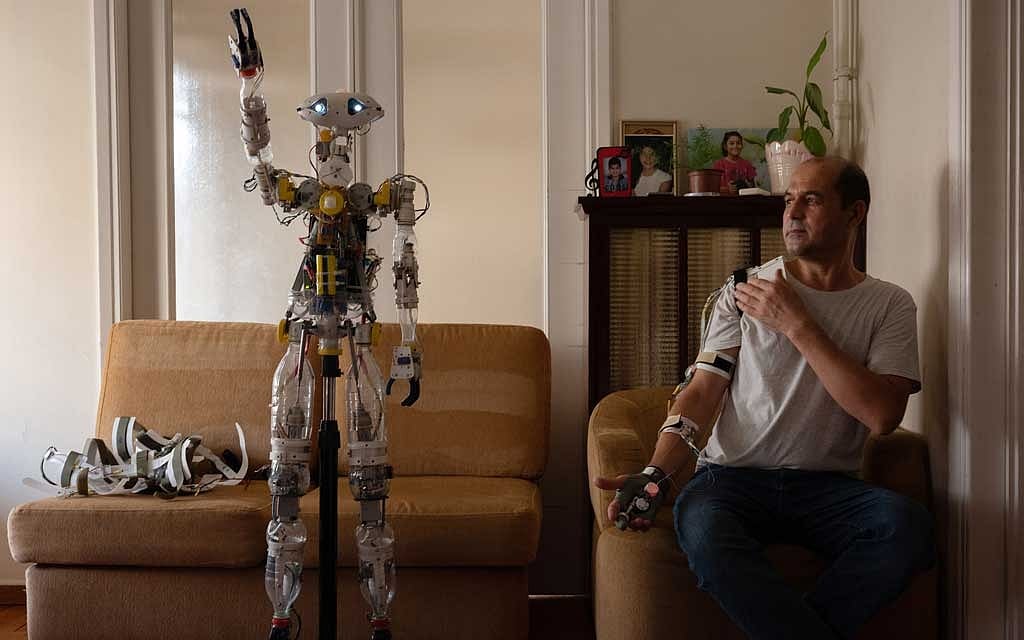
Athena is not a child or a pet, but a robot.
An Afghan refugee living in Athens, Karimi built the robot entirely from trash or, as he prefers to say, “recycled objects” he found on the street: discarded plumbing pipes; pieces of an abandoned printer; tiny motors and transmitters he extracted from broken remote control toys.
But Athena is more than the product of a talented hobbyist. Karimi, an orthopaedic technician, built her to stand as a symbol of what refugees can accomplish and contribute to their new societies — if given the chance. At a time when thousands of Afghans are fleeing their country with little more than the contents of a suitcase, Karimi’s story is particularly relevant.
“I wanted to show my capacity and the capacity of refugees,” Karimi said. He is a neat, trim man, slightly balding, with a reserved demeanor and usually wears black trousers and a T-shirt.
Athena is an astonishing tribute to his resourcefulness. The robot’s fingers were fashioned from the blue handles of Gillette razors, molded over the kitchen stove. “I tried toothbrushes but the razor handles worked best,” he said.
He made the feet and limbs from plastic bottles he baked in his oven to strengthen. He used suitcase wheels for the ankle joints and reinforced the knees with metal cut from a CD player. “I also purchased wireless devices and tiny microelectronics from the bazaar and robotics shop,” he said.
Karimi, 52, finished his robot this past spring but has kept it under wraps until now. He named it Athena after the ancient Greek goddess of wisdom and protector of his newly adopted city. She now guards his workshop, a small windowless room in his family’s apartment near Platia Victoria.
Karimi’s extraordinary engineering talents were developed over two decades in Afghanistan, designing, building and fitting artificial limbs and orthotic supports like braces and splints. He arrived in Athens in 2017 after a treacherous flight with his family across three countries, a snowy mountain pass and the Aegean Sea only to face the formidable and often demeaning hurdle of finding work.
“I applied to three orthopaedic workshops,” he said. “They told me: ‘You are coming from Afghanistan. Here is Europe.’” He felt the men at the workshops were laughing at him.
He took along a CV and the educational and professional certificates he had earned in Afghanistan and Pakistan, but the workshop bosses simply handed them back to him. “They told me: ‘The European technology is much different. You are not familiar with the machines.’”
In fact, the machines Karimi had used in Afghanistan all came from Germany, and because of the long Afghan war, Karimi had extensive experience with complex injuries. “There is a lot of demand for prosthetics in my country due to gunshot wounds, mines and bombs,” he said. “And lots of complicated cases like poliomyelitis, which you don’t find in Greece.”
Without work, Karimi found himself staying home. So he started wandering the streets and sitting in parks.
“It was a difficult time for me,” he said. “You can imagine. I worked 21 years in my country. Then I lost my job, my house. I came to Greece without any work or language.”
His response was both inventive and defiant. He set himself to build an entire body.
“I started to make something to show them,” Karimi said.
“One day I was drinking from a 2-liter Coca-Cola bottle and thought, ‘I could use this bottle for a thigh, and I could use a 1-liter bottle for the shin.’ I thought I could make a robot using recycled things. It’s very cheap. It’s suitable.”
In building Athena, Karimi also had in mind using her to help children with disabilities adapt to orthotic devices and exercises.
“I wanted to make a robot and fix sensors in the orthotics so that when the child moves his knee, the robot knee moves too,” he said. “I wanted the robot to copy the gait, hand movements, everything.” Beyond that, he added, a robot can makes an injured child happy.
Karimi was born in 1970, the seventh of eight children, and grew up in the Afghan cities of Mazar-i-Sharif and Kabul. His father was a director in the customs office.
“I always intended to work as an electrical engineer,” he said. “I love electric work.”
But in the mid-1980s, his eldest sister, a doctor, persuaded him to study nursing as a way to keep off the front lines. This was the time of the mujahedeen resistance to the Russian occupation. At age 18, Karimi was drafted by the government and assigned to hospital duty.
The Russians left in 1989, and the US-backed mujahedeen overthrew the Communist puppet government in 1992. Karimi hid for months. “As a government soldier, I would have been killed,” he said. Eventually, he set up a small medical shop in Mazar-i-Sharif.
A year later, he started work for the UN’s Comprehensive Disabled Afghan Project, a program that helped more than 100,000 land mine victims. By the time he fled Mazar-i-Sharif in 2016, he was supervising a team of 14, including seven technicians, in a workshop run by the Swedish Committee for Afghanistan.
But the fighting that made his work so essential eventually forced his own family to flee. Karimi does not relish talking about politics. Violence in Afghanistan then “was everywhere and everyday,” he said dejectedly, “and it is getting worse.”
“Nowadays I’m very sad,” he said. “But what can we do? We just pray for those people in bad situations. Everyone is worried because we had a lot of bad experiences.”
Karimi was personally threatened by unknown assailants when he and his wife, Shaista, married in 1996. He is Sunni and she is Shia, a mixed marriage that might have offended extremists. After 2011, when Mazar-i-Sharif was reeling once again from attacks and suicide bombings, he became increasingly worried that his family was not safe.
“I also thought terrorists might kidnap me to use my knowledge of microelectronics for remote control weapons,” Karimi said. When he spotted strange men in a car watching his house, he knew it was time to leave. “That was a bad time, really a very bad time,” he said. “We lost a lot of money, our passports, our papers and our dignity,” he said of their journey to Greece.
The couple arrived in Athens early in 2017, and moved into an apartment paid for by the Catholic charity Caritas. Their four children — Said Azim, then 18; Said Rahim, 16; Said Hakim, 8; and Sadaf, their only daughter, 5 — started school. Shaista Karimi, a trained physiotherapist, found work for an NGO, helping new mothers. They were safe, and the family was almost a model of immigration success.
Except that Karimi could not find work, and the asylum process was slow and torturous. To make matters worse, gearing up to talk to immigration officials triggered past trauma. “Every time I talked with the lawyer, I cried,” Karimi said.
At his wife’s prompting, he sought counselling, also through Caritas, which he said was very helpful. “Building Athena was also helping me,” he said. “It’s good for me to busy myself. It helped me avoid psychological problems.”
While working on Athena, Karimi studied English and Greek, and eventually passed a European qualifying examination. He is now recognised as an orthopaedic technician. In 2018, the Karimis were finally accepted as refugees and granted Greek resident permits. And, in 2019, they received refugee travel documents in lieu of passports.
These days, he is setting his sights on a license to make soft shoe soles and inserts. “This would allow me to treat refugees with minor disabilities, flat feet or hallux valgus toes, or people with diabetes who need soft soles,” he said.
As for the machines he’ll need for that, Karimi is already at work building his own 3D printer from scrap.












