Published : 21 Sep 2025, 06:13 PM
Updated : 28 Aug 2026, 01:27 AM


A partial solar eclipse, the last of the year, is set to dazzle skywatchers across parts of the Southern Hemisphere on Sunday, offering a fleeting glimpse of one of nature’s most dramatic celestial ballets.
Depending on location, the Sun may appear as a fiery arc or a misshapen orb, its brilliance dimmed just enough for viewers with protective glasses to see the cosmic alignment unfold.
People in Bangladesh, however, will miss the spectacle as the country lies outside the eclipse’s path of visibility.
Citing the Inter-Services Public Relations (ISPR), state news agency Bangladesh Sangbad Sangstha (BSS) reported that the eclipse will begin at 11:29:48pm Bangladesh Standard Time (BST) on Sept 21, and reach its peak at 1:41:54am on Sept 22, before drawing to a close at 3:53:36am. The entire event will last about four hours and 24 minutes.
According to the ISPR, the eclipse will be visible across parts of the Southern Hemisphere, including New Zealand, eastern Melanesia, southern Polynesia, and western Antarctica.
The central path of the eclipse will reportedly begin at 5:53:17am local time over the South Pacific Ocean northeast of the Samoa Islands in US territory.
The maximum phase will occur at 10:13:39am near the Dumont d’Urville Weather Station in Antarctica, and the eclipse will conclude at 5:48:38 pm northwest of Alexander Island in Antarctica.
The Bangladesh military’s media wing noted that the maximum magnitude of the eclipse will be 0.855, meaning that nearly 85.5 percent of the Sun’s surface will be obscured at its peak.
In a report on Saturday, The Times of India said the "mesmerising sight" that will “bring the year’s sky show to a close” will also pass India's skies unseen.
WHAT IS A PARTIAL SOLAR ECLIPSE
A partial solar eclipse occurs when the Moon passes between the Earth and the Sun, but does not completely cover the solar disc.
Instead, it takes a “bite” out of the Sun, leaving a glowing crescent of light that waxes and wanes as the Moon’s shadow drifts across the sky.
As a result, the Moon covers only a portion of the Sun’s disk, creating a crescent-shaped Sun as seen from Earth.
Unlike a total solar eclipse, where the Sun is completely obscured, a partial eclipse allows some sunlight to still reach Earth.
During a partial solar eclipse:
· The sky may appear dimmer, depending on how much of the Sun is covered.
· The Sun takes on a bite-like shape, especially during the maximum phase of the eclipse.
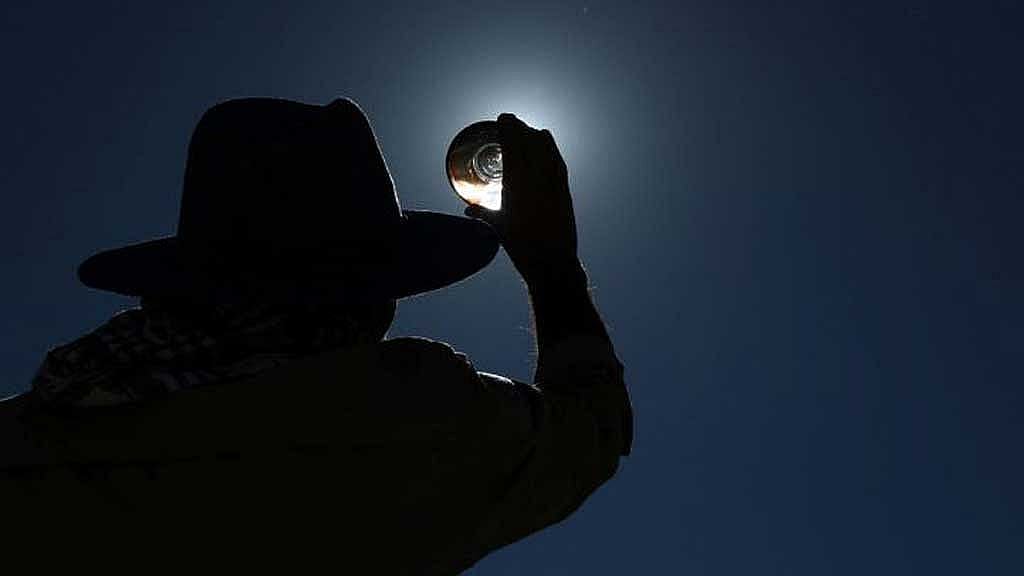
NASA SAFETY GUIDELINES
NASA strongly advises caution when observing any solar eclipse. Viewing the Sun without proper protection, even during a partial eclipse, can cause serious and permanent eye damage.
The following safety precautions are recommended by NASA:
· Use only certified solar viewing glasses (eclipse glasses) or a safe handheld solar viewer.
· Regular sunglasses are not safe for viewing the Sun, no matter how dark they are.
· Solar viewers must meet the ISO 12312-2 international safety standard.
· Inspect eclipse glasses or handheld viewers before use. If they are torn, scratched, or damaged, they should be discarded.
· Children should be supervised at all times when using eclipse glasses or solar viewers.
· Never look at the Sun through a camera lens, telescope, binoculars, or any other optical device while wearing eclipse glasses or using a handheld solar viewer. The concentrated solar rays can burn through the filter and cause serious eye injury.
· If proper solar viewers are not available, indirect viewing methods should be used, such as a pinhole projector.
If eclipse glasses are not available, one can still safely observe the event using a DIY pinhole projector, which allows indirect viewing of the eclipse.
NASA suggests this simple method:
· Use a cardboard box (for example, a shoebox).
· Cut a small square hole on one side and tape a piece of aluminum foil over it.
· Poke a tiny pinhole in the foil.
· On the inside of the box (opposite the foil), tape a white sheet of paper to serve as a screen.
· With the Sun behind you, sunlight will pass through the pinhole and project a crescent-shaped image of the Sun onto the paper.
· Look through another hole cut in the box to see the image -- never look through the pinhole itself.
For those planning to observe or photograph the eclipse using optical devices, NASA provides the following guidance:
· Eclipse glasses should not be used in combination with cameras, binoculars, or telescopes.
· These optical devices require dedicated solar filters that must be securely attached to the front of the equipment.
· When using a certified solar filter on such devices, additional eclipse glasses are not necessary, as the filter provides the needed protection.
· Improper use of filters or optical equipment can result in severe eye injury.
· Seek expert advice from an astronomer or optics specialist before using any solar filter with a camera, telescope, or binoculars.
The celestial event may pass unseen from Bangladesh, but it is a reminder of the universe's enduring rhythm and beauty.
While the eclipse will not grace local skies, it offers an opportunity to appreciate our place in the cosmos and to look forward to spectacles still to come.