Published : 07 Oct 2026, 04:36 PM
Updated : 07 Oct 2026, 04:36 PM


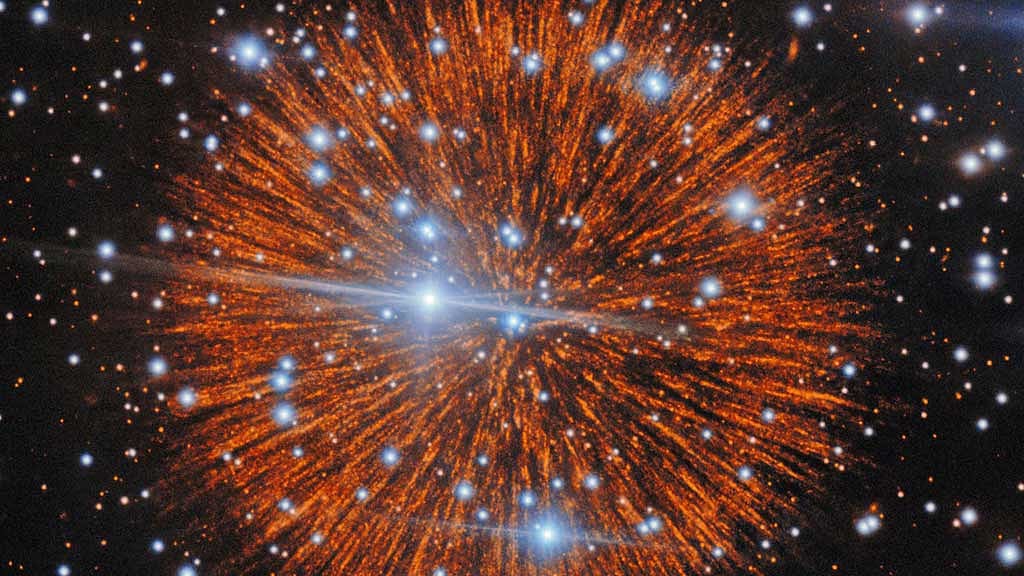
Astronomers have captured the most detailed images yet of a rare supernova remnant in the Milky Way -- the leftover wreckage of a stellar explosion that skygazers recorded nearly 850 years ago.
The object, known as Pa 30, is the only known remnant of its kind in our galaxy, reports The Independent.
Using the Gemini North telescope, researchers have now revealed its structure in remarkable clarity: vast filaments of debris stretching outward like a cosmic fireworks display, each strand wide enough to contain our solar system several times over.
Look closer, and those filaments are not simple streaks. They are long chains of knotted material -- pearls on a string, suspended in deep space.
At the centre sits what scientists call a "zombie star" -- the surviving core of the original star, which did not fully destroy itself in the blast.
The explosion belongs to a rare category called a Type Iax supernova, thought to occur when two white dwarfs collide. Unlike typical supernovae, the explosion leaves the star partially intact.
The event was observed in 1181 and independently recorded by astronomers in Japan, China and the Arab world.
The remnant itself went unnoticed until 2013, when a citizen scientist first spotted it. Pa 30 sits roughly 7,500 light years from Earth -- close enough, astronomers say, to study the debris field at its core in ways not possible with more distant examples, according to The Independent.
"We can see this much detail because of Pa 30's proximity to Earth," said Ilaria Caiazzo of the Institute of Science and Technology Austria, who co-led the research. "This proximity makes Pa 30 uniquely valuable for study."
The find also raises the possibility that similar objects remain hidden elsewhere in the Milky Way. "There might well be similar remnants still lurking in the dark in our own galaxy," said co-lead researcher Tim Cunningham of the University of Warwick.
The findings were published in The Astrophysical Journal.