Published : 15 Oct 2026, 11:12 PM
Updated : 15 Oct 2026, 11:12 PM


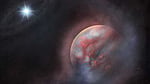
Astronomers have discovered the first green star ever observed, a finding that also reveals white dwarfs -- the dense remnants left behind when stars like our Sun die -- can glow in a far wider range of colours than previously believed, reports The Independent.
The star, designated WD J1330+6435, sits at around 4,000 degrees Celsius and has absorbed rocky material from a planetary system it once hosted.
That material introduced calcium, lithium, and sodium into its atmosphere, producing a chartreuse green glow.
“The traces of sodium in the atmosphere of this white dwarf absorb the orange part of the spectrum, leaving behind a ghostly green glow,” said Dr Mark Hollands of the University of Warwick, who led the study.
“Imagine standing on a planet and looking up at a green star. It feels like something out of science fiction,” he told The Independent.
Most stars, including the Sun, get their colour from temperature alone.
But white dwarfs are millions of times denser than the Sun’s outer shell, meaning elements in their vicinity interact with internal plasma and absorb light across a broader range of wavelengths.
Their colour, it turns out, reflects their chemical makeup rather than their heat.
Using spectral data -- essentially the light “fingerprint” of each star -- the researchers modelled how each white dwarf would appear to the human eye.
The results showed that those rich in carbon appear pink or purple, those surrounded by remnants of old planetary systems look yellow, and cooler ones with hydrogen and helium atmospheres glow blue.
The team also identified what may be the reddest star ever seen: WD J1011+2845, just 48 light years away, which glows a deep salmon-pink due to carbon being drawn up to its surface.
Of 151 white dwarfs studied -- all within roughly 65 light years of Earth -- five displayed unusual colouring.
The rest averaged out to a cool white, a finding that itself corrects a long-held assumption: astronomers had generally believed white dwarfs to be blue, but that skew was caused by the fact that blue examples are brighter and therefore visible from greater distances.
The findings are published in the journal RAS Techniques and Instruments.