Published : 24 Nov 2023, 04:25 AM
Updated : 25 Nov 2023, 12:30 AM


Some of their top leaders were hanged, while some were jailed and some went into hiding. The party is almost falling apart as their longtime alliance with the BNP also collapsed after years of controversy. Finally, the top appeals court confirmed the decision to revoke its registration as a political party, dismissing a challenge against a High Court verdict.
The Jamaat-e-Islami, which was banned after independence for collaborating with the Pakistani military during the 1971 Liberation War, has never been in such a deep political quagmire after being rehabilitated in Bangladesh politics with the help of military ruler and BNP founder Ziaur Rahman.
The Jamaat is now waiting for a written copy of the Appellate Division verdict so that it can decide whether to revive the appeal.
Legal experts say the Jamaat can still continue its legal fight to get back its registration.
At the same time, it has the option to make a fresh appeal by “eliminating the flaws” that led to the scrapping of its registration with the Election Commission.
“The full body [Jamaat’s central committee] will see the written copy of the Appellate Division verdict and decide the next strategy,” said the party’s Publicity Secretary Matiur Rahman Akand.
After Zia’s rule, the party was actively engaged in politics even during the reign of army dictator HM Ershad.
When Bangladesh re-established a democratic government, the Jamaat never faced any trouble during the rule of BNP Chairperson Khaleda Zia. Instead, two of its leaders became members of her cabinet.
The party, a known anti-liberation force, started to feel intimidated when the Awami League came into power and introduced the war crimes trial in 2010. Most of its top leaders were either hanged or jailed until death.
After the 10th general election, the BNP and the Jamaat launched protests to nullify the election. They resumed deadly protests a year later, but the Jamaat faced nothing but trouble as its leaders and activists were arrested.
The central office of the party in Dhaka has been locked for over a decade. None of the leaders visit it. Its offices in the districts outside the capital have faced the same condition as the leaders are often arrested in meetings for “plotting violent antigovernment activities”.
The High Court scrapped the Jamaat’s registration with the EC as a political party following an appeal by other religion-based parties.
It filed an appeal against that verdict which has recently been settled after a decade. The top court, too, turned down the Jamaat’s appeal.
As they had no registration as a political party, Jamaat candidates had to file their nominations as independent contestants in the 2018 general election. When their ally the BNP allowed them to use its symbol, the Jamaat candidates contested the election with the paddy sheaf logo.
Even before its registration was cancelled, the High Court had declared the Jamaat’s election symbol, the weighing balance’, illegal, as it was an emblem of justice in the courts.
Now the party faces two more risks, as the Appellate Division asked a petitioner to go to the High Court for the hearing of an appeal to ban the activities of the Jamaat as a political party; and the trial of the Jamaat at the International Crimes Tribunal as an organisation for committing war crimes.
IS THERE ANY SCOPE FOR REGISTRATION?
The Representation of the People Order sets out specific conditions for the registration of political parties, according to Barrister Tanjib-ul Alam, a constitutional law expert.
In Jamaat's case, however, it was discovered that these conditions were not met, leading to the cancellation of their registration, he said.
“This does not imply that they [Jamaat] cannot be registered in the future. Neither the High Court nor the Appellate Division has declared them ineligible for future registration.”
"They can reapply after meeting all the conditions, and the Election Commission will make the final decision."
Even without registration, there is an opportunity to participate in elections. Jamaat can align with a registered party and utilise its symbol, just like they did in the 2018 polls.
After the High Court scrapped the party's registration in 2013, Jamaat candidates took part in local government elections by running as independent candidates.
Another High Court lawyer noted that even as the Appellate Division has rejected the Jamaat's registration plea, restarting the legal battle is possible.
“The application in the Appellate Division was dismissed for 'default', indicating the appellant's absence during the hearing."
"If a case is dismissed for default, a revival suit can be filed. An application for revival has been submitted. If accepted, a new hearing will be scheduled."
On the Jamaat's strategy moving forward, its Publicity Secretary Matiur said, "The Appellate Division has not issued a written order -- it gave a verbal order. We will obtain the written order in the next 10-12 days and decide our course of action."
“If the decision is to go for restoration, then we will initiate the legal process. If not, we will contemplate our political approach moving forward as a party."
'FUNDAMENTAL CHANGES NECESSARY'
The High Court deemed the Jamaat’s registration “illegal and void”, saying its charter was contradictory to the country's constitution.
The writ petition leading to the judgment outlined four reasons behind declaring the Jamaat ineligible for registration.
Firstly, the Jamaat does not fundamentally recognise the people as the source of all power, and it does not acknowledge the absolute authority of people's representatives to enact laws.
Secondly, communal parties, under the Representation of the People Order, cannot be registered. The Jamaat is identified as a sectarian party in both its actions and beliefs.
Thirdly, a registered political party is prohibited from discriminating based on religion, caste, and sex. However, the Jamaat restricts women and non-Muslims from reaching the top positions.
Lastly, political parties are not allowed to have branches abroad, yet the Jamaat functions as a branch of a foreign organisation, openly admitting its global presence.
"The Jamaat can reapply if it addresses these issues. The court did not explicitly bar them from reapplication," said lawyer Tanjib.
However, addressing these issues requires fundamental changes within the Jamaat, according to him.
Asked about the party's willingness to change, Matiur said, "I can't comment at this moment. Let the judgment from the Appellate Division be released first. The court will provide an explanation. We will decide our course of action after reviewing the explanation."
OTHER APPEALS AT RISK
On Jun 26, Tarikat Federation Secretary General Syed Rezaul Haque Chandpuri and several others filed a writ petition with the Appellate Division seeking a ban on all of Jamaat’s political activities until the disposal of the case over its registration.
Later, 42 distinguished citizens sought to become a party to the petition.
After postponing the hearing several times, the Appellate Division asked the petitioners to move the High Court on Nov 19. But that has yet to happen.
Barrister Tanzib said if the party is banned, then it will no longer be able to work under the same banner.
“Again if the party is penalised following the steps taken against it as a war criminal party, it has no hope in future.”
Former Jamaat chief and party supremo Ghulam Azam was sentenced to 90 years in prison by the International Crimes Tribunal in July 2013. After that the state appealed for his death sentence and sought a ban on the party.
MK Rahman, then an additional attorney general, said: “Because the tribunal gave an observation mentioning them [Jamaat] as a criminal organisation, we called for a ban on the party in our appeal.”
“Article 104 of the constitution states the Appellate Division has the power to enforce “complete justice”. The Jamaat can be banned in light of that power.”
In at least four of the International Crimes Tribunal’s verdicts, Jamaat has been mentioned as a force allied to the Pakistan Army during the Liberation War. In an observation of these verdicts, the Jamaat has been held responsible for wartime atrocities.
A probe into the Jamaat as an organisation began in August 2013 and the investigation agency of the tribunal submitted a report in March the following year.
It brought seven charges against the Jamaat, including war crimes, genocide and crimes against humanity during the Liberation War.
The investigators also asked for the seizure of the party’s wealth, a ban on its activities and the dissolution of the organisation.
But the laws of the International Crimes Tribunal lack clarity of justice and provisions of punishment. People demanding action against the Jammat as an organisation have sought that the words “organisation” and “organisation’s liabilities” be added to the act, alongside “individual” and “individual’s liabilities”. In another section, the “accused individual” should be replaced with “the accused individual or organisation”, they said.
In October last year, Law Minister Anisul Haque said that the law will need amendment to try the Jamaat. Proposed changes to the law were sent to the cabinet.
“We will pass the law in a few days and the trial will then begin,” he had said, but no progress in this move is visible now.
Parliament will not convene unless it is an emergency and with the election schedule announced, the government has no way to amend the law. So the issue must wait until the next parliament is formed.
Shahriar Kabir, executive president of the Ekattorer Ghatak-Dalal Nirmul Committee, said: “There’s pressure from the US. They’re against banning the Jamaat. They supported the Jamaat even in 1971. Our government is probably not able to ignore that pressure for some reason.”
Drawing attention to the government’s promise to revise the law, he said: “The law minister has been saying this since 2014. We just need a small amendment. He asks what the penalty would be. We told him to leave it on the judges. But he didn’t listen to us. Actually we need to take a strong step like Bangabandhu did against the Jamaat.”
NO COALITION BUT ALLIANCE INTACT
Different quarters of society called on the BNP to cut ties with the Jamaat during the war crimes trials, but that did not happen.
Even after the Four-Party Alliance was expended to a 20-party coalition, the Jamaat remained as the BNP’s chief ally.
Under pressure, “reformists” of the Jamaat formed the Amar Bangladesh Party in 2020.
The convenor of the first 222-member committee of that party was AFM Solaiman Chowdhury, a former secretary who resigned from the Jamaat. Former Islami Chhatra Shibir president Mojibur Rahman Monju was the member secretary.
Although they spoke of reforms, many suspected it was a “B team” of the Jamaat.
The new party applied for registration this time, but was rekected by the Election Commission.
The BNP launched protests against the government in 2022 but the Jamaat’s participation in the demonstrations was not visible.
In the meantime, Jamaat chief Shafiqur Rahman said their alliance with the BNP was broken.
BNP Secretary General Mirza Fakhrul Islam Alamgir said the same thing three months later. He added like-minded parties will organise simultaneous programmes.
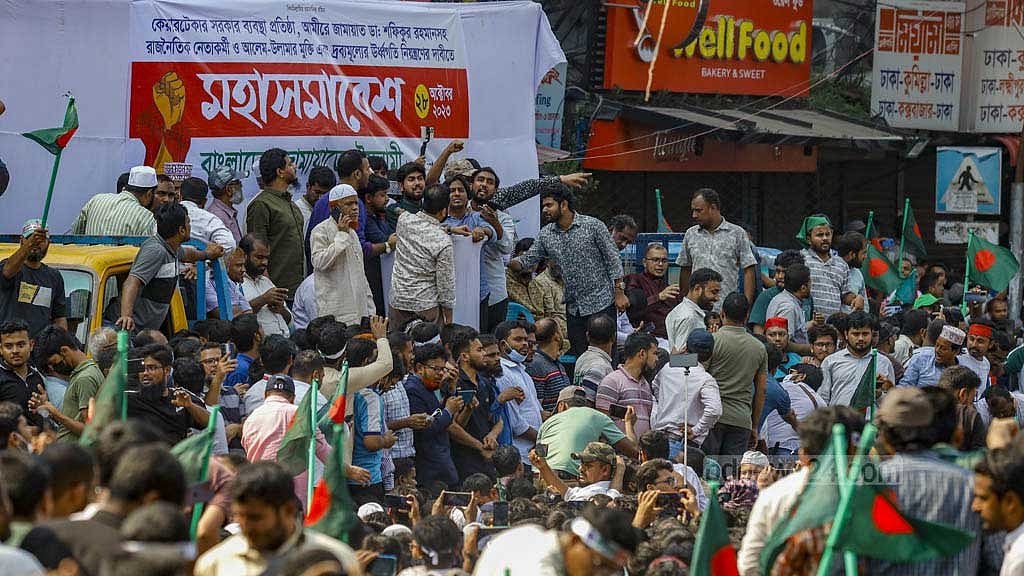
Having been out of political activities for a long time, the Jamaat is seeking to revitalise its activities for the past few months. Despite not being an ally to the BNP anymore, the Jamaat has been observing the same programmes with similar demands.
[Writing in English by Sabrina Karim Murshed, Turaj Ahmad and Syed Mahmud Onindo; editing by Osham-ul-Sufian Talukder]