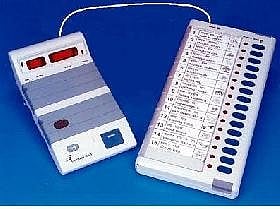
EC working on introducing e-voting
The Election Commission is planning to hold Dhaka City Corporation elections at the end of January, introducing electronic voting system at least in one of the wards on an experimental basis. UPDATES
bdnews24.com News Service
bdnews24.com
Published :
06 Oct 2009, 08:05 AM
Updated :
12 Aug 2022, 01:53 PM
Dhaka, Oct 6 (bdnews24.com)—The Election Commission is planning to hold Dhaka City Corporation elections at the end of January, introducing electronic voting system at least in one of the wards on an experimental basis.
"We are considering introducing e-voting system at least in a ward," chief election commissioner ATM Shamsul Huda told reporters on Tuesday after a meeting at the EC Secretariat.
"We want to introduce e-voting. Before introducing the system countrywide we are likely to introduce it in a ward of Dhaka city on an experimental basis," Huda said.
"It will be a good move if it can be introduced," he said.
SM Lutful Kabir, director of the Institute of Information and Communication Technology of BUET, went to the EC Secretariat to brief on the e-voting system.
Asked when the DCC polls would be held, Huda said: "We want to hold the polls at the end of January. It might also take place in February."
The tenure of the DCC mayor and ward commissioners expired in May, 2007.
Parliament on Monday passed The Local Government (City Corporation) Bill 2009.
The CEC said after the passage of the bill the commission would move to hold DCC polls by formulating different regulations.
According to experts, if steps are taken now the e-voting can be used for holding the elections of the 10th parliament.
The EC wants to move for e-voting as existing manual voting involves huge expenditure in arranging ballot papers and ballot boxes, apart from allegations of rigging.
Lutful Kabir earlier told bdnews24.com that the IICT presented a working model for e-voting to the Election Commission for review.
'It may cost a total of Tk 150 crore to introduce this system all over the country, Kabir said.
"But the system may be used in next parliamentary election if initiative is taken from now. It would take two-three years to complete all works to use it countrywide."
He also said overseas technology may not be as suitable as a locally tailor-made system.
The commission earlier said all decisions on e-voting would be taken after discussing with the political parties.
The commission will inform the IICT after scrutiny about how many electronic voting machines would be required for a ward in the DCC polls.
Replying to a query, the CEC said: "We will introduce it on an experimental basis. If it becomes successful we will consider using it in the next elections."
Huda said an election costs much in ballot papers, ballot boxes and other formalities for over 8 crore voters.
"We have to gradually move to e-voting by using modern technology. It needs adequate experiment and public awareness."
E-voting system is being used in many countries around the world, the CEC said.
"We have to see many other things before using electronic voting machine. First of all, we have to create trust among the public.
"It took 20 years in India to introduce e-voting."
Almost 10 lakh election officers and law enforcers cannot vote on the election day, Huda said.
"It is not even possible to get their votes in postal ballots. We are also moving to register the expatriates as voters. We have to think how their voting can be ensured after the introduction of e-voting system"
During the presentation on the use of e-voting system, Lutful Kabir said using EVM will be helpful in saving cost as well as ensuring transparency and flawless and quick counting.
The system will also help curb storming of polling centres, voter rigging, and manipulation of results by concealing information.
The same machine can be used in next elections. The machine will contain ballot unit, display unit and battery unit.
It will take one minute on average to vote. One machine will be used for 400 voters. It will cost Tk 7,800 to manufacture a machine at the estimate of ballots of 16 candidates.
If there are more than 16 candidates it will cost Tk 2,500 more for separate ballot unit.
After the IICT invented EVM in 2007, it was used in the election of Dhaka Officers' Club.
There are 35,263 polling centres for over 8 crore voters across the country, having 1,77, 277 rooms.
According to EC officials, two lakh voting machines will be needed if one machine is kept at each room.
Among others, election commissioners Muhammed Sohul Hussain, M Sakhawat Hussain, EC secretary Muhammad Humayun Kabir were present.
bdnews24.com/mhc/su/ec/bd/1347h