Published : 24 Dec 2022, 01:32 AM
Updated : 24 Dec 2022, 02:38 AM


The ruling Awami League is going to hold its 22nd National Council while the opposition parties set their sights on bringing down the government and a global economic crisis hurts Bangladesh.
The party leadership is not expected to go through major changes, but the council before the general election is significant as the Awami League scrambles to tackle political and economic challenges by strengthening itself and garnering more popular support.
“When the Awami League wins, it’s a victory for just a few leaders; but when it loses, the entire Bangladesh loses,” famed author Ahmed Sofa said of the 73-year-old party that led Bangladesh throughout the struggle for independence, and economic development in the past 14 years.
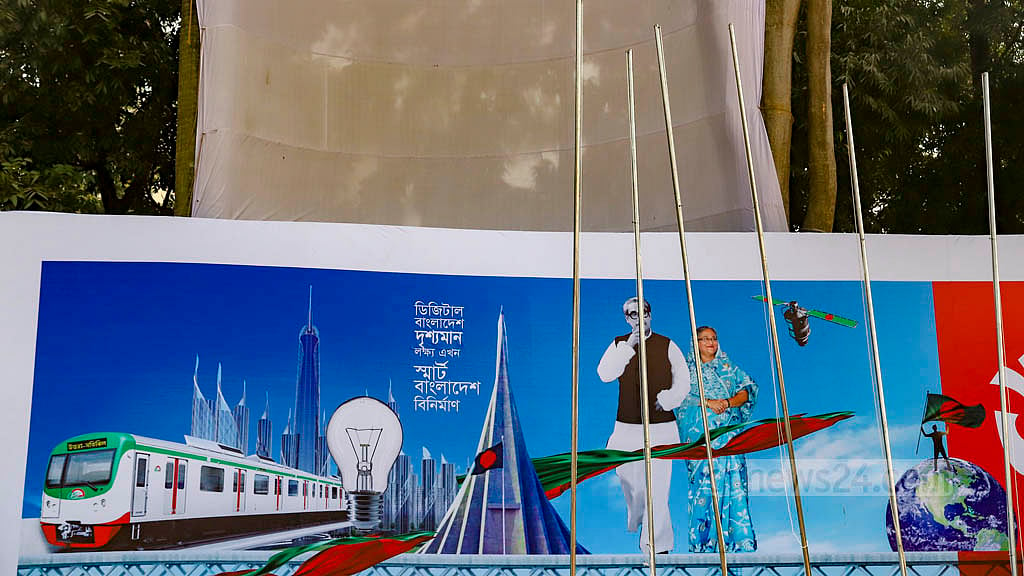
The Awami League now aims to win the election by the end of 2023 or early 2024 and oversee the transition of the country from a ‘Digital Bangladesh’ to a ‘Smart Bangladesh’ as envisioned by Prime Minister Sheikh Hasina, who has been helming the party for over four decades.
She will preside over the council at Suhrawardy Udyan in Dhaka on Saturday – an event expected to draw local leaders from across the country to elect a new committee and set future strategy.
STRENGTHENING THE PARTY
The Awami League has held three councils since it came into power in 2009, with the last one in 2019 after winning the parliamentary polls for the third consecutive term.
The BNP boycotted the previous polls in 2014, as its demand for an election-time caretaker government was not met. After failing to stop the polls and topple the government through protests, the opposition party took part in the 2018 election, but lost. After the protests, the party could not pose any major challenge to the government.
Now it has geared up for a simultaneous anti-government movement with its allies, demanding a non-partisan government for election after the resignation of the Hasina administration.
“Local and international conspiracies are hatched whenever the election approaches. The BNP will also try to warm up the political field. If the party [Awami League] is strong, it’ll be easy to tackle any conspiracies or movements,” said Jahangir Kabir Nanak, a presidium member of the Awami League.
Asked about the key goal of the ruling party now, General Secretary Obaidul Quader said it would strengthen and organise itself under Hasina’s leadership. “We’re committed to developing a secular Bangladesh by upholding the spirit of the Liberation War. We’ll work to reach that goal. Our main goal is to create a developed, prosperous and smart Bangladesh.”
As part of the plan to strengthen the party, the Awami League has held councils of its affiliated organisations, including the Mohila League, Jubo Mohila League, and Bangladesh Chhatra League. New leaders are appointed to all tiers of the local level in all organisational districts.
The party announced general amnesty for the rebel members who were expelled for contesting against party candidates in local government polls.
Ahead of the national council, leaders said, the Awami League held councils in 75 percent of its local units and completed half of the work to form full-fledged committees
“As many as 73 of the 78 organisational units have completed their councils. Also most Upazila and metropolitan units have completed theirs,” said Biplob Barua, office secretary of the Awami League.
NO HINT OF CHANGES IN LEADERSHIP
Awami League leaders do not see an alternative to Hasina, the daughter of Bangabandhu Sheikh Mujibur Rahman, as party chief.
The prime minister recently said she would step down as Awami League president even if a single councillor voted against her in the national council.
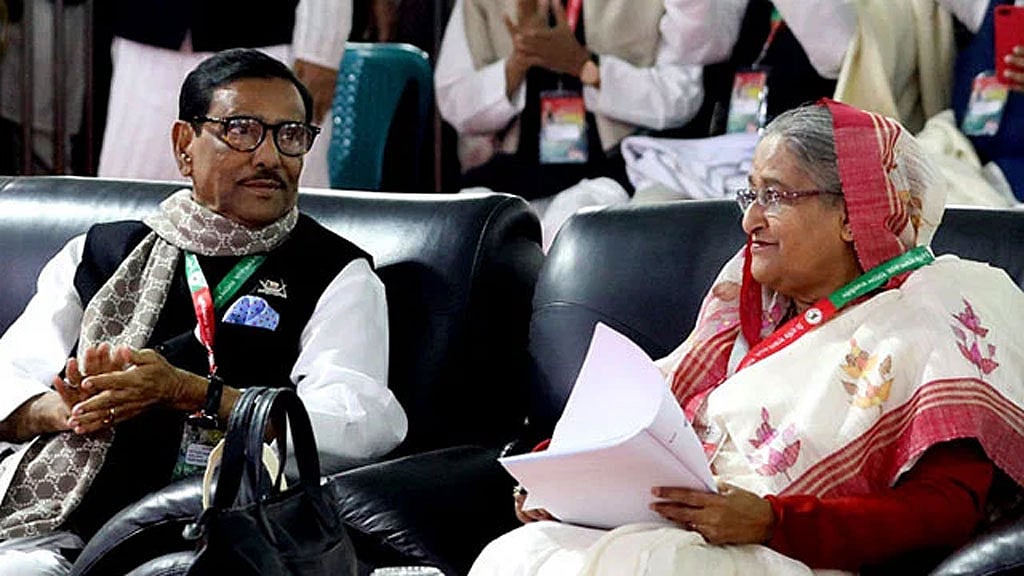
Quader said the question of Hasina leaving as party chief does not arise as he strongly believes there is not any member who does not want her to lead the party. “Our party president is indispensable for us. She is the emblem of our unity.”
The general public, along with Awami League activists, will eagerly watch the council to see if Quader continues to hold the general secretary’s post or is replaced by someone else.
The party has at least 10 leaders who are willing to take the general secretary’s job, according to Quader, who is also the road transport and bridges minister.
“It’s the party president’s decision and the councillors’ opinion which will be reflected in the council. I can’t predict anything right away,” he said.
Quader, who was immensely praised by Hasina in a recent event, however, gave a hint that there would not be a big change in the leadership of the ruling party.
Quader retained his post in the 2019 council but the central committee had some new faces.
The local leaders are looking forward to a leadership that will help the party confront the BNP’s political moves and protest programmes before the election as they see a tough time ahead.
“The leaders who will guide us must be tried and tested ones. If the tested former student leaders and those who remained with the party in bad times join the leadership through this council, we’ll be able to confront the upcoming challenges,” said Mizanur Rahman Bitu, general secretary of the Kumarkhali Municipality Awami League who came to Dhaka to participate in the council.
The council this year is very important for the Awami League, believes Altaf Hossain Biplob, general secretary of Keraniganj Model Thana Awami League.
“I feel that those who worked for the Awami League during its tough time should be brought forward. I hope Sheikh Hasina, a leader of the masses, will choose the right candidates,” he said.
THE COUNCIL
Slogan: The party is holding the council with a slogan to establish a developed, prosperous and smart Bangladesh, as dreamt by Bangabandhu, in a journey under Hasina’s leadership.
Inauguration: Hasina will inaugurate the council at 10 am by hoisting the flags of Bangladesh and the party, and releasing pigeons. The national anthem will be played at that time.
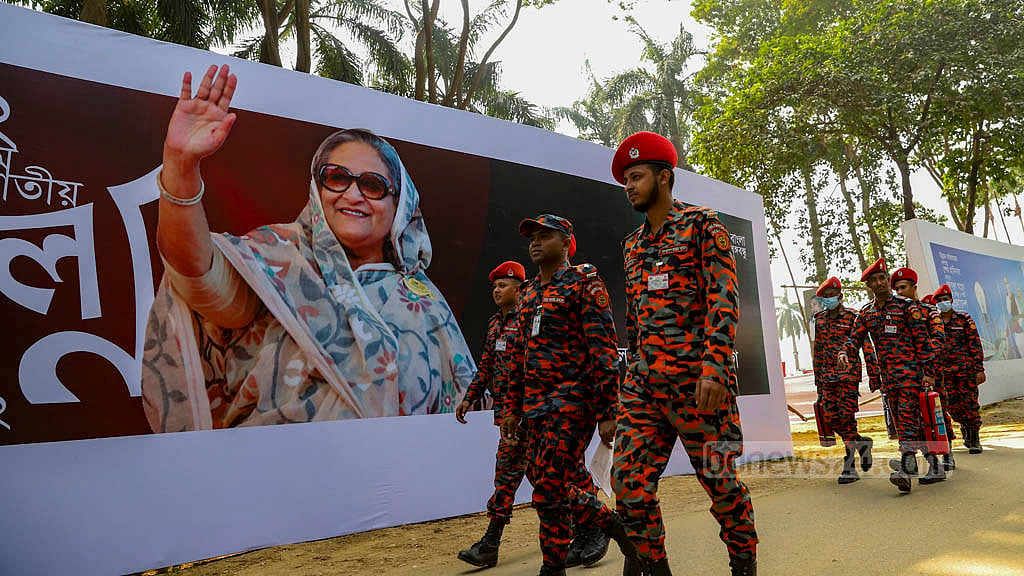
Participants: Around 100,000 leaders and activists, including 7,500 councillors and 7,500 representatives from across the country, will take part in the council. At least 2,000 volunteers will work to maintain discipline. Usually, the Awami League invites foreign delegates to its conference but this time no one was invited to scale down the cost.
Opening session: A cultural programme will be held after the inauguration. Then a condolence motion will be placed remembering the dead leaders following recitations from religious scriptures. After observing a minute’s silence, the organisers will deliver speeches.
Council session: Hasina will inaugurate the main council session at the Institution of Engineers, Bangladesh at 3 pm. Then a close-door council meeting will begin where the party will pass amendments to its constitution. The new committee will be announced in the evening.
Election commission: A three-strong election commission has been formed to select the new leadership of the party. The commission is led by Yusuf Hossain Humayun. Moshiur Rahman and Sahabuddin Chuppu are the members.
DAYLONG EVENT
The stage for the daylong event has been set in the shape of a boat on the Padma Bridge at the south-eastern corner of Suhrawardy Udyan.
There will be 120 seats on the stage, which is 80 feet long, 44 feet wide and seven feet high. Members of the Central Working Committee along with Hasina will sit on the stage.
The ruling party minimised the budget for the council, keeping the global economic crisis in mind. A lot of programmes have been curtailed and the two-day event has been shortened to one day.
Traffic will be controlled in the areas around the Suhrawardy Uddyan during the council. Police have also designated parking places.
A separate stage has been set for the cultural event. Adequate LED monitors will also be installed for people to witness the council events clearly.
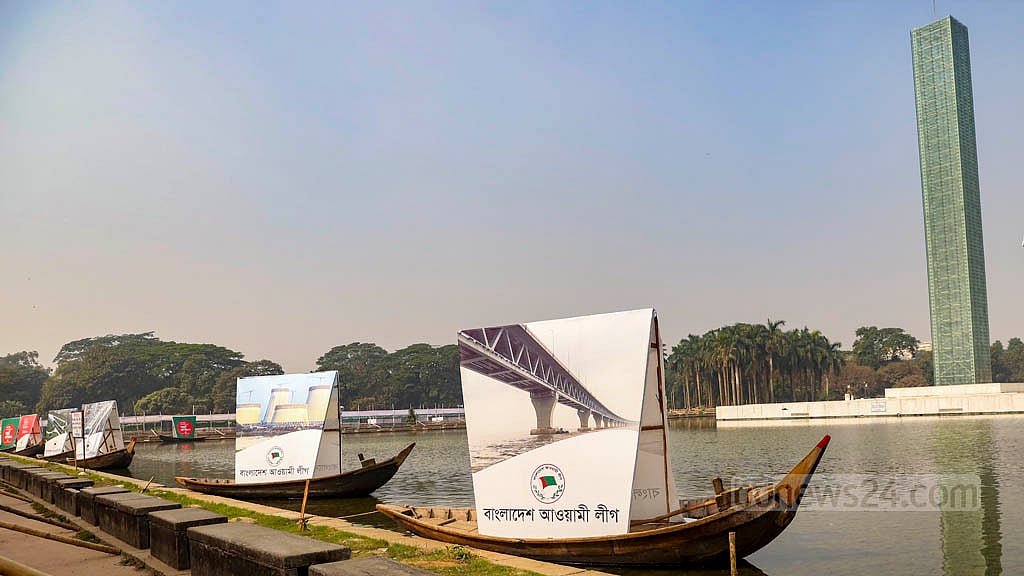
The party will fly 78 of its flag next to the stage marking the organisational districts .
The entrance is decorated with colourful flags. Pictures of Bangabandhu, Hasina and her sister Sheikh Rehana adorn the entrance of the venue.
In front of the stage and around the marquee, paintings will display the history and traditions of the Awami League.
The Awami League’s research wing Centre for Research and Information will livestream the opening session on Facebook and YouTube.
The party has made arrangements to accommodate 40,000 leaders and activists. Food will be distributed from 10 booths.
It will distribute gifts, including memorabilia, a copy of the condolence motion, speeches of the party president and general secretary, party constitution and manifesto, in 15,000 jute bags.
As many as 12 sub-committees have been preparing for the council for a month with a budget of around Tk 43 million.
73 YEARS
The Awami League was formed on Jun 23 in 1949 at Rose Garden in Old Dhaka's KM Das Lane with Moulana Abdul Hamid Khan Bhashani as the president and Shamsul Haq as the general secretary.
Sheikh Mujib was appointed the organisation's acting general secretary in 1952. The East Pakistan Awami Muslim League convention held in the Mukul theatre in Dhaka the next year saw him being elected as general secretary.
Even though Awami League originally went by the name Muslim League, the word Muslim was eliminated in the 1955 council to uphold the secular spirit. East Pakistan Awami League became the new name. The organisation changed its name to Bangladesh Awami League after independence.

Through a number of developments, including political conflicts, the creation of the United Front, and success in the 1954 elections, the Awami League rose to prominence as East Pakistan's dominant political party in the 1950s. But in 1957, Bhashani left the party owing to political disagreements and founded the National Awami Party or NAP.
After that, the Awami League built trust among the populace by leading a persistent anti-military government movement under the leadership of Sheikh Mujib, who later became Bangabandhu, or the Friend of Bangla.
In 1966, Bangabandhu presented the Six Point charter, known as the Charter of Freedom. On the basis of the six points, the Awami League won the election in 1970.
The Awami League then led the nation in the Liberation War when the Pakistani occupation forces launched genocide of unarmed Bengalis in 1971. After nine months of bloodbath with Bangabandhu held captive in a Pakistani jail, Bangladesh defeated Pakistan and received international recognition.
Following the assassination of Bangabandhu and the massacre of his family on Aug 15, 1975, and the killings of the four national leaders on Nov 3, the military administration began tormenting and oppressing the Awami League, which saw some of the leaders defecting and some others falling silent in fear of brutal suppression.
On May 17, 1981, Bangabandhu's daughter Hasina returned home as the party president and united a divided Awami League, starting a movement against the then military ruler HM Ershad. Since then, she has been holding the position of president of the party.
The Awami League returned to power by winning the 1996 election. It lost the 2001 polls, but alleged the election was engineered.
The party formed government again after winning the 2008 election following two years of military-backed caretaker government, which took charge after a political turmoil. The party is now ruling the country for a third consecutive term.