Published : 15 Jun 2023, 02:13 AM
Updated : 15 Jun 2023, 02:13 AM


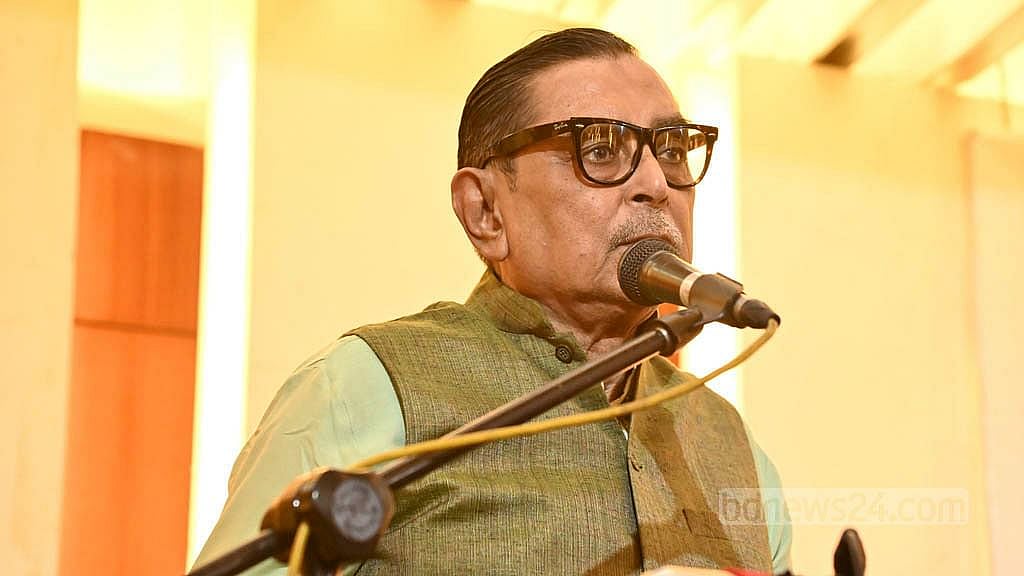
The president of the Workers Party of Bangladesh, Rashed Khan Menon, has accused the United States of meddling in Bangladesh’s domestic politics to ensure the downfall of the Sheikh Hasina-led administration in an effort to assert its dominance.
The leader of the self-proclaimed largest communist party in Bangladesh, also a junior coalition partner of the incumbent Awami League-led government, made the accusation on Wednesday during a debate in parliament on the recently proposed national budget for the upcoming fiscal year.
Earlier in the day, a Chinese Foreign Ministry spokesperson, Wang Wenbin, had accused the US of meddling in Bangladesh and others’ internal issues “under the pretext of democracy and human rights”.
Referring to the sanction on the Rapid Action Battalion and seven of its current and former officials imposed in 2021, and the current visa restriction policy, Menon said: “All these are a part of regime-changing tactics by the US.”
Menon, leader of a party known to have deep ties with the ruling Communist Party in China, also made some arguments to support his accusation.
“The US wants St Martin’s Island, and they also want Bangladesh in the Quad,” he said.
The leftist leader, however, did not elaborate on why he believes the US would like to take over the picturesque coral-made island, a popular domestic tourist destination, on the Bay of Bengal.
The US and the partner countries of the Quadrilateral Security Dialogue, commonly known as the Quad, have been actively seeking to widen their strategic partnership with Bangladesh as part of the former’s Indo-Pacific Strategy since 2018.
First established in 2007, Quad is an informal strategic dialogue between the US, Japan, Australia and India. The initiative is widely regarded as a response to China's growing economic and military influence.
In April this year, Bangladesh published a 15-point outlook on the same subject, highlighting issues like counter-terrorism, peace-building and peacekeeping initiatives in the Indo-Pacific Region.
Bangladesh’s own outlook supports “Rules-based International Order” and “Free and Uninterrupted Movement and Trade”.
In 2021, the then Chinese Ambassador to Bangladesh, Li Jiming, officially cautioned Bangladesh about joining Quad, saying “any form of participation in that ‘small group of elites’ would substantially damage bilateral relations between Dhaka and Beijing.”
‘LETTERS FROM 6 MEPS PERHAPS WRITTEN BY BNP’S EUROPEAN WING’
Participating in the same debate, Abdur Razzaque from the Treasury also criticised the recent letter issued by six members of the European Parliament or MEPs, addressing a senior official of the union, to ensure free, fair, and impartial general elections in Bangladesh, tentatively scheduled to be held early next year.
To achieve that, the six MEPs-- Ivan Stefanec from the Slovak Republic, Michaela Sojdrova from the Czech Republic, Andrey Kovatchev from Bulgaria, Karen Melchior from Denmark, Javier Nart from Spain and Heidi Hautala from Finland-- suggested the High Representative of the EU for Foreign Affairs and Security Policy and Vice-President of European Commission Joseph Borrell ensure installation of a poll-time non-partisan government in Bangladesh to carry out electoral duties.
The letter also criticised the Bangladesh administration’s apparent failure to protect minorities and ensure their civil rights.
Razzaque, a senior member of the Cabinet and of the Presidium - the Awami League’s highest policymaking body, said he was disappointed to read the nuances in the language of the letter.
“I felt like the BNP’s European wing drafted the letter for the MEPs,” he remarked.
The agriculture minister also said Dhaka would welcome any UN delegation who would like to examine the status of the minorities in the country.
“If the delegation finds any truth to the claims made in the letter, we [the government] will accept any sanctions,” he said.