Published : 13 Aug 2026, 04:55 PM
Updated : 08 Sep 2026, 09:32 AM


Bangladesh has not witnessed a contested presidential election in three and a half decades, but that changes this month, with both the ruling and Opposition parties fielding candidates.
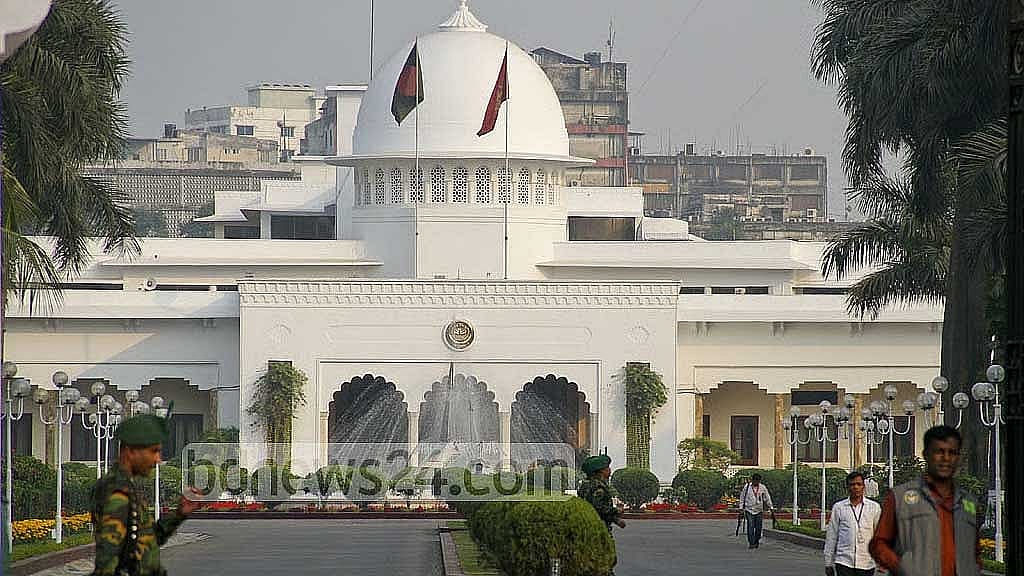
Lawmakers will vote inside parliament to choose the country's 23rd president.
Members of parliament will cast their votes on Aug 20 to elect the head of state.
Chief Election Commissioner AMM Nasir Uddin, the returning officer for the poll, has already called a sitting of MPs in the parliament chamber at 2pm that day.
Under the announced schedule, nomination papers are to be submitted by Aug 13, scrutinised on Aug 16, with Aug 18 the last day for withdrawal of candidacies.
Under the parliamentary system, the president is elected by a vote of MPs.
Article 48(1) of the Constitution says the president shall be elected by members of parliament in accordance with the law.
The ruling BNP and Opposition Jamaat-e-Islami are both fielding candidates this time, making a vote necessary.
Vote Equation
The 13th Parliament has 350 seats in total: 300 general and 50 reserved for women.
With one general seat's candidacy cancelled, 349 MPs will be eligible to vote in the presidential election.
Of them, 247 are BNP MPs and 77 belong to Jamaat.
The rest include eight independents, eight from the National Citizen Party (NCP), three from Bangladesh Khelafat Majlis, one each from Islami Andolan Bangladesh, Bangladesh Jatiya Party (BJP), Ganosamhati Andolan, Gono Odhikar Parishad, Khelafat Majlis and Jatiya Ganotantrik Pary (JAGPA).
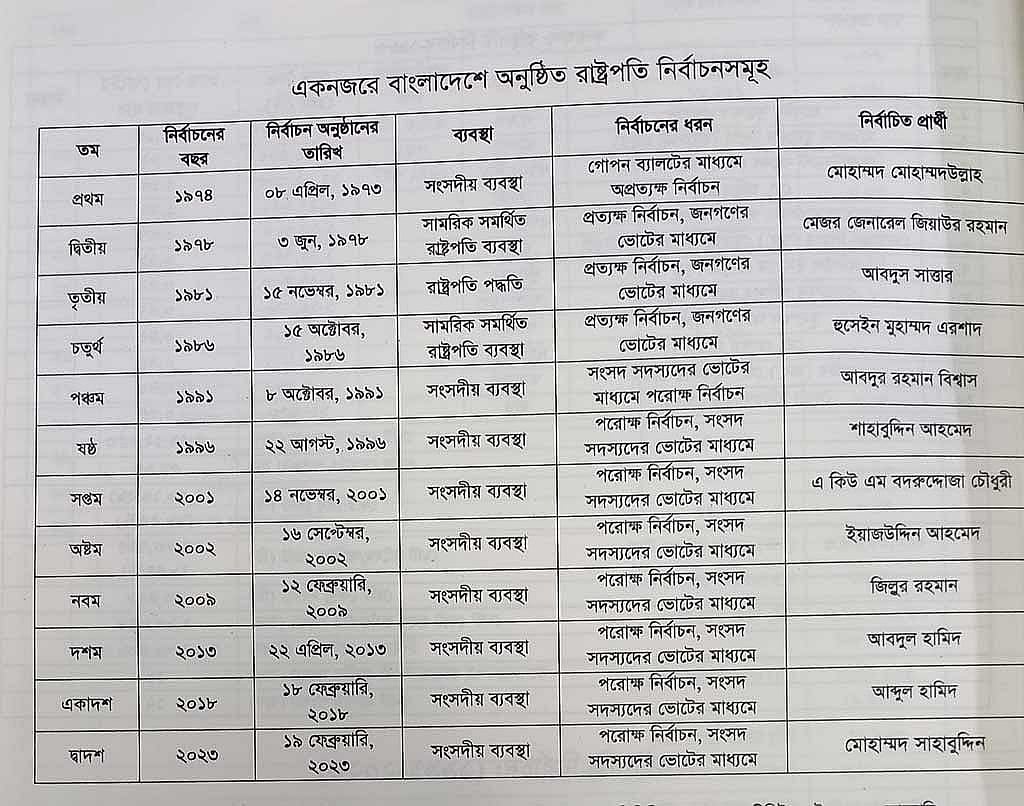
Since the parliamentary system was reintroduced, Bangladesh has held eight presidential elections -- in 1991, 1996, 2001, 2002, 2009, 2013, 2018 and 2023 -- but only the 1991 vote went to a contest.
In the other seven, the ruling party's sole nominee was elected unopposed.
Two candidates contested the 1991 election.
This time too, two candidates are expected to be in the running, according to the information available so far.
During periods of military rule and a presidential system, Bangladesh's head of state was elected through direct public vote.
Ten candidates ran in 1978, 32 in 1981 and 12 in 1986.
First Election
After the country's first parliamentary election, MPs unanimously elected a president in 1974.
The 1972 Constitution's second schedule provided for the president to be chosen by secret ballot of MPs.
Bangladesh's first parliamentary presidential election was held on Jan 24, 1974.
The then parliament speaker Mohammad Mohammadullah, facing no rival, was elected the country's third president unopposed.
1978 Presidential Vote
Independent Bangladesh's first direct public presidential election was held on Jun 3, 1978.
Total voters stood at 34,886,247, with a turnout of 54.27 percent.
Eleven candidates filed nomination papers, though only 10 ultimately contested.
Nationalist Front candidate major general Ziaur Rahman was elected with more than 15 million votes.
His nearest rival was Democratic United Front candidate general Ataul Gani Osmani.
Other contenders included independent Hakim Maulana Khabiruddin Ahmed (burning torch), Jatiya Jana Mukti Union's Abul Bashar (umbrella), independent Azizul Islam (plough), independent Golam Morshed (bullock cart), Islami Democratic Group's Md Abdus Samad (weighing scales), Jatiya Dal's Syed Sirajul Huda (date palm), independent Sheikh Md Abu Bakar Siddique (lantern), and Jatiya Jana Mukti's Principal Abdul Hamid (bicycle).
Among them, the lowest tally was 24,000 votes and the highest 81,000.
1981 Vote
Bangladesh voted for the president again on Nov 15, 1981.
Total voters stood at 38.95 million with a turnout of 56.51 percent.
The BNP's justice Abdus Sattar was elected with 14.2 million votes, defeating his closest rival, Awami League candidate Kamal Hossain.
A total of 83 hopefuls collected nomination papers, though only 31 eventually contested, drawn from the BNP, Awami League, Jatiya Samajtantrik Dal (JaSad), NAP, Samyabadi Dal and other parties, alongside independents.
1986 Presidential Vote
The third direct presidential election was held on Oct 15, 1986.
There were 47.91 million registered voters and turnout was 54.88 percent.
Jatiya Party candidate HM Ershad won.
His closest rival was independent candidate Maulana Muhammadullah, popularly known as Hafezzi Huzur.
Sixteen people collected nomination papers, with 12 eventually contesting.
1991 to 2023: Indirect Vote
After the parliamentary system's return, presidents were elected by MP votes.
Those elected this way include Abdur Rahman Biswas, Justice Shahabuddin Ahmed, AQM Badruddoza Chowdhury, Iajuddin Ahmed, Zillur Rahman, Abdul Hamid (for two terms) and Mohammed Shahabuddin.
Of these, only the 1991 election went to a vote, since both the BNP and Awami League fielded candidates.
Every election since has returned the ruling party's nominee unopposed.
The Last Vote, Recalled
The BNP formed the government after the fifth parliamentary election in 1991, with Jamaat as its ally, while Awami League sat as the main Opposition.
That August, parliament passed the Presidential Election Act, making MPs the voters for the presidential poll.
On Oct 8, BNP's Biswas contested against the Awami League's candidate, former chief justice Badrul Haider Chowdhury.
In the 330-member parliament, Biswas won with 172 votes against Chowdhury's 92; 66 members abstained.
The then chief election commissioner Justice Abdur Rouf served as the returning officer, with voting held inside the parliament chamber.
Mihir Sarwar Morshed, then an Election Commission official, served as a polling officer for that vote. Recalling the experience 35 years on, he said a separate seat had been arranged beside the speaker's chair for the returning officer, with four division-wise vote counters set up in the chamber and EC officials assisting with the polling.
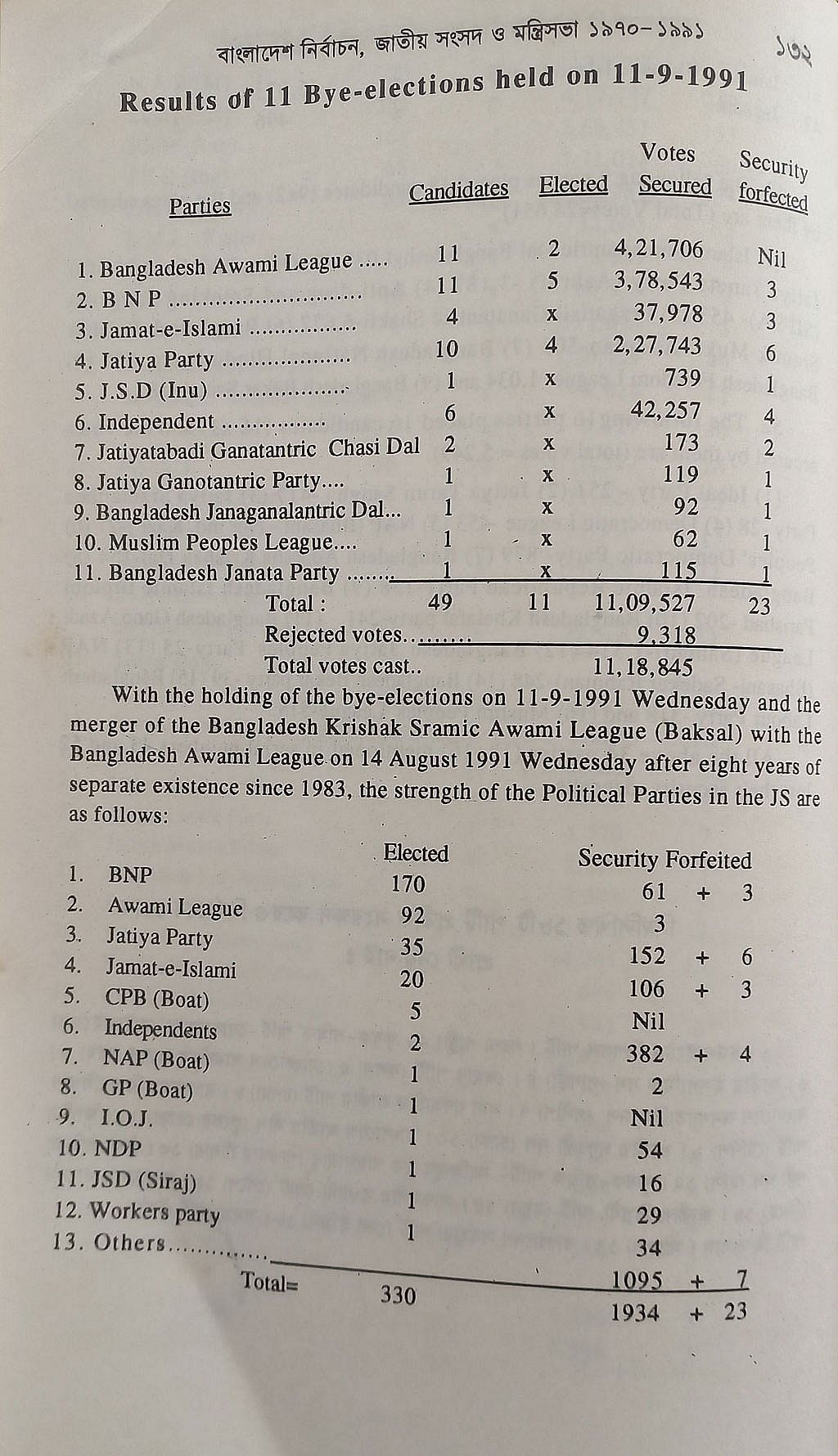
MPs signed and wrote division numbers before placing their ballots in designated boxes.
Morshed said a few Awami League MPs at the time had kicked up a commotion over a mistaken belief that the CEC was seated in the speaker's chair; it later turned out a separate chair had been placed beneath the platform of the speaker's seat for the returning officer.
Current Speaker Hafiz Uddin Ahmad and Chief Whip Nurul Islam Moni were independent MPs in that parliament.
The BNP's polling agent that day was Barrister Rafiqul Islam Miah, while the Awami League's was Tofail Ahmed. Neither is alive today.
That was the first time voting was held in the open, Morshed said. "The ballots weren't signed and shown openly. But the officials on duty, along with both candidates' polling agents, could see from a distance who was voting for whom.
“Agents from each party even noted down who voted for whom."
Md Zakaria also served as a polling officer in that 1991 election, later going on to serve as the Election Commission's acting secretary.
Now director general of the NGO Affairs Bureau, Zakaria said: "We assisted in the process. The Jatiya Party boycotted the vote... Article 70 was in effect if anyone voted against their party."
Voting began at 2pm that day and ran without a break until 5pm. BNP chairperson and the then prime minister Khaleda Zia voted at 2pm, after which she took the prime minister's seat and watched party members cast their votes.
Awami League president Sheikh Hasina voted at 3:34pm. As the clock struck 5pm, the CEC declared voting time over.
Counting began at 5:05pm, with results announced by quarter to six.
Result
BNP's Biswas was elected president in the 1991 vote, with Awami League's Badrul Haider as his nearest rival.
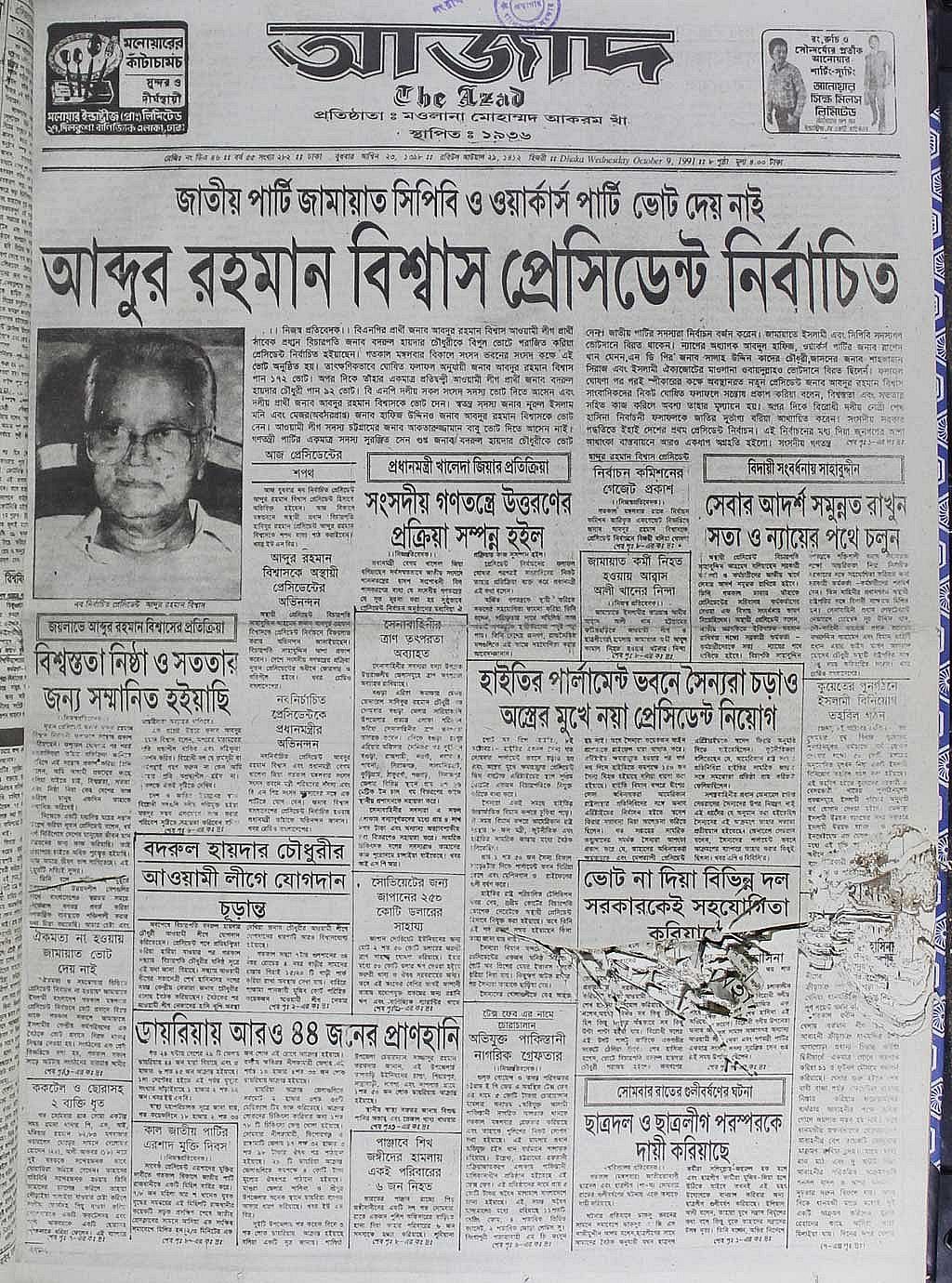
In the fifth parliament, BNP held 140 seats, Awami League 88, Jatiya Party 35, Jamaat 18, BAKSAL five, CPB five, and one seat each for Islami Oikya Jote, NAP (Muzaffar Ahmed), Gonotantri Party, NDP, JaSad (Shahjahan Siraj faction) and Workers Party.
Alongside the 300 general seats, there were 30 reserved seats at the time.
Of the 330 members overall, 66 abstained from voting, including members of the Jatiya Party and Jamaat, according to parliamentary affairs researcher Prof Nizam Uddin Ahmed.
He said the BNP candidate's 172 votes came from the party's 140 MPs, plus 28 reserved women's seats, two independents and two others.
A report published in the Azad newspaper the day after the vote, on Oct 9, said the Jatiya Party, Jamaat, CPB and Workers Party did not vote.
The eight-column report said all BNP MPs turned up and voted for party candidate Biswas, with independent members Nurul Moni and Hafiz Uddin also backing him.
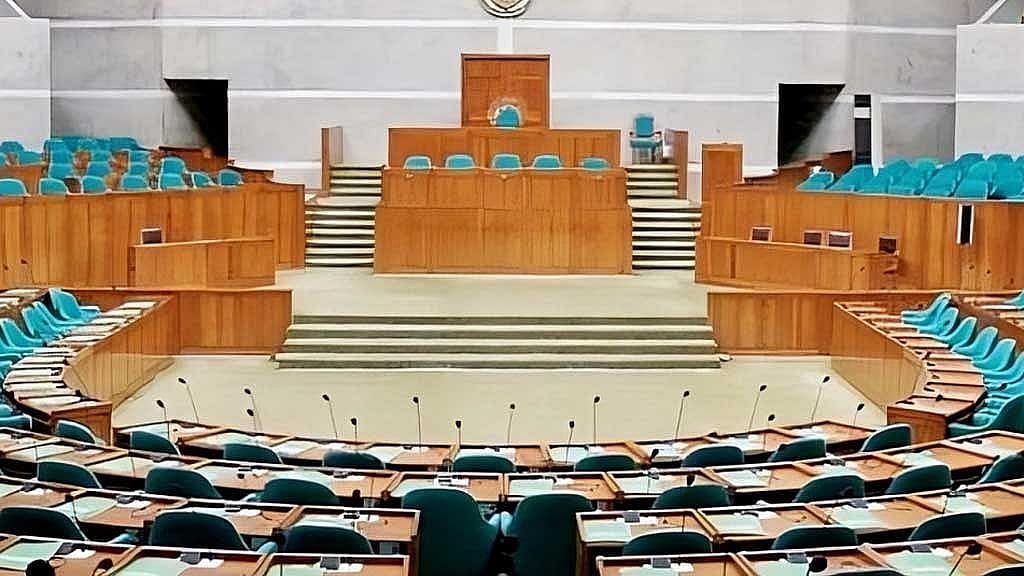
Gonotantri Party's Suranjit Sengupta voted for Awami League candidate Badrul Haider, though the party's Akhtaruzzaman Babu did not turn up to vote.
The Jatiya Party boycotted the election altogether, while Jamaat-e-Islami and CPB members abstained.
NAP's Abdul Hafiz, Workers Party's Rashed Khan Menon, NDP's Salauddin Quader Chowdhury, JaSad's Siraj and Islami Oikya Jote's Maulana Obaidullah also abstained.
The Election Commission published the results gazette the same day, confirming Biswas had won 172 votes to Badrul Haider's 92.
Party Line Still Final Word
A total of 349 MPs will vote in the Aug 20 presidential election, to be held inside the parliament chamber.
Under Article 70 of the Constitution, an MP elected on a party's nomination loses their seat if they resign from that party or vote against it in parliament.
Chief Whip Moni said this provision will apply to the presidential vote as well.
"Since Article 70 hasn't been amended, it will apply in the presidential election. MPs can't take any decision outside their party's. Anyone who does will lose their membership.”
Explaining the voting process at a briefing at the parliament media centre on Tuesday, the chief whip said MPs would write the candidate's name in front of them, openly or in secret, along with a division number.
“So everyone will know who I'm voting for,” he added.