Published : 31 Jul 2023, 05:28 AM
Updated : 31 Jul 2023, 05:28 AM


Music was his religion, even as he prayed five times a day as a devout Muslim. In his songs it was faith straddling the mosque and the temple which came alive. He sang of the sanctity of Ramadan and yet held fast to the belief that the religion of man was humanity.
And therein came the number, ‘tu Hindu banega na Mussulman banega / insaan ki aulad hae insan banega.’
Versatility was his. It was a trait which carried him, on a magic carpet as it were, to a universe of melody all his own, leaving lyricists and music directors alike mesmerised. Decent in his dealings with people, he spoke in softness as mellifluous as his music.
Mohammed Rafi transported us all to a world of dreams, of passions born of the rhythms of the heart. And thus he sang:
‘Agar tu hai sagar to majdhar main huun / tere dil ki kashti ka patwar main huun / chale gi akele na tum se ye naiya / miley gi na manzil tumhein bin khewaiya ….’
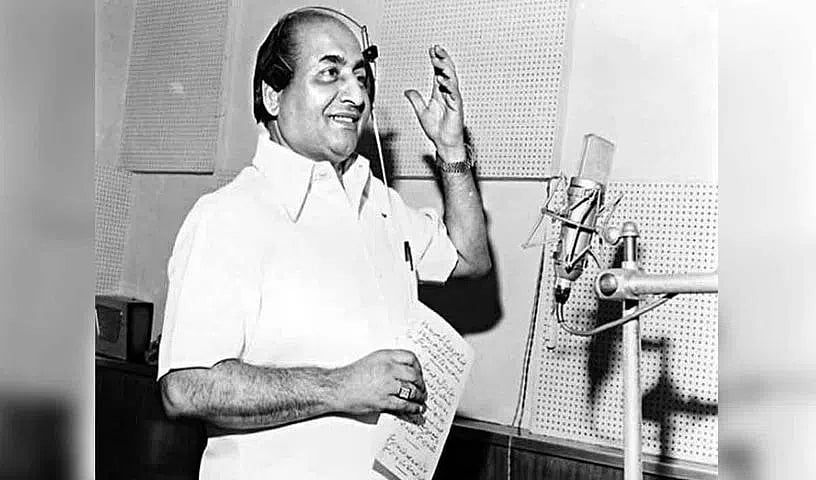
Forty-three years after his death, Mohammed Rafi remains a defining symbol of what songs in the Urdu language ought to be. In these four decades-plus since his passing, no artiste has come close to setting the record, to lifting music on to the high perches of poetic ecstasy in the way Rafi did it. The music director Naushad had his way of explaining the Rafi phenomenon. There was a gift of divinity in him, said he, a manifestation of the power of God to endow men with voices that touched the heavens in their intensity. Rafi was one such man.
There is the old Mohammed Rafi song you cannot but hum, ‘hui shaam un ka khayal aa gaya / wohi zindagi ka sawal aa gaya.’ He was a maestro, in that true sense of the meaning. Think of ‘Radhike tu ne bansri churai’; or dwell on ‘hue hum jin ke liye barbaad.’
Rafi’s versatility said it all. There is forever a huge dash of uplifting spirituality in‘parwardigar-e-alam tera hi hai sahara / tere siwa jahan mein koi nahi hamara.’ There will come into you a true light of God as you have never experienced it before. And then listen to Rafi’s love songs.
The heart stops in a woman when he sings ‘mohabbat choome jinke haath /jawani paaon parhe din raat.’ Or maybe she and you will recreate the old Rafi-Lata duet, ‘kabhi raat din hum duur thhe / din raat ka ab saath hai / wo bhi ittefaq ki baat thi / ye bhi ittefaq ki baat hai’?
Or perhaps you will recall that scene where Dilip Kumar sings for Waheeda Rehman: ‘tu hai saqi / main hoon sharabi.’ Carry on, to the lines, ‘teri baton mein geeton ki sargam / teri chaal mein payel ki chham chham’ in another song, ‘tere husn ki kya taareef karoon / kuch kaehte hue bhi darta huun.’ Absolute romance is in the air.
High tragedy underscored Rafi’s songs. Reflect on the sadly lilting ‘koi saghar dil ko behlata nahi / bekhudi mein bhi qarar aata nahi.’ Or the heart-breaking ‘toote hue khwabon ne / hum ko ye sikhaya hai / dil ne jise paaya tha ankhon ne ganwaya hai.’ In ‘main zindagi ka saath nibhata chala gaya / har fikr ko dhuen mein urhata chala gaya’, you see not worry but a world burning up in the cigarette smoke rising from Dev Anand’s lips.
Rafi could easily slip into singing light, even comical numbers. That was his versatility at work. In ‘kanto mein phansa anchal / zulfon mein phansa ye dil’, it is a frivolous Rafi you run into. There is also ‘lal chharhi maidan khari’ or ‘ae dil hai mushkil jeena yahan /zara hat ke zara bach ke / ye hai Bombay meri jaan.’
In the movie Aan, the passionate ‘dil mein chhupa ke pyar ka toofan le chale’ is soon replaced by the calmer ‘takra gaya tum se dil hi to hai / roye na ye kyun ghayel hi to hai.’And just as you begin to think that no song could beat that one, you spot an epic tale of undying love in ‘tere mere sapne ab ek rang hain.’ Love bores its way into the heart, as in ‘chhalkaye jaam aaiye aap ki / ankhon ke naam honton ke naam.’
In the movie ‘Meri Surat Teri Ankhen’, a lonely, despondent Ashok Kumar sings, in an atmosphere of funereal gloom, ‘tere bin soone nayan hamare.’ Such a sense of gloom you will again find in ‘maine chand aur sitaron ki tamanna ki thi / mujhko raaton ke siyahi ke siwa kuch na mila’; and in the duet, again with Lata Mangeshkar, ‘dekh liya main ne / qismat ka tamasha dekh liya.’
Rafi was of a class. Indeed he was a class comprising himself. If he danced his way through ‘hum tum ye bahar dekho rang laya pyar / barsat ke mahine mein’, he also walked ponderously through ‘dil jo na kaeh saka / wohi raaz-e-dil kaehne ki raat aayi.’Remember the lugubrious beauty in the Bahadur Shah Zafar ghazal, ‘na kisi ki aankh ka noor huun / na kisi ke dil ka qarar huun / jo kisi ke kaam na aa sakey / main wo ek musht-e-ghubar huun’?
Rafi’s songs lift you to the vicinity of the stars --- ‘chalo dildar chalo / chand ke paar chalo.’ In ‘yaad na jaaye beete dino ki / jaa ke na aaye jo din / dil kyun bulaye unhen’, it is old world romance which takes hold of you, sensibilities and all, once more.
Romance in its pristine purity is in the air when he sings ‘ab kya misaal doon mae tumhare shabab ki’ and then ‘likhe jo khat tujhe wo teri yaad mein’. In ‘madhuban mein Radhika naache re’, where Dilip Kumar makes music on his sitar, you get mesmerised by the explosive energy of the song. And ‘na jhatko zulf se paani / ye moti phoot jayenge / tumhara kuchh na bigrhe ga / magar dil toot jayenge’?
God manifested himself in Rafi, as has been said about him. The song ‘aap ke haseen rukh / pe aaj naya noor hae’ recreates the old passions which underscored our youth and yet lends colour to our approaching twilight. Much a similar feeling arises when we go back to ‘ik haseen sham ko / dil mera kho gaya’ and ‘chhoo lene do nazuk honton ko / kuchh aur nehi hae jam hae ye’.
With Rafi it is an endless celebration of life -- its shining moments and clouded skies. Who among us will not serenade the beloved with ‘tumhari zulf ke saaye mein / sham kar loonga / safar ik umr ka pal mein / tamam kar loonga’? A young man in search of love will sing ‘kisi na kisi se / kahin na kahin / kabhi na kabhi dil lagana parhe ga.’ And as we walk through the old woodlands of romantic innocence, many among us recall the tantalisingly beautiful women at whom we directed the song ‘main pyar ka rahi huun / teri zulf ke saaye mein / thorhi der theher jaoon.’
The melody in Mohammed Rafi -- his ghazals, his solo as also duet numbers together with his renditions of Bengali music -- encompasses an eternity. He makes the heart leap to the skies in sheer joy of beauty in ‘hae kali kali ke lab par / tere husn ka fasana / mere gulsitan ka sab kuchh / tera sirf muskurana.’ He educates us on the sorrow of love lost, as in ‘kabhi khud pe / kabhi halaat pe /rona aaya / baat nikli to hare ik baat pe / rona aaya.’
The song ‘mujhe duniya walo / sharabi na samjho / main peeta nehi huun / pilayi gayi hae’ has never been equalled in its intensity of passion. And no farewell to a newly-married young woman setting off for her in-laws’ home will carry greater substance than ‘babul ki duayen leti jaa / ja tujhko sukhi sansar miley / maeke bhi kabhi na yaad aaye / susral mein itna pyaar miley’.
Subtlety of passion begins to beat in our ageing hearts again as the song ‘aese to na dekho / ke hum ko nasha ho jaaye / khubsoorat si koi / hum se khata ho jaaye’ wafts along and straight into the memory.
There will not be a Mohammed Rafi to sing songs in twenty-three languages again. Nor will there be, we suspect, any artiste to approximate the heights he scaled in the land of music that the South Asian subcontinent has always been.
(Mohammed Rafi, pre-eminent Indian playback singer, died on Jul 31, 1980, aged 55)