


Published : 03 Apr 2018, 10:53 PM
Updated : 08 Apr 2022, 03:03 PM


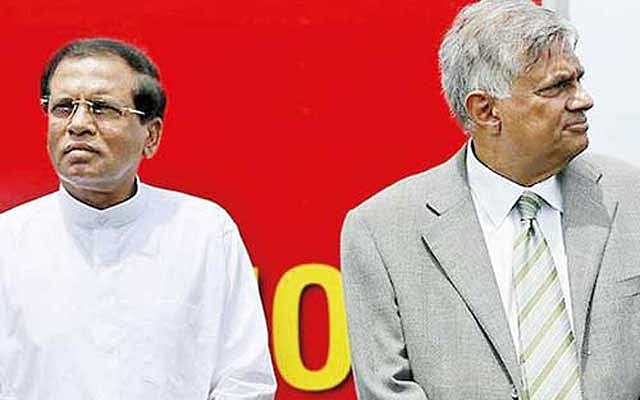
Cabinet Minister and SLFP leader, Chandima Weerakkody, told newspersons on Monday the decision to ask Wickremesinghe to step aside was taken after the SLFP MPs met President Sirisena the same day.
Sirisena also held discussions with Prime Minister Wickremesinghe and cabinet ministers belonging to Wickremesinghe’s United National Party (UNP).
The Sri Lankan government is a grand coalition in which the principal parties are the SLFP led by Sirisena, and the UNP, led by Wickremesinghe.
At his meeting with Wickremesinghe, President Sirisena reportedly asked the former to resign to make away for a new leader who will be acceptable to all parties which are now in the grand coalition government.
But the prime minister apparently refused to accede to that request on the grounds that it is not proper for outsiders to dictate who should lead the UNP, especially when the incumbent enjoys the confidence of the party.
Earlier last week, the Working Committee of the UNP had unanimously agreed to back Wickremesinghe, and vote en bloc to defeat the no-trust motion brought by the Joint Opposition (JO) led by former president Mahinda Rajapaksa.
The Joint Opposition and the ruling SLFP are now in cahoots against the UNP and the prime minister.
They are chips of an old bloc which broke up after Sirisena split and stood against Rajapaksa in the Jan 8, 2015 presidential election supported by the UNP.
But equations between these three groups drastically changed after the Feb 10 elections to the local bodies, which were swept by Rajapaksa’s newly formed Sri Lanka Podujana Peramuna (SLPP). The SLFP and the UNP were crushed.
The left-leaning and nationalistic SLFP and President Sirisena promptly blamed the prime minister’s pro-West and right-wing political and economic policies for the defeat, and noisily sought Wickremsinghe’s resignation.
But Wickremesinghe said he could not be driven out of office so long as he was the leader of the single largest party in parliament.
The UNP and its allies in the United National Front (UNF) had 106 members in the parliament of 225 MPs. The SLFP and SLPP together had only 95.
However, determined to oust Wickremesinghe, the JO presented a no-confidence motion and began to collect signatures. The SLFP and the six-member Janatha Vimukthi Peramuna (JVP) agreed to support the motion, giving it a total of 101 potential supporters.
Given the present line-up in parliament, Wickremesinghe should be able to survive the no-confidence. To boost his chances, he has the support of the 16-member Tamil National Alliance (TNA) as well.
But the critical question is what after the no-confidence motion?
The prime minister will stay, but the president, who is head of the cabinet and the defence minister to boot, and the SLFP ministers will be against him.
The two factions have not been able to work together so far. The president has been frequently intervening to reverse the decisions of the prime minister especially on economic and foreign policy matters.
Matters will only get worse when the prime minister comes rejuvenated by a victory in parliament on the no-confidence motion. Wickremesinghe can be expected to assert himself more, forcing the president to use his powers as the Executive President more resolutely.
Sri Lanka is thus set to witness a power struggle at the highest level until the next presidential and parliamentary elections in 2020, if the rickety government does not collapse before that.
It is foreseeing this that SLPP leader Rajapaksa has been asking for the dissolution of parliament and the election of a new one to reflect the political realities on the ground.













