


Published : 29 Mar 2018, 04:09 PM
Updated : 08 Apr 2022, 03:03 PM


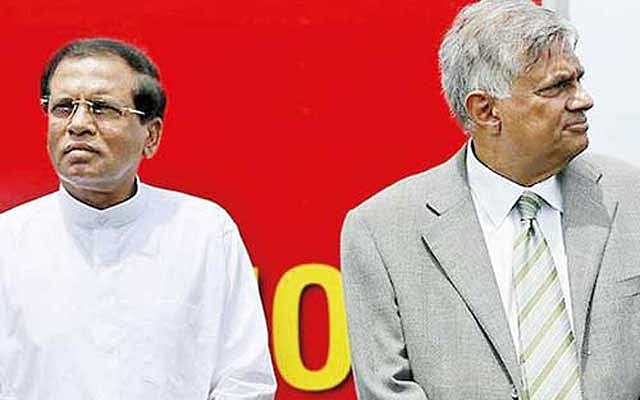
They are unable to see eye to eye on most matters, especially on economic policy which is critical for winning elections.
Given the fact that in elections, governments are judged on the basis of the goods and services they provide to the common man, the centre-left president has found the right of centre economic policies of Prime Minister Wickremesinghe to be greatly wanting from the electoral angle.
The results of the Feb 10 local bodies’ elections proved this.
The main parties in the ruling coalition, Prime Minister Wickremesinghe’s United National Party and President Sirisena’s Sri Lanka Freedom Party, came a cropper at the grassroots level polls.
They could not face of the populist onslaught of the fledgling Sri Lanka Podujana Peramuna (SLPP) led by former President Mahinda Rajapaksa.
Rajapaksa had formed the SLPP after splitting from the SLFP led by Sirisena.
The fault lay in the division of cabinet portfolios, with UNP being given most of the economic ministries.
But this arrangement went awry from the world go. The prime minister promptly took the Central Bank and the Securities Exchange Board under his wing. And in a little over a month of assuming charge, in Feb 2015, the LKR 11.5 billion Central Bank bonds scam had taken place.
An unfavourable agreement to lease out Hambantota port to China for 99 years was signed. Large sums of money were borrowed from abroad but there was no development work done to justify it. The creation of one million jobs remained a pipedream.
A frustrated president, Sirisena, then formed the National Economic Council to guide policy and oversee implementation. Three weeks back, Sirisena asked the Prime Minister to wind up his cabinet committee on economic management, which was dominated by a coterie and two outsiders.
But when the Prime Minister did not oblige, the president took away, this week, the Central Bank and many subjects from the purview of the Ministry of National Policies and Economic Affairs under the prime minister and returned it to the Ministry of Finance. The Security and Exchange Commission of Sri Lanka was also transferred to the Ministry of Finance.
NO CONFIDENCE MOTION
It is significant that the president should do this to the prime minister when the latter is to face an opposition sponsored No Confidence Motion (NCM) against him on Apr 4.
The NCM had been submitted by the Joint Opposition (JO) led by the SLPP, and has the tacit support of the majority of the SLFP led by the President.
The SLFP feels that it should combine with the SLPP to throw out the UNP yoke, and form a Left of Center government of their own. Or, at the least, they should get rid of Wickremesinghe.
But throwing out Wickremesinghe is not easy. Sirisena had asked Wickremesinghe to step down in favor of an alternative leader. But Wickremesinghe pointed out that, as per the 19th. Amendment of the constitution, the President cannot ask a Prime Minister to quit. The Prime Minister can be ousted only by his party MPs or through an NCM.
The UNP appears to be backing Wickremesinghe, with almost all UNP MPs supporting him, refusing to be dictated to by the President and the SLFP.
And the UNP is the single largest party in parliament with 82 members out of a total membership of 225. Combined with its allies in the United National Front (UNF), the UNP has the support of 106 MPs.
The UNP also has the support of the Tamil National Alliance (TNA) which has 16 MPs, and the Sri Lanka Muslim Congress having one MP.
On the other hand, even if the SLFP and the SLPP-led Joint Opposition group combine, their NCM will get only 95 votes.
However, there a danger lurking in the parliamentary law. A No Trust Motion can be passed with a majority of MPs “present and voting.” Therefore, Wickremesinghe will have to ensure that his party and alliance MPs attend the debate and vote on April 4.
He has asked all UNP and UNF MPs to come back to Colombo on Apr 1.













