


Published : 28 Mar 2022, 11:18 PM
Updated : 03 Aug 2022, 11:40 AM


As Indian authorities raced to roll out contingency plans to deal with the strike, the country’s federal power ministry directed all publicly run electricity companies to be on high alert to ensure that hospitals, defence installations and railways continue to be supplied with power.
The shutdown, which began early Monday, was called by dozens of labour unions representing workers from both public and private sectors. Union leaders said the protests were aimed at a variety of government policies that they said harmed workers, farmers and Indians in general. They also said they were demanding an immediate scrapping of a new labour law that allows contract work, gives employers greater leeway in setting wages and increases working hours.
“The present government is anti-workers and against poor people,” said Arthanari Soundararajan, an opposition politician from Communist Party of India (Marxist) in the state of Tamil Nadu.
Across the southern state of Tamil Nadu, hundreds of protesters in red shirts appeared on the streets blocking roads and chanting anti-government slogans, saying they are against the privatisation of electricity boards and rising fuel prices.
The government of Prime Minister Narendra Modi has made a strong pitch for the privatisation of some state-owned assets that it characterises as underperforming. Government-backed financial institutions are protesting a federal move to privatise them and also protesting a bill that is expected to reduce the minimum government holding in public sector banks from 51% down to 26%.
With bank unions joining the strike, the State Bank of India, a government institution, warned its customers that banking services were likely to be affected Monday and Tuesday.
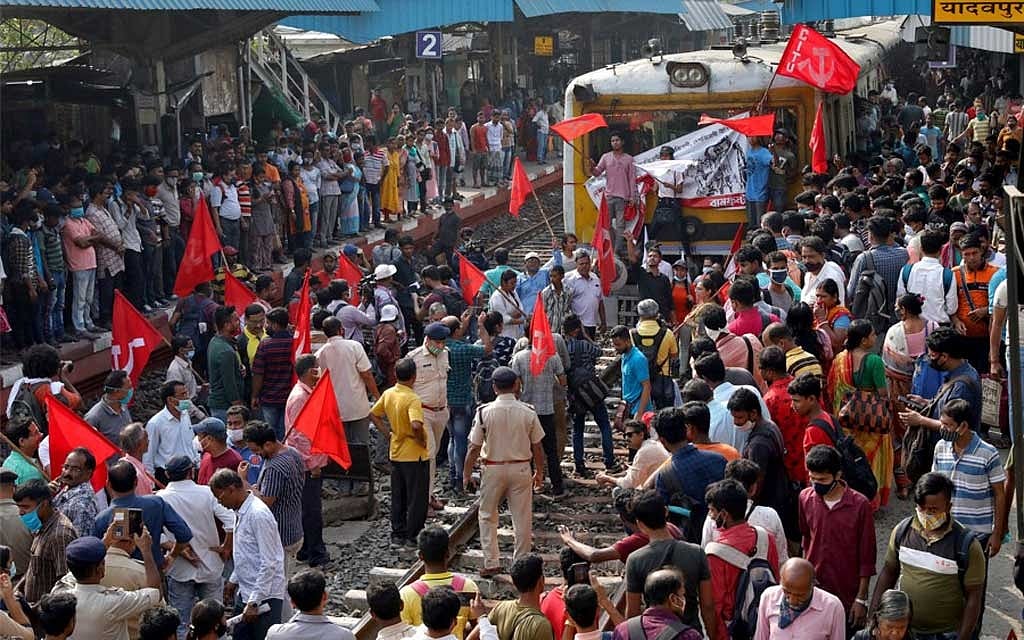
Protesting employees blocked railway lines and stopped trains at several locations in the state of West Bengal. In Kerala, in the south, streets were empty and shops shuttered.
In the western state of Maharashtra, home to the financial capital Mumbai, the local government invoked a law barring employees of public electricity companies from joining the protest.
In New Delhi, India’s capital, some lawmakers were backing the protest, holding placards inside the country’s federal Parliament protesting hikes in the price of fuel.
The strikers’ list of 12 demands includes freezing all privatisation plans and providing universal social security for workers in the so-called informal sector of the nation’s labour force, like rag pickers, street sweepers and rickshaw drivers. The informal sector makes up an estimated 80% of India’s 470 million workers.
Anurag Saxena, a top official with the Centre of Indian Trade Unions, which has over 6 million members nationwide who work in the coal, steel, oil, telecom, banks and insurance sectors, said that Modi’s government is changing labour laws to the detriment of workers, effectively lowering wages even amid rising inflation. Privatisation plans are another sore point.
“They are selling railways, airports, ports, oil industry and gas refineries and our power transmission sector, there is nothing left,” Saxena said. “Whatever our forefathers have built in this country is being now sold to big corporate and private entrepreneurs.”
© 2022 The New York Times Company












