Published : 18 Dec 2022, 12:01 AM
Updated : 18 Dec 2022, 10:36 AM


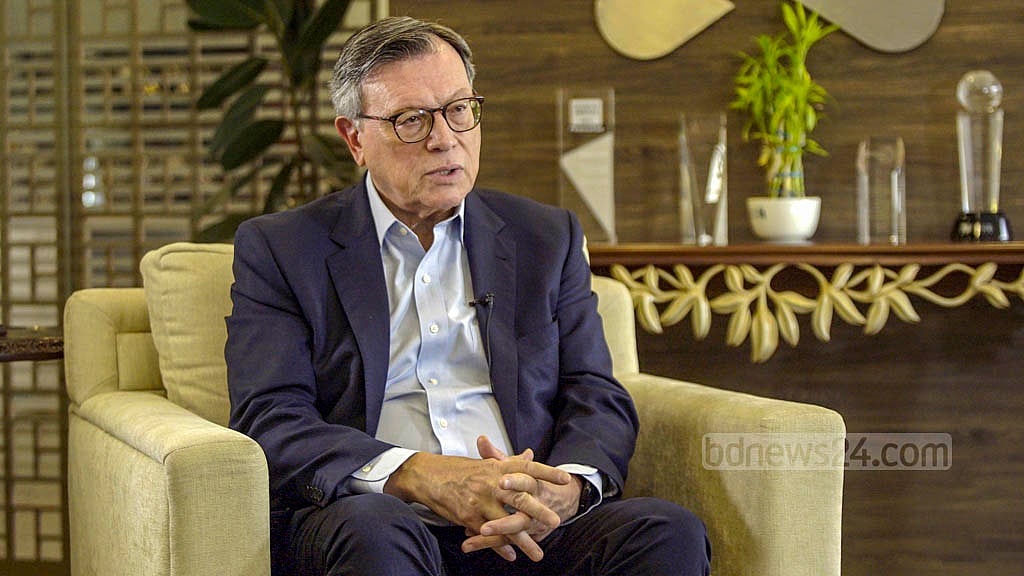
Like the rest of the world, Bangladesh is navigating some short-term turbulances stemming largely from the global economic crisis. The medium-term prospects for 5-10 years and beyond, on the other hand, remain bright and "stars will align" for Bangladesh for a better year in 2023. But it all hinges on whether Bangladesh can play the cards wisely. The observation came from José Viñals, chairman of Standard Chartered Bank and an economist with a stint at the Central Bank of Spain as the deputy governor.
To make sure that these prospects materialise, Bangladesh needs to address the balance of payments pressure and foreign currency shocks. It comes at a time when the South Asian nation is on track to graduate from the UN list of the least developed countries in 2026. A question lingers -- whether the combined effects of the pandemic and Russia’s war in Ukraine could be a setback. In the fallout from the global crisis, Bangladesh went to the International Monetary Fund seeking $4.5 billion in loans as a buffer against dwindling foreign currency reserves.
“I think that it was very important that Bangladesh and the IMF reached a staff-level agreement. If the [IMF] programme, as I would expect, is confirmed in the coming months, then this is something that can help Bangladesh,” Viñals said in an interview with bdnews24.com on Thursday.
“Crises may leave scars, or not, depending on how they are addressed. And crisis may also be an opportunity to resolve deep-seated issues, which under less difficult conditions may remain unsolved for a long time,” he said. “Bangladesh has now the opportunity, in the context of the international support that it's receiving from multilaterals, to move forward and advance on a number of things.”
The issues are “extremely important” for ensuring not only the stabilisation of the foreign currency market and forex reserves, which are short-term issues, but also for dealing with inflation and establishing the basis for medium-term growth, according to Viñals.
The Bangladesh government’s loan request to the IMF raised questions over whether the economy was resilient enough to deal with the global headwinds. The widening current account deficit due to unfavourable terms of trade and Bangladesh Bankʼs attempt to defend the taka, have eroded reserves by about $11 billion for the last 12 months. As of November, forex reserves, excluding gold and SDRs, fell to $30 billion or about four months of imports from eight months in January 2021, rating agency Moody’s said. That probably justifies the government’s turn to the IMF.
“In my view, it is wise not to wait until the very last minute in order to approach the IMF, because it may be too late and then the troubles may have compounded. I think it is better to act when there is still time so as to avoid the problems that have been faced by other countries,” Viñals said. “Normally things happen faster and then you get into trouble. So I think it's a good idea not to have delayed things.”
I think that stars will align for 2023 to be a better year for Bangladesh to have a higher growth rate in going forward than it's been the case in the current fiscal year.José Viñals
Viñals was appointed to Standard Chartered Plc in October 2016 and became the group chairman in December 2016. He also chairs the Governance and Nomination Committee.
Viñals was appointed chairman of Standard Chartered Bank in April 2019.
Viñals was most recently the financial counsellor and the director of the Monetary and Capital Markets Department at the International Monetary Fund and was responsible for the oversight and direction of the IMF’s monetary and financial sector work. He was the IMF’s chief spokesman on financial matters, including global financial stability.
Before the IMF, he began his career as an economist and as a member of the faculty at Stanford University, before going to the Central Bank of Spain, where he was the deputy governor.
Viñals has a PhD in Economics from Harvard and a Master’s in Economics from the London School of Economics.
“Bangladesh, fortunately, is in a different situation. You don't have high external debt. With the level of coverage of foreign reserves, even if it has declined, you still have a number of months there,” Vinals said.
“Then I see a private sector in spite of these recent turbulences is very determined to succeed and has a lot of vitality. Frankly speaking, I think that Bangladesh has the potential over the medium term to become one of the stars in Asia,” he said.
Bangladesh’s economic landscape has shifted to some extent since Viñals’s previous visit to Bangladesh in 2018, a year without a pandemic and the effects of the Russia-Ukraine war. The country’s GDP growth sharply came down to 3.45 percent in the 2019-20 fiscal year from 7.88 percent a year earlier. Then the growth accelerated over the next two years, reaching 7.25 percent in the 2021-22 fiscal year.
Viñals predicts the growth rate of Bangladesh over the next 5-7 years could be 7.5 percent or “even slightly higher”, a forecast consistent with the government’s projection. But for that to happen, things need to be done to keep improving the ease of doing business, strengthening economic governance and institutions and the rule of law.
“Governance is something that is an issue in many countries across the board. For instance, in the financial system, it's important to make sure that there is legal predictability. Legal stability is required in order to make sure that both domestic and foreign investments come in,” he said.
Bangladesh has a “very significant opportunity” to continue benefiting and benefit even more from the international diversification of global supply chains, thanks to cost advantages, location advantages and the US-China trade tensions and broader geopolitical issues in the region, he said. “I think that Bangladesh, if it can play its cards wisely, can benefit enormously.”
The country ought to continue to diversify the economy and export sources and build important infrastructure, not only physical, but also digital. And in terms of the building of human capital, Bangladesh must address the short-term challenges of macroeconomic stabilisation, according to Viñals.
Asked to specify an area of the economy where governance is an issue that needs to be fixed, Viñals said: “I don't want to go into specifics of the Bangladesh economy. I would just make the remark that we know from the experience of many other markets and countries that one of the preconditions for growth to be sustained is to make sure that the rule of law is strong, that institutions are strong across the board -- both public institutions and also the institutions in the private sector, including the governance of important financial institutions.”
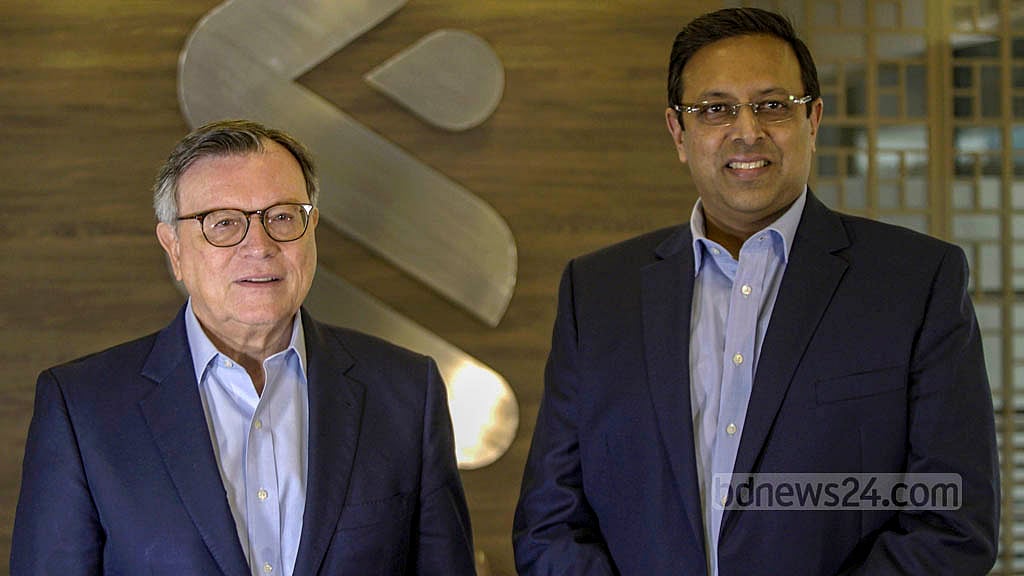
Viñals seemed hesitant to speak on Bangladesh’s banking system, which grabbed the spotlight recently due to reports of suspicious lending and he diverted a question to Standard Chartered Bank’s man in Dhaka -- Naser Ezaz Bijoy.
Nevertheless, Viñals touched upon the broader issue of governance. “There are always issues in all banking systems. After you have a period of some challenges, some of those challenges are reflected in the accounts and in the balance sheets of banks. So things can be done always to improve asset quality, to clean up the balance sheets, to enhance governance, to improve the capitalisation of banks. Again, it is not for me to tell what needs to be done. What I can tell you is what Standard Chartered is doing. And what we're doing is to continue to invest in Bangladesh.”
BANKING ON BANGLADESH
Viñals said Standard Chartered Bank is working closely with clients to provide them with the services and products and advice which is necessary to navigate this difficult situation because banks need to be close to their clients, especially when the going gets tough. “We grow with our clients and we have very important clients which are very important to the growth of Bangladesh. So that's how I think that we can make a contribution,” he said.
Since Viñals’s previous Bangladesh visit in 2018, digital channels for banking have become one clear accelerator of changes as a result of the pandemic.
“Nowadays, the familiarity of digital channels for our customers, for all types of customers, is much higher and their ability to do banking in a purely digital manner is growing. This is something that is not just a phenomenon in Bangladesh. This is a global phenomenon that we're seeing basically throughout our footprint. In our case, we're trying to respond to this by significantly enhancing our investment in our digital capabilities so that we can be sort of ahead of the pack in providing the best digital products and services to our clients. And that is a big difference, not just for us, but for the rest of the banking sector.”
$300 BILLION IN SUSTAINABLE FINANCE
Standard Chartered made sustainable finance a core pillar of its banking strategy. “We think it is not only the right thing to do, but also a smart thing to do from the business point of view, because there are extraordinary commercial opportunities around sustainability.”
Emerging markets currently have a $94.8 trillion financing gap. If these countries are left to finance this shortfall themselves, it will leave emerging market households around $2 trillion poorer each year between now and 2060, Standard Chartered research shows. The bank last year launched 16 new sustainable finance products linked to environmental, social and governance criteria and has committed to mobilising $300 billion between now and 2030 to support green and transition finance, according to the lender’s website.
A lot of that money will go into emerging markets and developing economies because there is where the need for investments is. “Those are the countries which are mostly affected by things like climate change. And speaking of Bangladesh, you are a very small contributor to global emissions, for example, but you are disproportionately affected by the adverse consequences of climate change,” Viñals said.
“Having a financial bridge that can channel money from where it sits, which is in the global financial centres into where it's most needed, which is in countries like Bangladesh and, in general, in emerging markets and developing economies, is extraordinarily important because the financing gap is very large.”
There is a big demand for sustainable finance around the world because the “economic impact is fantastic”. Viñals cited water as an example to illustrate his point: for every dollar invested in water safety in developing economies, it gains $4 in economic return -- in terms of higher productivity and better health.

Let's not forget that thanks to globalisation, the world probably had much faster growth rates. Let's not throw away the baby with the bathwater.José Viñals
GLOBALISATION FAR FROM DEAD
Viñals is a staunch defender of globalisation and does not shy away from responding to the concept of deglobalisation, a movement towards a less connected world. And there’s a strong argument in favour of deglobalisation: for every $1 of efficiency gain from trade, there is typically $50 worth of redistribution towards the rich.
In a letter to The Financial Times in April, Viñals wrote: “In spite of recent challenges, there continues to be a strong case for globalisation. It’s been a hard time for global trade: the pandemic put immense pressure on global supply chains and the dislocation caused by the war in Ukraine is yet another reminder of how connected we are as a global economy. Nonetheless, a retrenchment to domestic operations and supply chains cannot be the answer to our current travails. The impact of doing so would slow growth, reduce opportunity and have huge unintended consequences for emerging economies.”
Then in the interview with bdnews24.com, Viñals, when asked, elaborated on his argument: it would be a big mistake to go back to protectionism that restricts international trade to the detriment of all. “Globalisation is far from dead. Globalisation is changing its form, but it will continue to be there,” he said.
“If you look at global trade, many people forget that global trade is higher now than it used to be pre-COVID. So global trade is already higher in many countries. Global GDP is lower, but global trade is higher. What we are seeing also is a shift in global trade patterns -- more towards emerging markets,” he said, adding that emerging markets right now account for 50 percent of global trade, compared with 40 percent ten years ago.
Viñals concedes that globalisation needs to be perfected rather than disbanded or discarded because globalisation has led to the improvement of income levels and the reduction of poverty around the world.
But he reminds the critics of globalisation that many of the problems that scarred many countries are “homemade” and cautions them against not attaching everything to globalisation.
“I agree that globalisation can be improved. It can be made more equitable, more inclusive, where the gains are not just distributed amongst the few, but also benefit the many or everybody. Let's not forget that thanks to globalisation, the world probably had much faster growth rates. Let's not throw away the baby with the bathwater.”
His worldview mirrors the stance at Standard Chartered Bank. The global bank has three stands: accelerating net zero, enhancing social inclusion through financial inclusion and resetting globalisation, which goes in the direction of improving access to globalisation, according to Viñals.

WILL 2023 BE A BETTER YEAR?
This question emerged after Moodyʼs Investors Service placed Bangladeshʼs Ba3 ratings under review for downgrade on Dec 9 as the country’s “deteriorating external position raises external vulnerability and government liquidity risks”.
“We already looked closely at Bangladesh and all the economic and non-economic variables that are important for the future of the country. And on the basis of that, we take all of those into account in making our own internal assessments regarding the creditworthiness of Bangladesh,” Viñals said in response to a question on Moody’s reassessment.
“Let me tell you that whatever Moody’s or other rating agencies may have done or may do in the future would be something that we look at with interest. But we have our own internal assessments. And to me, the most important thing is to see the indications that the country is going to address its internal challenges and then move forward in order to achieve a higher sustained growth path,” he said. “We trust very much our internal assessment processes and there is information we look at, but that doesn't mean that we mechanistically react to anything that we see coming from any rating agency.”
In the shadow of the global crisis, there’s a palpable difference between the East and the West. The United States, the United Kingdom and Europe are going into a significant slowdown of growth, which is bringing them to a recession of different intensities, probably milder and shorter in the United States compared to what is happening on the other side of the Atlantic Ocean in Europe and the UK.
“Then you see the East and then you see Asia, and then you see more dynamism, relative to what you see in the West. Recession is not a word that people [here] talk about. Even countries like Bangladesh, which are under short-term challenges, have growth rates that would be the envy of both the United States, Europe or the UK,” he said.
Let’s put those things in perspective. There’s rebalancing in Asia: China is opening up after COVID, which will provide further strength to its own economy and improve the economic climate in the region. And India, which is doing quite well, is one of the largest emerging markets economies with the highest growth rates in the foreseeable future.
“All of that context is going to have a beneficial effect on Bangladesh. Between the IMF programme, once it's confirmed, I would hope in January, and the implementation of that programme, plus the reduction of external headwinds, I think that stars will align for 2023 to be a better year for Bangladesh to have a higher growth rate in going forward than it's been the case in the current fiscal year.”
With assistance from Shoumik Hassin.