Published : 09 Sep 2025, 01:41 PM
Updated : 28 Aug 2026, 01:26 AM


Dhaka University students are casting their ballots for the central and hall unions, marking the first DUCSU elections in six years -- and the first since the July Uprising reshaped national politics.
Nearly 40,000 students are eligible to vote at eight centres across the campus. Polling began at 8am on Tuesday in 810 booths and will continue without break until 4pm.
A total of 471 candidates are vying for 28 positions in the central union, while more than 1,000 are competing for 234 posts in 18 hall unions.
Alongside at least 10 formal panels, many independents are also in the fray.
This year’s polls come at a time when no single student organisation dominates the campus, and there is no longer the influence of a ruling party’s student wing. Voters are not backing any one candidate or panel by a wide margin either.
The contest has drawn attention well beyond the university, with many seeing it as a pointer to the political climate ahead of next year’s general election.
Prof Zobaida Nasreen, a political analyst at Dhaka University, noted two major shifts. “First, [Islami] Chhatra Shibir is participating actively, though under a different banner. In my 25 years I have never seen Shibir so visible on this campus.
"Second," she added, "there is no longer the singular dominance of a ruling party’s student wing. Although the [National Citizen Party's] student wing is in the race and is being seen by some as a ‘King’s Party’. BNP’s [Jatiyatabadi] Chhatra Dal, leftist groups and others are also present, so there is no single hegemonic force.”
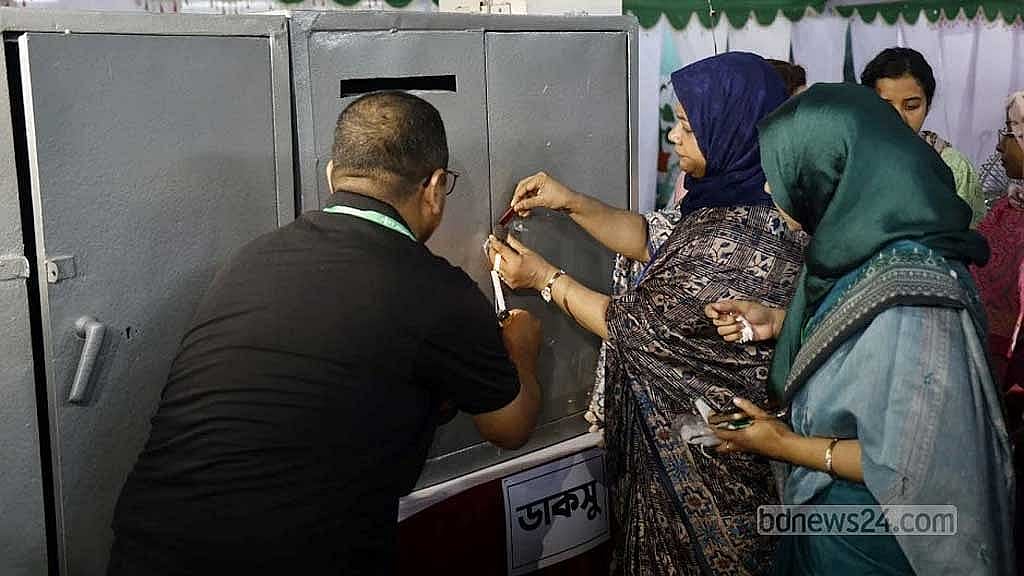
The university authorities have introduced several new features this year: polling centres have been shifted outside the residential halls, ballot boxes are being sealed in front of the media, and counting results are to be displayed live on LED screens.
As before, voting in the DUCSU and hall union elections will be conducted using Optical Mark Recognition (OMR) ballot sheets. Each ballot will contain a ballot number, the candidate’s name, and a space to mark a cross for voting.
Braille ballot papers are being used for the first time in Bangladesh to assist visually impaired students.
Security has been stepped up with around 2,000 police officers, Border Guard Bangladesh personnel, armoured vehicles and water cannons deployed across the campus.
A temporary police control room has been set up at TSC, while the DMP commissioner has assured that the arrangements will remain in place until Wednesday evening.
Chief Returning Officer Prof Md Jasim Uddin dismissed concerns over unrest. “Law and order is very good," he said. "We see no cause for concern. Voting will continue from 8am to 4pm without interruption, and anyone in line at closing time will still be allowed to vote. This will be a model election that students of other universities can follow.”
Urging students to cooperate, he called on both residential and non-residential students to come to the polling centres. "We seek the cooperation of all stakeholders so that we can conduct a free and fair election," he said.
IMPACT ON NATIONAL POLITICS
Author and political analyst Mohiuddin Ahmed believes that the new reality surrounding the DUCSU election will give hints regarding the general election that is to come in five-and-a-half months.
Describing the DUCSU election as a “rehearsal” ahead of the national polls in February, he told bdnews24.com, "With the national elections scheduled in five and a half months, how will this DUCSU election go? It generates interest.
"Panels of candidates from affiliate organisations of various political parties are taking part in this election. So, the results of this election will give us an idea.”
He said, "The DUCSU election is being held after many years, which is why everyone is interested. Secondly, this time the DUCSU election is being held in a slightly different situation after the 2024 uprising. Many are curious about what will happen as a result."

"[It gives an idea] of what the state of the political parties is ahead of the general election. If you consider these points, the DUCSU election is also very important for our politics in general. It is also important that the election remains transparent and impartial."
When asked how transparent and impartial he thinks this election will be, Mohiuddin said: "It is difficult to say in advance what will happen tomorrow. However, I hope that there will be no incidents such as the ballot snatching in the 1973 election."
However, Prof Kazi Mahbobor Rahman of the Dhaka University Department of Political Science says, despite the widespread interest the DUCSU polls have drawn, he does not believe that it will have a major impact on national politics.
"Dhaka University has been involved in various parts of Bangladesh's history at different times. That is why people across the country are also interested in the DUCSU election,” he said.
"However, I do not think this election will have a major impact on national politics in Bangladesh. This is an election among the university students themselves. However, many people may be interested in this election because of the historical significance of Dhaka University."
Just because people are interested in something does not mean that it will have an influence on something else, Mahbobor said. "DUCSU has been irregular for many years. DUCSU elections are being held, that is why everyone may be a little more interested."
Bangladesh Jatiya Samajtantrik Dal (Bangladesh JaSaD) Standing Committee member Mushtuq Husain believes a democratic atmosphere have prevailed over the DUCSU polls so far and it will be conducted in a transparent and impartial manner.
Mushtuq was elected the general secretary of DUCSU in the 1989-90 academic year.
He believes that whoever wins the election should be in a position to challenge or question those in power.
Mushtuq said, "The atmosphere of the election seems good so far. It remains to be seen whether many of our national politicians will learn from this election."
CONTESTING CANDIDATES
In the post-July uprising reality, no single student organisation now holds dominance on the Dhaka University campus.
Control over seat allocation in the residential halls for regular students has also largely been established by the university administration.
This time, at least 10 panels are contesting the DUCSU polls, either in full or partial form, alongside a number of independent candidates.
With the banned Bangladesh Chhatra League and its allies absent, the contest is now between their rivals -- the groups who stood shoulder to shoulder in last year’s movement that brought down Sheikh Hasina’s government.
The panels include Jatiyatabadi Chhatra Dal, the Bangladesh Ganatantrik Chhatra Sangshad (BGCS) founded on the spirit of the July Uprising, the Protirodh Parshad of seven left-leaning organisations, the Independent Students Unity led by July movement figure Umama Fatema, Islami Chhatra Shibir, “Aparajeyo 71, Adommo 24” representing three left groups, Chhatra Odhikar Parishad, and Islami Chhatra Andolan.

The panels have largely selected candidates who played an active role in the Uprising, often favouring younger leaders over senior figures.
Chhatra Dal, for example, has nominated Abidul Islam Khan, joint general secretary of its Dhaka University chapter, for VP; Shaikh Tanvir Baree Hamim, convenor of Kabi Jasimuddin Hall unit, for GS; and Thanbir Al Hadi Mayod, convenor of Bijoy Ekattor Hall unit, for AGS.
BGCS has fielded Abdul Kader for VP and Abu Baker Mojumder for AGS, both of whom were coordinators of the Students Against Discrimination.
Its AGS candidate Ashrefa Khatun, now the panel’s spokesperson, was also active in the July protests.
Due to internal rifts over the DUCSU election, several members left BGCS to contest independently.
NCP leader Mahin Sarker lost his position after deciding to run for GS against the party's choice.
Although Mahin later withdrew to support BGCS candidate Baker, several independents are still running for different posts.
The Protirodh Parishad, representing seven left-leaning organisations, has nominated Sheikh Tasnim Afroz Emi for VP.
Emi, who played a leading role during the July Uprising, was elected VP of Shamsun Nahar Hall in the 2019 DUCSU and hall elections.
The Protirodh Parishad’s GS candidate is Meghmallar Bosu, president of the DU unit of one faction of Bangladesh Chhatra Union.
Their AGS candidate is Jabir Ahmed Jubel, central general secretary of Biplobi Chhatra Moitree.
These candidates have remained active not only in the July Uprising but also in other student movements.
Umama Fatema, a former coordinator of the Students Against Discrimination and previously member secretary of the DU unit of Bangladesh hhatra Federation, has formed the Independent Students Unity panel by selecting candidates from among the independents.
Her panel’s GS candidate Al Sadi Bhuiyan is a former president of the Dhaka University Journalists’ Association (DUJA).
He was also elected literary secretary of Masterda’ Surja Sen Hall in the 2019 DUCSU elections.
Known for his journalism on campus, Al Sadi was also actively involved in the July movement.
Before the anti-government protests in July, he was one of two students who appealed against the High Court’s verdict reinstating the quota system.
AGS candidate of Umama’s panel is Jahed Ahmed, organiser of the study circle platform “Gurubhar Adda”.
Abu Shadik Kayem, who was an active participant in the Uprising, was later revealed to be the president of Dhaka University’s unit of Chhatra Shibir -- a fact unknown to many of the movement’s organisers.
His identity shocked many when it became public. Shadik, currently Shibir’s central publication secretary, is now running for VP.
Shibir’s GS candidate is SM Farhad, now president of the Dhaka University unit.
He previously held leadership positions in both the Jasimuddin Hall Debating Society and the Social Welfare Institute Debating Society.
Farhad's name once circulated in connection with the Chhatra League, with even a photo identifying him as a former unit secretary.
This led to a case that reached the High Court. Farhad has since denied any affiliation with the Chhatra League.
The AGS candidate of the Shibir-backed United Students’ Alliance panel is Md Mohiuddin Khan, general secretary of the organisation’s university chapter.
The “Aparajeyo 71, Adommo 24” panel consists of one faction each from Chhatra Union, Socialist Student Front, and Bangladesh Chhatra League (BCL – Bangladesh JaSaD).
The panel has managed to field 13 candidates.
VP candidate Nayem Hasan Hridoy is president of the university unit of BCL-JaSaD.
GS candidate Anamul Hasan Onoy is central education and research secretary of one faction of Chhatra Union.
AGS candidate Adite Islam is the Dhaka University chapter’s member secretary of the Socialist Student Front.
VP candidate Shamim Hossen, an English department student from Bijoy Ekattor Hall, has gained attention for his eloquent speaking style and a unique manifesto.
In the past, he was spotted at a protest programme held by JaSaD Chhatra League -- once part of the Chhatra Sangram Parishad led by Chhatra League.
Chhatra Odhikar Parishad, which emerged as the runner-up in the 2019 DUCSU polls against the Chhatra League, has now nominated its central president Bin Yamin Mollah for VP.
The panel has nominated Sabina Yasmin for GS and Rakibul Islam, member secretary of the university chapter, for AGS.