Published : 30 Sep 2026, 09:37 AM
Updated : 30 Sep 2026, 09:37 AM


Global bonds wobbled on Wednesday and were set for their worst month in years, hit by a toxic mix of deteriorating government finances, a glut of issuances and rising inflation as the seven-month-old US-Israeli war on Iran keeps energy costs elevated.
Meanwhile, stocks fared better, largely unfazed by the surge in bond yields and were upbeat in Asia.
The rise in borrowing costs has been front-and-centre for investors, given that sovereign yields are an anchor for global markets, a reference price for investing in riskier stocks and a benchmark for mortgages and corporate borrowing.
Benchmark 10-year US Treasury yields held near their highest point since 2007 at 5.2383 percent in Asia and were set for a rise of nearly 50 basis points this month, the largest in about two years. Bond yields move inversely to prices.
The 2-year yield fell slightly to 4.8889 percent after New York Federal Reserve President John Williams pushed back against expectations for earlier policy tightening, though yields remain more than 50 bps higher for the month.
"This is becoming much bigger than another repricing of the next few central bank meetings," said Charu Chanana, chief investment strategist at Saxo.
"I do think we are moving towards a structurally higher-yield regime ... The hurdle for yields to return sustainably to the ultra-low levels investors became accustomed to after the (Global Financial Crisis) looks much higher."
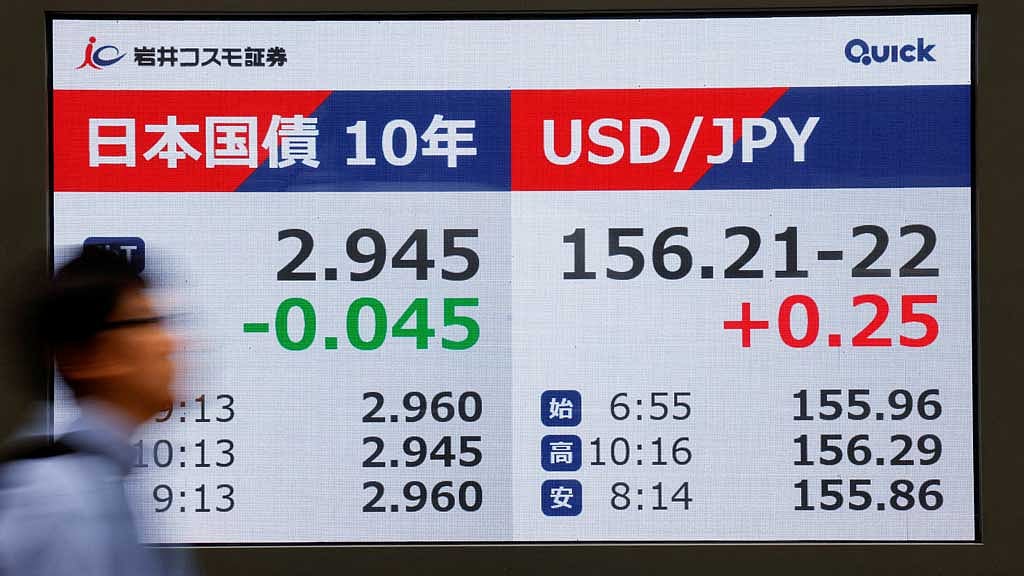
Yields in Japan are hovering near multi-decade highs, while 10-year government bond yields in Germany and France hit 17-year and 18-year peaks this week.
Defying the Yield Surge
While a persistently higher risk-free rate increases the cost of refinancing for companies and weighs on growth, its impact on stocks has thus far been relatively limited.
MSCI's broadest index of Asia-Pacific shares excluding Japan .MISX00000PUS rose 0.2% in early trading and was on track for a monthly fall of just over 1 percent.
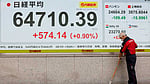
Japan's Nikkei rose 0.9 percent and was set to end the month little changed, while South Korea's Kospi was headed for a monthly gain of 1.4 percent.
Nasdaq futures edged 0.13 percent higher and S&P 500 futures added 0.16 percent. EUROSTOXX 50 futures and DAX futures advanced 0.5 percent each, while FTSE futures tacked on 0.4 percent.
Much of the resilience in equity markets can be attributed to upbeat corporate earnings, strength in the global economy and continued hype around artificial intelligence.
"What was surprising to us was the sanguine reaction of the equity market where the growth in nominal GDP was driving earnings optimism," said Citi's head of Asia-Pacific trading strategy Mohammed Apabhai in a note, referring to the recent rise in bond yields.
"US equity markets are reacting to the rise in bond yields but only outside of the tech space."
He added that, in meetings with macro funds and institutional investors in New York, many asked how high bond yields could go, at what level hyperscalers might scale back capital spending and when equity markets would react.
Dollar Gets a Lift
In currency markets, the dollar was on track for a monthly gain of 2 percent, aided by the rise in US yields.
That left the euro trading near a 16-month low at $1.1336. It was headed for a monthly loss of 2.4 percent as the currency struggles in the face of a global energy shock and growing political risk in Europe.
Sterling fell 0.03 percent to $1.3227 and was set to lose 2.4 percent for the month.
The yen, however, steadied at 157.03 per dollar and was eyeing a monthly gain of 1.7 percent, with investors wary of pushing the currency lower due to the threat of a joint intervention by Tokyo and Washington.
In commodities, oil prices rose on Wednesday, with Brent crude futures up 0.56 percent to $103.16 a barrel, while US crude edged 0.11 percent higher to $89.49.
Both were set for monthly gains, on concerns about prolonged supply disruptions due to the ongoing Middle East war.
Spot gold was down 0.2 percent at $4,171.93 an ounce.